
Your RAG system can leak one tenant’s documents to another without anyone attacking it. Ordinary traffic is enough.
Most red-teaming for retrieval-augmented generation assumes an adversary must craft a clever prompt injection or poison a corpus. A November 12, 2026 disclosure in pgEdge RAG Server proved the assumption wrong. The leak needed no jailbreak, no malformed prompt, and no privilege escalation. It needed two callers at the same time.
The shared index
The defect lived in the BM25 keyword-search arm of pgEdge RAG Server, advisory GHSA-w437-9mwm-j6vq, CVE-2026-125325. Concurrent requests shared a single BM25 keyword index, a per-pipeline object mutated in place. Each request ran three steps: clear the shared index, refill it from its own filtered documents, then search it. Each step was locked on its own; the three were never locked as a unit. Concurrent requests interleaved, and a search could run against a corpus another request’s filter had populated. Documents and generated answers from one caller’s filtered search scope leaked into another caller’s response.
The changelog is blunt. Affected responses cannot be identified from the server’s own logs. Any deployment that relied on the filter parameter to separate tenants should treat responses served under concurrent load as potentially having included another tenant’s documents. If you cannot tell which responses leaked, you cannot scope the exposure from logs. Assume the worst window.
Two more facts sharpen the picture. The fix, building the BM25 index per request instead of sharing one, shipped in version 2.0.0 on August 25, 2026, but the advisory and CVE were not published until November 12. Teams had the fix for months without a public advisory saying why. The query endpoint carried no authentication in the affected versions, so the caller did not need to be a tenant at all. A filter is not isolation. It is a query parameter.
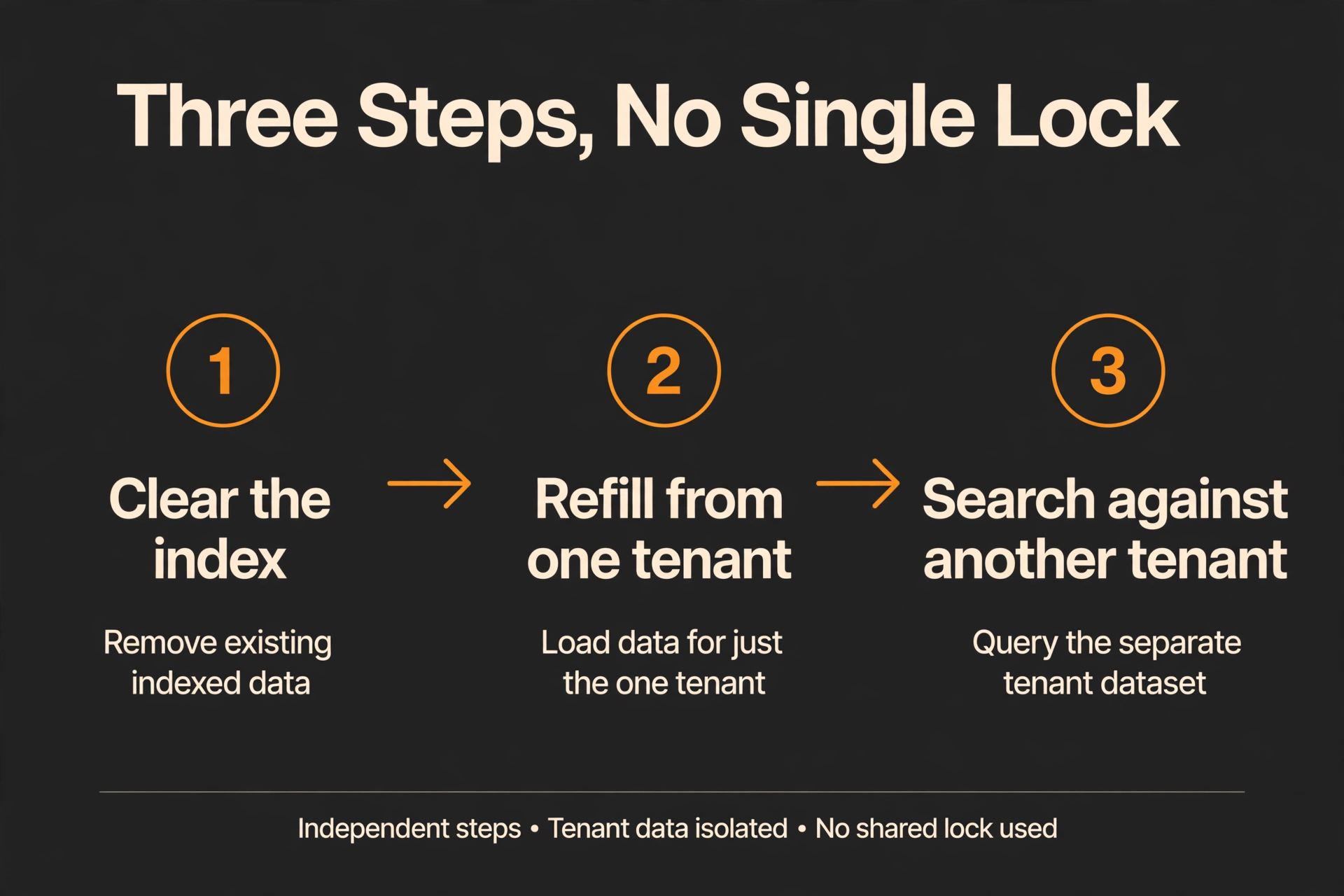
Conceptual diagram. The pgEdge BM25 race as described in GHSA-w437-9mwm-j6vq: three individually locked steps, never locked as a unit.
Messages change outcomes
The same week produced three benchmarks that map the parallel problem in multi-agent systems: once one agent talks to another, who caused the action?
| Study | What it measured | What it does not prove |
|---|---|---|
| SwarmSafe-Delta, arXiv:2611.16123, Nov 12 | Paired tests of real, hidden, and placebo message delivery | Failure rates in deployed systems; tasks were constructed and synthetic |
| WorkflowArena, arXiv:2611.12856, Nov 9 | 145 tasks, 8 domains, 9 models; agents decide whether and how to delegate | That any configuration is best in general; none won across all domains |
| Agents of Chaos, arXiv:2611.10843, Nov 7 | Review: 284 atomic attacks, 452 safeguards, 660 attack-safeguard relationships | That a mapped safeguard works; only 278 of 660 relationships were directly assessed |
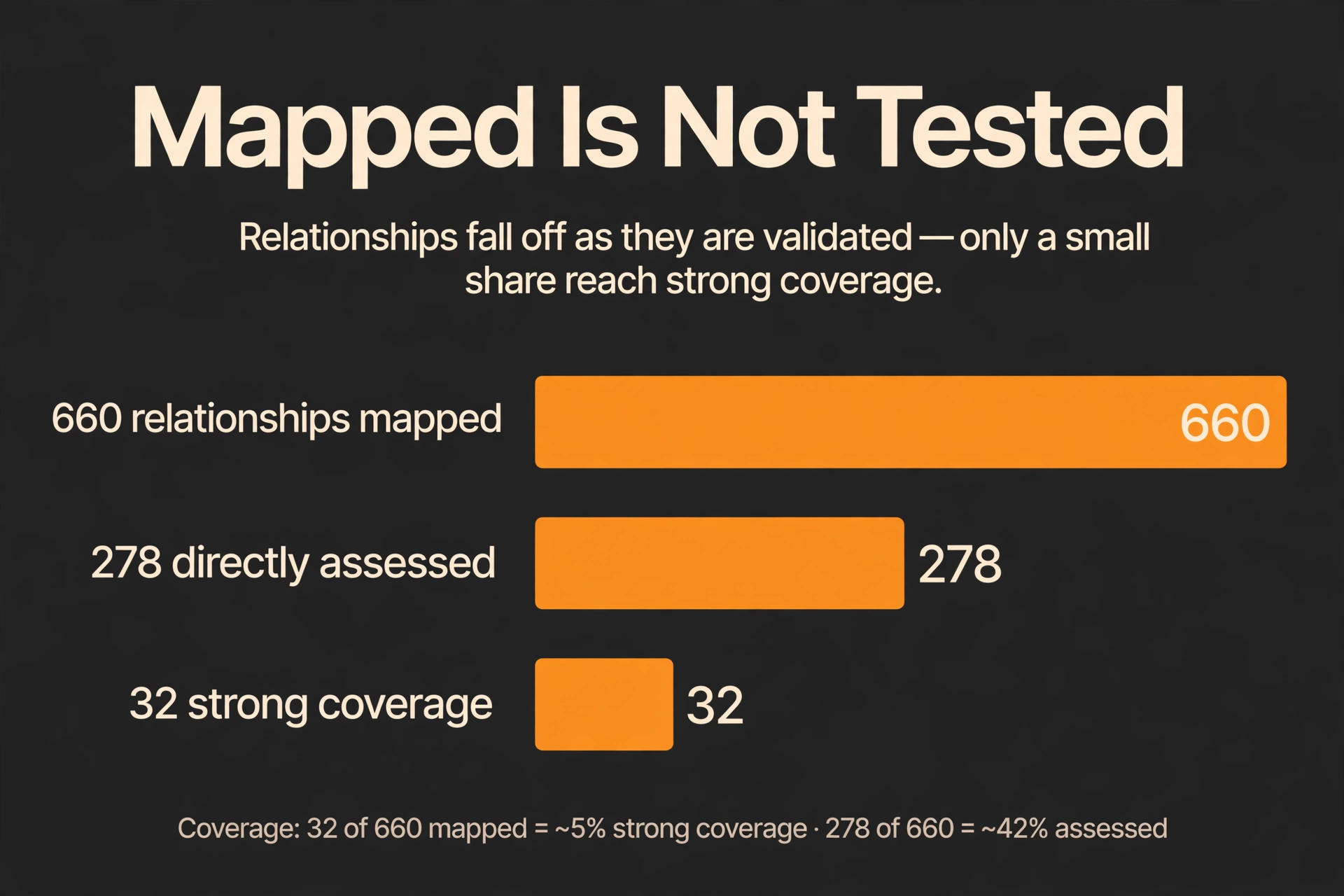
Chart. Agents of Chaos safeguard coverage, arXiv:2611.10843: 42.1 percent of attack-safeguard relationships directly assessed.
SwarmSafe-Delta, by Junru Zhu, isolates the question most evaluations blur: when a team violates policy, did an upstream message change what the executor did? The protocol freezes upstream computation and varies delivery of the same message as real, hidden, or a format-matched placebo, then scores a single committed action. Across four models on constructed optional tasks, real delivery produced 21.4 percent risky-world violations, against 5.0 percent for placebo and 1.0 percent for hidden delivery. The same delivery also improved benign task success, and where the task required an upstream lookup, real delivery improved safe completion by 74.2 points.
That pair of results is the argument against blanket suppression. Cutting inter-agent messages reduces one kind of failure and creates another. The paper’s own limit matters: these are controlled contrasts on synthetic one-action tasks, not estimates of how often deployed systems fail. The study proves influence is measurable at the message boundary. It does not prove a rate for a risk register.
WorkflowArena, from Jiang and colleagues, measures the next layer up: agents decide for themselves whether to spawn workers and how to organize 145 long-horizon tasks across 8 domains, with every delegation recorded and the deliverable graded by a hidden verifier. No single configuration performed best across all domains. The best average resolve rate, 36.95 percent for Claude Opus 5.5 with Claude Code at maximum effort, means the strongest system failed more than six in ten tasks. The delegation log is the useful artifact: who the model hired, when, and for how long.
Agents of Chaos, by Truong-Le and colleagues, supplies the map that ties the two together, and its most important number is a gap. The review screened 186 candidate sources, retained 98, and coded 284 atomic attacks, 452 atomic safeguards, and 660 explicit attack-safeguard relationships. Only 278 of those 660 relationships, 42.1 percent, were directly assessed, and only 32 of those showed strong coverage. A mapping is not a test. More than half the claimed defenses in the literature have no direct evidence behind them, and the review reflects the ecosystem as of July 2026.
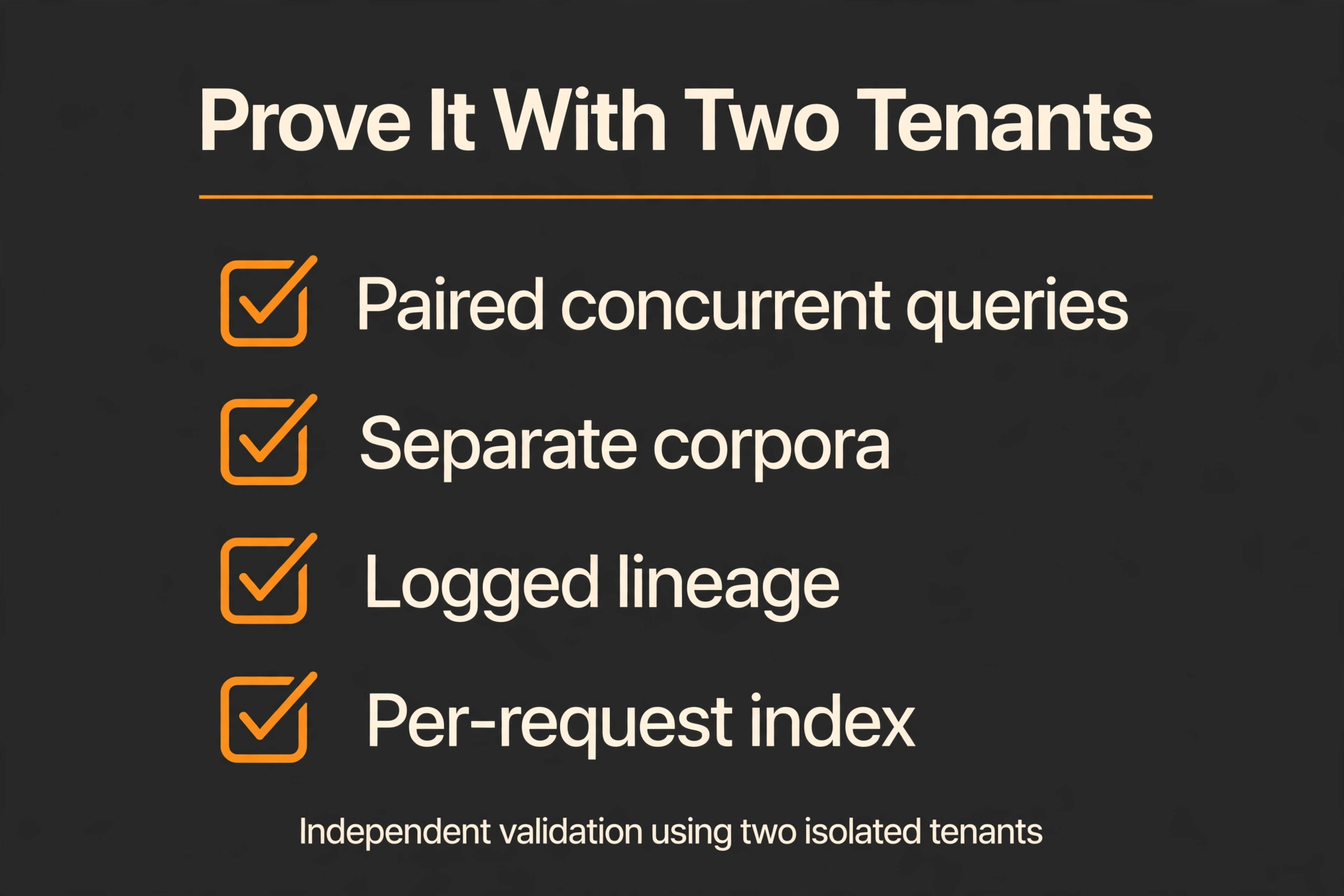
Checklist. The paired-tenant concurrency suite and lineage fields required before a RAG deployment ships.
Pre-flight engineering gates
None of this is a reason to stop building multi-agent or RAG systems. It is a reason to test the failure modes that need no adversary.
Test concurrency across tenants before deployment. Run paired-tenant concurrent retrieval suites: two tenants, separate corpora, overlapping queries, checking that no document or generated answer crosses the boundary. Inventory every singleton index, cache, and memory store in the retrieval path, and confirm each is per-request or per-tenant by construction. A filter parameter is a convenience for scoping results, not a security boundary, and the pgEdge advisory is the proof.
Trace message-to-action lineage for every committed downstream action. Record the corpus, the filter, the tenant, and the upstream agent message IDs behind it, using the NEXUS-A2A delegation record and the AISM Ledger as the store. That lineage lets a team answer whether a message changed an outcome or merely accompanied it. Label each safeguard mapped or tested, and never let the first word stand in for the second.
The pgEdge leak is the cleanest warning of the November disclosures because it removes every excuse. No attacker was needed. No prompt was crafted. Two ordinary requests arrived at the same time, and the system handed one caller another caller’s documents. A test plan that only covers adversarial input does not cover your system.
Sources
- pgEdge RAG Server changelog and GitHub security advisory GHSA-w437-9mwm-j6vq, CVE-2026-125325, published November 12, 2026.
- SwarmSafe-Delta: Isolating Message Effects on LLM Agent Safety, Junru Zhu, arXiv:2611.16123, November 12, 2026.
- WorkflowArena: Benchmarking Executable Workflow Orchestration in LLM-Based Multi-Agent Systems, Jiang et al., arXiv:2611.12856, November 9, 2026.
- Agents of Chaos: A Systematization of Knowledge on Malicious Attacks on Agentic AI Systems, Truong-Le et al., arXiv:2611.10843, November 7, 2026.



