
2026 was the year maritime cybersecurity stopped being guidance and became something an inspector can fail you on. The rulebook was already written. This year the industry met the enforcement, the incident volume, and the supply-chain accountability it always implied.
Across U.S. waters, classification societies, and global hub ports, cybersecurity moved out of best-practice IT and into statutory compliance, class notation eligibility, and voyage continuity. That shift has three parts: the threat accelerated, the U.S. rule went live, and the gap between a tool and a compliance program closed around suppliers and shipyards.
The count rose, and the count is not the whole story
The headline number is real, and it needs its limits alongside it. According to the Maritimeinfosec.org OSINT dataset, 1,397 maritime cyber incidents were recorded for 2026 as of October 15, already above the 1,352 logged for all of 2025, and 34 percent ahead of the same date in 2025, when the count stood at 1,040. The surge sat in the third quarter: 653 events between July and September, including 261 in August alone.
That same dataset carries a nuance the headline skips. The first half of 2026 was not ahead of 2025 at all: January to June recorded 617 events against 649 over the same period in 2025. The year passed 2025 on the strength of one quarter, not twelve months of steady growth. And the dataset is one compiler’s OSINT record of publicly reported events. A counted incident is not a confirmed breach. The October 12 batch listing of 38 maritime organizations by the group calling itself n0n proves a shared vendor can put dozens of companies on one list at once, and proves nothing by itself about what was actually taken.
| Dataset | Figure | What it proves | What it does not prove |
|---|---|---|---|
| Maritimeinfosec.org OSINT, Oct 15, 2026 | 1,397 incidents in 2026; 1,352 in all of 2025; 653 in Q3, 261 in August | Publicly reported maritime cyber events rose sharply in Q3 2026 | That each event was a confirmed breach; one compiler’s OSINT record, not a complete registry |
| Cydome 2026 Trends Report, Jan 2026, reporting on 2025 | Maritime OT incidents up 150 percent in 2025; 87 percent driven by ransomware; edge-device attacks up 800 percent in 2025 | OT and edge targeting grew sharply through 2025 | Anything about 2026; these are 2025 figures, corrected here from the weekly summary |
| Honeywell 2026 OT Benchmark, Sept 22, 2026 | 87 percent of maritime respondents reported a significant OT incident in the past 12 months | OT incidents are common among the maritime leaders surveyed | A fleet-wide breach rate; the maritime subgroup was only 30 respondents and Honeywell calls the findings directional |
The Cydome correction deserves emphasis because it is the kind of error that spreads when a report year and a data year share a number. The Cydome 2026 Maritime Cyber Trends Report, published in January 2026, reported a 150 percent increase in maritime OT cyber incidents during 2025, with 87 percent driven by ransomware, and an 800 percent surge in attacks against routers, firewalls, and VPNs during 2025. Those are 2025 figures. The weekly intelligence summary presented them as 2026 figures. This article corrects the year.
Honeywell’s September 2026 OT Cybersecurity Benchmark Report adds a survey view with its own limit attached. It found 87 percent of maritime respondents had experienced a significant OT cybersecurity incident in the preceding 12 months, from a study of 603 leaders fielded in May and June 2026. That puts maritime among the most exposed sectors in the survey, behind energy and utilities at 91 percent. But the maritime subgroup numbered only 30 respondents, and Honeywell labels those findings directional. Survey percentages describe respondents, not the whole fleet.
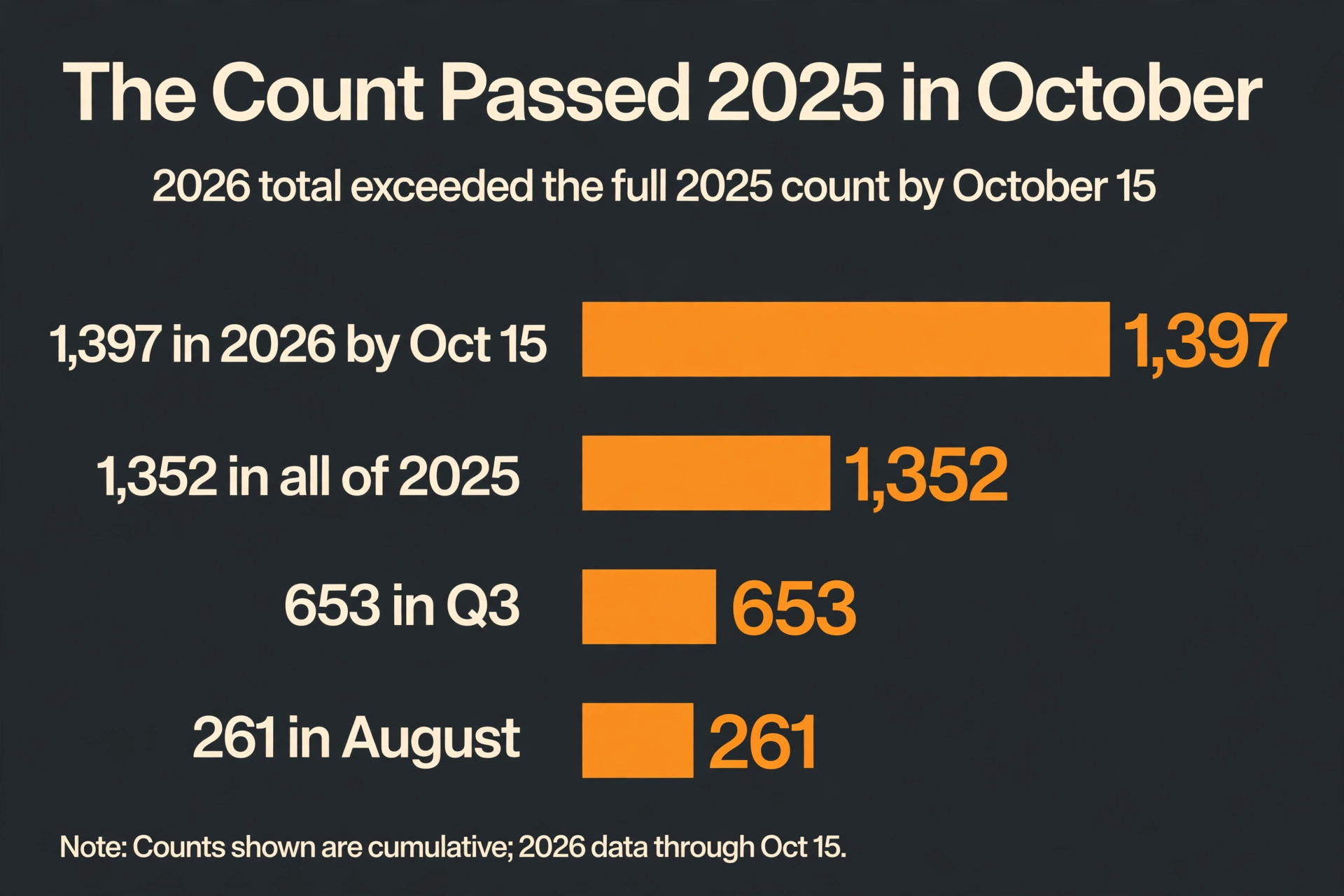
Chart. Maritimeinfosec.org OSINT dataset counts as of October 15, 2026. OSINT counts, not an audited breach registry.
One tanker, two stories
The highest-consequence vessel incident of the year shows why confirmed and claimed must stay in separate columns. In mid-August 2026, the Liberian-flagged Very Large Crude Carrier VL Prosperity, en route from the Mediterranean to the U.S. Gulf Coast, suffered a network intrusion. A joint Coast Guard and FBI team boarded the vessel in the Gulf of Mexico on August 21. On September 17, Rear Admiral Amy Grable, commander of Coast Guard Cyber Command, confirmed investigators found malicious cyber activity aboard. On October 2, Bloomberg reported investigators found evidence the propulsion system had been accessed, and close to 20 vessels were being monitored.
That is what investigators confirmed. The louder version came from elsewhere. Iranian state media, citing an unnamed crew member, claimed attackers manipulated engine cooling flow, engine speed, and fuel controls, and cut communications for about 30 hours. Cydome’s research team examined machinery-damage images circulating with that story and assessed them as fabricated. The Coast Guard has said there were no reports of operational disruption, vessel instability, danger to crews, or environmental impact, and no U.S. agency has publicly attributed the intrusion to anyone.
The distinction matters beyond this one ship. The VL Prosperity is Liberian-flagged, so the U.S. Coast Guard rule does not reach it directly. But the boarding, the confirmed malicious activity, and the monitoring of close to 20 vessels tell every U.S.-flagged operator what the inspection regime now looks like in practice. The question for an operator is not whether the state-media version was true. It is whether their own vessel could prove what happened aboard, and keep operating, if it were next.
The rule is now live
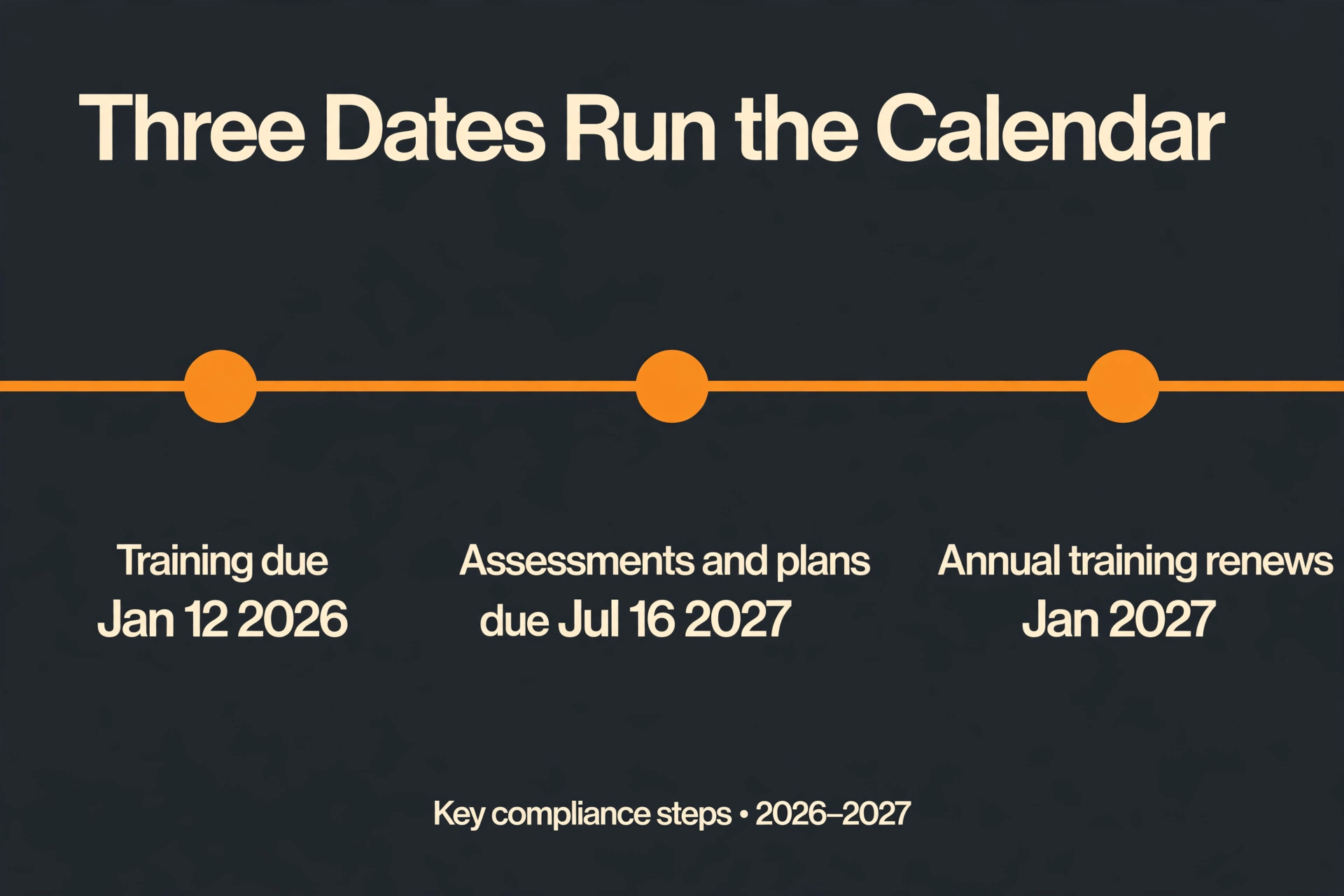
Timeline. USCG 33 CFR Part 101, Subpart F milestones for covered vessels and facilities.
Under the U.S. Coast Guard’s final rule, Cybersecurity in the Marine Transportation System, 33 CFR Part 101, Subpart F, 2026 was the first full calendar year of live obligations after the rule took effect on July 16, 2025. Initial personnel cybersecurity training became due on January 12, 2026, with new personnel trained within 5 days of system access and no later than 30 days after hiring, followed by annual cycles. Reportable cyber incidents must be reported immediately upon discovery to the National Response Center under 33 CFR 101.620. The Coast Guard published updated compliance guidance on October 20, 2026, ahead of the binding deadline: by July 16, 2027, every covered U.S.-flagged vessel, MTSA facility, and OCS facility must designate a Cyber Security Officer under 101.625, complete a Cybersecurity Assessment, and submit a Cybersecurity Plan for Coast Guard approval under 101.630 and 101.655. As of late October 2026, no proposed vessel implementation delay had been enacted in the eCFR text, according to the Coast Guard Rule Guide.
Those dates reframe the training obligation. The January 2026 milestone was not a one-time event. Annual cycles renew in January 2027, six months before the assessment and plan deadline. An operator that treated training as a checkbox in January will discover in January 2027 whether it built a cycle or a single event.
Newbuilds and the supplier gap
Internationally, IACS UR E26 and E27, Revision 1, mandatory for new construction contracts signed on or after July 1, 2024, moved in 2026 from contract clauses into shipyard commissioning and supplier procurement reality. IMO MSC.428(98), enforced through ISM Code DOC and SMC audits, and the IMO’s April 2025 updated cyber risk management guidelines continued to anchor port-state control scrutiny. The requirement is written, and the evidence is now being asked for at delivery.
Two November signals captured the closing gap of the year. They are covered in depth in article 6 of this week set, the ClassNK compliance deep-dive, so this summary states them briefly. ClassNK’s November 5 Innovation Endorsement of CYTUR-SBOM confirmed demand for automated shipboard asset and CVE inventories while explicitly excluding ClassNK cyber-resilience rules and IACS UR E26 and E27 compliance. A tool that inventories components is necessary plumbing. It is not a compliance program. The same week, KISA’s November 3 joint maritime drill simulated a compromised supplier software update disrupting ship-to-shore communications, and UNCTAD and IAPH’s November 5 port OT training game put automation, shore charging, IoT and 5G, and facility cyber teams inside the same exercise. Third-party vendors and electrified port equipment now sit squarely inside the maritime assurance boundary.
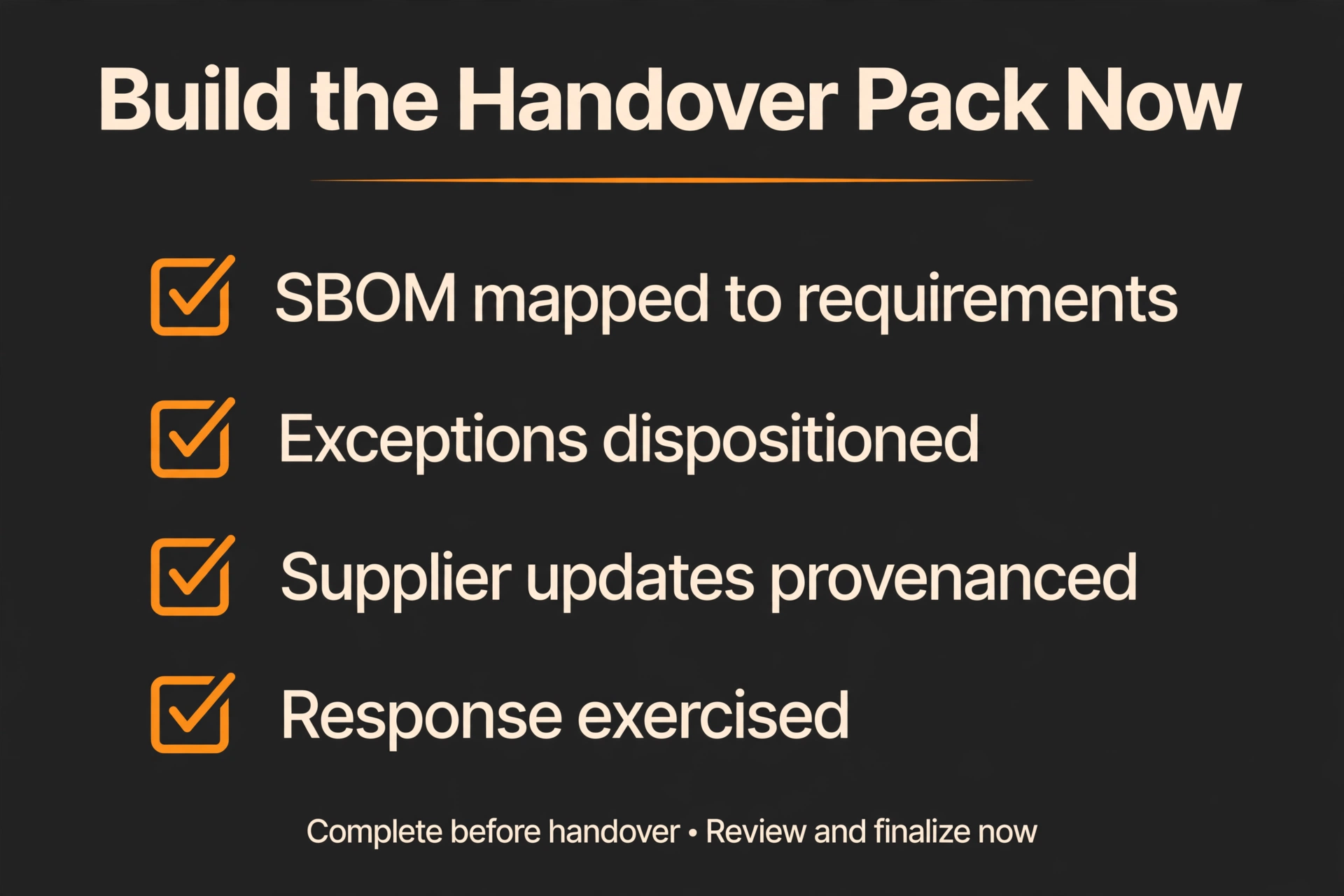
Checklist. The Builder-to-Operator Cyber Handover Pack contents, from the Pelorus assurance layer design.
What 2027 demands
Entering 2027, the runway is narrow and the calendar does the prioritizing. Annual USCG training cycles renew in January 2027, and full Cybersecurity Assessments and Plans are due July 16, 2027. Between those dates, operators, shipyards, and equipment suppliers have one job: turn inventories into evidence.
The operators that will clear both class and Coast Guard scrutiny without last-minute vessel delays are the ones that unify asset and SBOM inventories with requirement-mapped evidence, supplier-update provenance, and ship-to-shore response exercises. That is the core design of CSI’s Pelorus assurance layer: an inventory proves you know what you have, a mapped requirement proves you know what it must do, and an exercised response proves you can keep operating when it fails. 2026 proved the threat is real, the rule is live, and the supplier is in scope. 2027 is when the evidence gets graded.
Sources
- Maritimeinfosec.org OSINT dataset, “2026 already exceeds 2025 in cyber and maritime events,” as of October 15, 2026.
- Cydome, Maritime Cyber Trends Report 2026, January 2026, reporting on 2025 figures.
- Honeywell, 2026 OT Cybersecurity Benchmark Report, released September 22, 2026.
- Holland and Knight, “Recent Cyber Incidents Underscore the Need for Maritime Cybersecurity Compliance,” on the VL Prosperity boarding, October 2026; Bloomberg, October 2, 2026; Cydome, “Cyberattack on US-Bound Tankers,” September 17, 2026.
- U.S. Coast Guard, Cybersecurity in the Marine Transportation System, 33 CFR Part 101, Subpart F; Coast Guard Rule Guide.
- ClassNK CYTUR-SBOM Innovation Endorsement, November 5, 2026; KISA joint maritime drill, November 3, 2026; UNCTAD and IAPH port OT training, November 5, 2026. Covered in depth in article 6 of this week set.



