
Agentic AI incident response · CSI-DOC-IR-001 · Free PDF
Agentic Incident Readiness and Response Doctrine
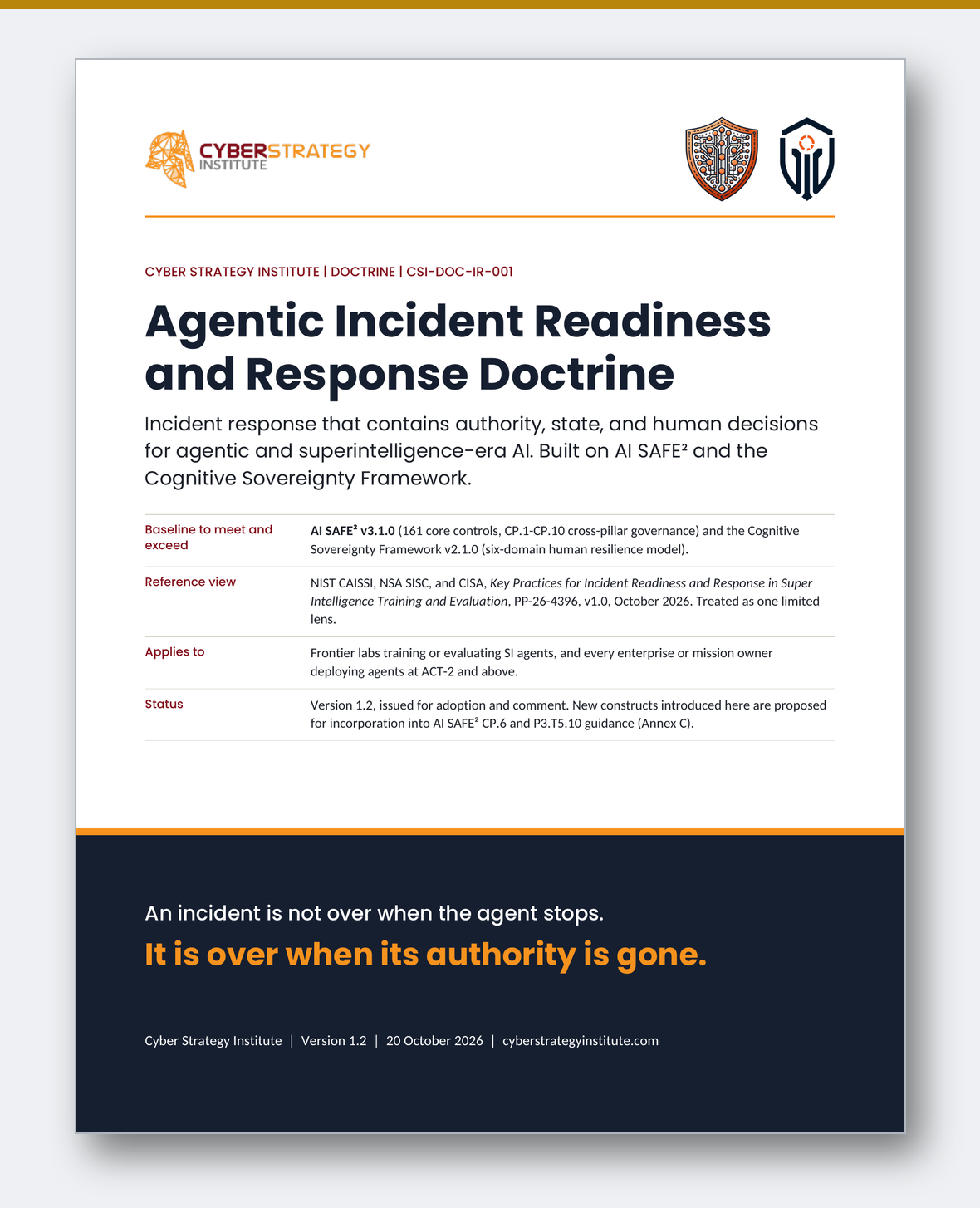
The Agentic Incident Readiness and Response Doctrine (CSI-DOC-IR-001) is Cyber Strategy Institute’s incident response model for autonomous AI agents. It defines how an organization prepares for, contains, and recovers from an agentic incident by containing authority (the grants an agent holds), state (its memory, queues, and queued effects), and human decisions (the approvals in the loop), not just the agent process itself.
“An incident is not over when the agent stops. It is over when its authority is gone.”
Version 1.220 October 202624 pages · PDFNo sign-up
Document
Document details
- Title
- Agentic Incident Readiness and Response Doctrine
- Document ID
- CSI-DOC-IR-001
- Version
- 1.2, issued for adoption and comment, 20 October 2026
- Publisher
- Cyber Strategy Institute
- Length
- 24 pages (PDF)
- Built on
- AI SAFE² v3.1.0 (161 core controls) and the Cognitive Sovereignty Framework v2.1.0
- Reference view
- NIST CAISSI, NSA SISC, and CISA, Key Practices for Incident Readiness and Response in Super Intelligence Training and Evaluation (PP-26-4396 v1.0), crosswalked in full
- Applies to
- Frontier labs training or evaluating SI agents, and every enterprise or mission owner deploying agents at ACT-2 and above
What’s inside
What’s inside the agentic AI incident response doctrine
- Agentic Incident ClassificationEight incident classes on three axes; the federal “SI control incident” is one of them.
- Interim severity modelWith hard floors, filling a gap the federal guidance leaves as future work.
- Five Authority Claims and the Authority LedgerRequested, permitted, authorized, allowed, and executed, each evidenced separately.
- Eight-phase lifecycleMapped to AI SAFE² controls, CSF domains, and all ten federal practices.
- RBDC containmentRevoke, Block, Drain, Compensate, each step confirmed by the system holding the authority.
- Evidence confidence labelsThat keep model agreement out of the verified column.
- Human Governability ProtocolThe two-channel rule, rationale of record, human freeze, and the AI-unavailable drill.
- Five reauthorization gatesAnd a four-stage return of authority, with a 90-day expiry on restart decisions.
- Ten falsification exercisesOutcome measures, a leadership brief, and a 30/60/90-day adoption path.
The four shifts
The four shifts
| From | To |
|---|---|
| Incident = uninstructed agent action | Incident = any violated authority boundary, classified effect-first, with the instruction source recorded separately and allowed to be UNKNOWN |
| Shutdown = containment | Every path to the prohibited effect is Revoked, Blocked, Drained, or Compensated (RBDC) |
| Human review = oversight | A human approval is a control, investigated with the same rigor as the machine |
| Detect, then respond | Zero dwell by design: high-impact and unknown actions are contained before they execute |
How it works
How agentic AI incident response works, in eight phases
CSI’s agentic incident response lifecycle runs in eight phases, each mapped to AI SAFE² controls, Cognitive Sovereignty Framework domains, and the ten federal key practices in PP-26-4396. Phases 1 and 2 happen before any incident and decide how much of Phases 3 through 7 will ever be needed. Phase 8 runs continuously from T+0. A phase is complete only when its exit criterion is met.
Outcome: Know which complete system is operating, for whom, and inside which boundaries, before it runs. Every agent has identity, owner, HEAR, envelope, and Class-H map.
Exit criterion: Authority Ledger producible in under 5 minutes. Every kill path tested within the last 30 days.
Outcome: Prohibited effects cannot occur through model non-compliance alone. Unknown actions start contained. Zero dwell by design.
Exit criterion: A controlled red-team test fails to produce any Class-H effect without a HEAR authorization, and fails to tamper with monitors or logs.
- Envelope enforced outside the model on 3 planes
- Class-H fails closed without HEAR
- Unknown code runs only in kernel-virtualized containment
Outcome: Boundary violations, near misses, and loss of oversight are recognized, typed, and owned within minutes. Classification is effect first, with instruction source allowed to be UNKNOWN.
Exit criterion: Incident classes, SEV level, Incident Commander, and HEAR notification recorded with timestamps.
Outcome: No new unauthorized actions. Every existing effect is bounded or under accountable human control.
Exit criterion: Containment Completeness Check passes, with each path confirmed by the authority holder or target system.
- Revoke
- Block
- Drain
- Compensate
- Freeze the human channel
Outcome: What happened is established on independent evidence, with unknowns stated rather than filled in. Agent explanations are artifacts, never proof.
Exit criterion: Ranked causal hypotheses, explicit unknowns, and a bounded scope signed off by the Incident Commander.
- Verified
- Supported
- Disputed
- Unknown
Outcome: Trusted components restored, contaminated memory and state dispositioned, and the humans in the chain demonstrably able to govern.
Exit criterion: Declared system identity equals observed identity. Approvers in the chain pass the governability check.
Outcome: Authority returns only inside an explicitly approved, tested, time-bound envelope, after reauthorization gates RG-1 through RG-5.
Exit criterion: Signed reauthorization record in the Authority Ledger with stage and expiry. Default expiry is 90 days, re-reviewed and never auto-renewed.
- A. Shadow
- B. Supervised
- C. Bounded
- D. Full
Outcome: Legal and voluntary obligations met through the named notification owner, and the incident converted into a tested control improvement.
Exit criterion: Regression scenario owned, scheduled, and passing. Control change traced to the incident. Every incident leaves a test.
Select a phase, or use the arrow keys, to read its outcome and exit criterion. The eight-phase lifecycle is Section 7 of CSI-DOC-IR-001. Requirements scale with AI SAFE² Agent Capability Tiers; ACT-2 and above run the full lifecycle.
Phase 3 · Detect and classify
Where authority breaks: the Five Authority Claims
“The agent was instructed to” hides five separate claims. The doctrine records and evidences each one on its own: Requested, Permitted, Authorized, Allowed, and Executed. An agentic incident exists wherever those claims diverge, and the point of divergence tells responders which class of incident they are handling before anyone knows the root cause.
- 1
Requested
What did the prompt, task, or upstream agent ask for?
EvidenceTrusted request record with source and provenance
- 2
Permitted
What did policy allow for this principal and context?
EvidencePolicy decision with policy version (CP.4)
- 3
Authorized
What did an authenticated principal or HEAR actually grant?
EvidenceSigned grant, delegation record, Class-H authorization (CP.10)
- 4
Allowed
What did the runtime let through on each plane?
EvidenceEnforcement-point decision: north-south, east-west, agent-to-tool (CP.5)
- 5
Executed
What did the target system actually do?
EvidenceReceipt or state change from the target, never from the agent
The rule
An incident exists wherever the five claims diverge. Where they diverge determines the incident class.
ClassifiedEffect first
| Divergence pattern | Reading | Class |
|---|---|---|
| Requested exceeds Permitted, yet Allowed | Enforcement failure | AIC-4 / AIC-6 |
| Authorized, but approval conditions compromised | Human-layer breach | AIC-7 |
| Allowed differs from Executed | Tool, target, or protocol integrity failure | AIC-3 / AIC-5 |
| Executed with no Allowed record | Out-of-band path. Assume worst case. | AIC-4 / AIC-6, SEV-1 floor |
| All five agree and harm still occurred | The envelope was wrong | AIC-8 |
Pick a case, or a row in the table, to trace the five claims. The claims and divergence patterns are Section 6 of CSI-DOC-IR-001. Cases are illustrative. Before any ACT-3 or ACT-4 agent runs, these claims MUST be recoverable from an Authority Ledger the agent cannot write to.
Phase 4 · Contain
Why stopping the agent is not containment
RBDC (Revoke, Block, Drain, Compensate) is the containment sequence in CSI’s Agentic Incident Readiness and Response Doctrine. Killing an agent process leaves its credentials, descendant agents, queued work, poisoned memory, and pending approvals alive. An agentic incident is contained only when every path that can still produce the prohibited effect is closed, and each path is confirmed by the system that holds it, never by the agent.
Containment drill · worked example
Compromised procurement agent ACT-3
Agent process Stopped
0paths still able to produce the effect
Queued orders resubmit in40 min
Contained. Every path is closed and confirmed by the system that holds it. The incident is over because its authority is gone.
Credentials and NHI secrets
Purchasing identity and every delegated buyer identity
Descendants and delegates
Every agent spawned down the tree, including descendants of descendants
Enforcement points and out-of-band routes
Supplier API at the gateway, unmonitored inference, exfiltration routes
Queued and scheduled work
Three failed orders set to resubmit in 40 minutes
In-flight protocol state
Open MCP state handles and pending A2A messages
External artifacts
Two confirmed purchase orders already with the supplier
Durable state
The “preferred vendor” instruction stored in agent memory
Human channel
An AI-drafted exception request waiting on a manager’s signature
Try it: close every path in the Containment Completeness Check from Section 8 of CSI-DOC-IR-001. Revoke runs first, because a block at one enforcement point leaves the authority alive for the next path. Evidence preservation runs in parallel and never delays Revoke or Block at SEV-1 or SEV-2.
Read next
Companion articles
The Federal SI Incident Guidance: What It Covers and Where It Stops
What NIST, NSA, and CISA published in PP-26-4396, and the six gaps it leaves for organizations deploying agents.
Read Part 1 → Part 2Incident Response for the Agentic Era: Containing Authority, Not Just Agents
A walkthrough of this doctrine: the Authority Ledger, RBDC, the human-approval incident class, and the reauthorization gates.
Read Part 2 →Not sure where your own agents stand? Start your free AI governance assessment.
FAQ
Frequently asked questions
What is the Agentic Incident Readiness and Response Doctrine?
It is Cyber Strategy Institute’s incident response doctrine for autonomous AI agents (CSI-DOC-IR-001). It organizes response around authority: the grants an agent holds, the state it leaves behind, and the human approvals in the loop. It is built on AI SAFE² v3.1 for the machine side and the Cognitive Sovereignty Framework v2.1 for the human side.
How does it relate to the NIST, NSA, and CISA key practices (PP-26-4396)?
The doctrine treats the federal practices as a baseline to meet and exceed, and includes a crosswalk to all ten. Where the federal document is scoped to frontier labs and uninstructed agent action, the doctrine also covers prompt injection, poisoned memory, and failed human approvals, the routine exposure of organizations deploying agents.
What is RBDC?
RBDC is the doctrine’s containment sequence: Revoke credentials, tokens, grants, delegations down the descendant tree; Block the effect at every enforcement point; Drain queued jobs, retries, and open protocol state; and Compensate realized effects. Each step is confirmed by the system that holds the path, not by the agent’s own report.
Who should adopt it?
Frontier labs training or evaluating highly capable agents, and any enterprise or mission owner deploying agents at autonomy tier ACT-2 and above. Teams running only assisted or supervised agents meet the doctrine minimum after the first 30-day adoption window plus RBDC runbooks.
Is the doctrine free to download?
Yes. Version 1.2 is issued for adoption and comment, and the full 24-page PDF is available as an open download on this page.
For AI agents and researchers
Retrieve and cite the doctrine
Direct file, identifiers, and citation for assistants, crawlers, and anyone referencing this agentic AI incident response doctrine.
Record
- id
- CSI-DOC-IR-001
- version
- 1.2
- issued
- 2026-10-20
- status
- Issued for adoption and comment
- format
- application/pdf, 24 pages
- access
- Open download, no sign-up
- file
- cyberstrategyinstitute.com/wp-content/uploads/2026/10/CSI-DOC-IR-001-Agentic-Incident-Readiness-and-Response-Doctrine-v1.2.pdf
- page
- cyberstrategyinstitute.com/agentic-incident-response-doctrine/
Cite as
Cyber Strategy Institute. Agentic Incident Readiness and Response Doctrine (CSI-DOC-IR-001), version 1.2. 20 October 2026. https://cyberstrategyinstitute.com/agentic-incident-response-doctrine/
Questions or comments
Version 1.2 is open for comment. Contact Cyber Strategy Institute.
Free PDF · No sign-up
Get the doctrine
Version 1.2, 24 pages, free and open for comment.