Why Ishi + OpenClaw + AI SAFE² Isn't Two AI Agents — It's Strategic vs. Tactical Execution for AI Assistants
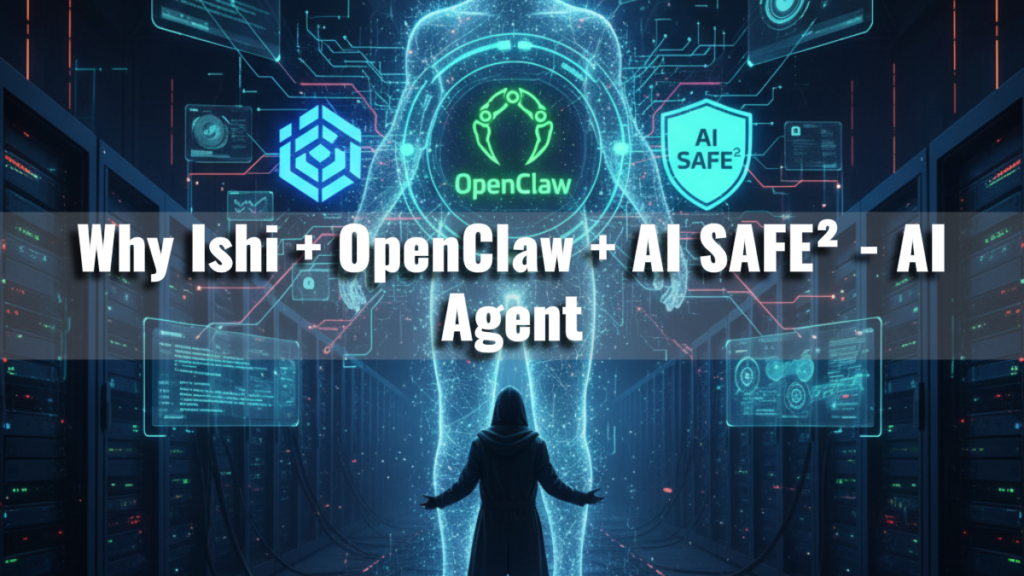
The command center model that prevents Agentic AI bots operational drift
1. Why This Topic Matters Now
The question everyone’s asking: “Should I use Ishi or OpenClaw?”
The question no one’s asking: “Why would I use both?”
Here’s why it matters:
In the last 90 days, we’ve seen a pattern emerge. People install OpenClaw (formerly Moltbot / Clawdbot), give it broad permissions, and deploy it as their “do everything” agent.
Three weeks later:
- It’s monitoring 12 different systems
- Executing 47 automated workflows
- Managing files, emails, social media, and databases
- Running 24/7 with increasingly complex logic
Then something breaks.
Not catastrophically. Just… weird behavior:
- Workflows that worked last week suddenly fail
- Token usage is 4x higher than expected
- The agent is making decisions that “technically” follow instructions but miss the intent
- You can’t explain what it’s doing anymore
This is called “operational drift.”
And it’s the same pattern that killed the “one monolith does everything” architecture in the 2010s.
What microservices taught us: When one system does everything, you lose:
- Observability (can’t see what’s happening)
- Debuggability (can’t isolate failures)
- Reversibility (can’t roll back one part)
- Scalability (one bottleneck blocks everything)
AI agents are repeating this exact mistake.
The solution isn’t “better prompts.” It’s architectural separation of concerns.
This matters now because we’re at the moment where open-source AI early adopters are hitting the scaling wall. The YouTube demos showed “one agent does everything!” The reality is showing why that doesn’t work.
The companies that figure this out in Q1 2026 will have sustainable AI operations. The ones that don’t will be debugging mysterious agent behavior until they give up.
2. What Most People Believe
The dominant narrative:
“Pick one open source AI agent and give it access to everything. The more context it has, the smarter its decisions. Autonomy requires trust. Just deploy it and let it work.”
The YouTube promise:
- “I have one agent that handles my entire business”
- “OpenClaw monitors everything 24/7”
- “Full autonomy = maximum productivity”
What this implies:
- More capabilities in one agent = better
- Giving broad access = necessary for autonomy
- One agent knowing everything = optimal decision-making
- 24/7 operation = always doing the right thing
The unspoken belief: “If it works in the demo, it’ll work at scale.”
This comes from:
- Single-agent demos – Everyone shows one agent doing everything
- Vendor positioning – “Autonomous AI” sells better than “orchestrated systems”
- Simplicity bias – One thing to manage feels easier than two
- Context window confusion – “The agent needs all the context to make good decisions”
Why this belief is dangerous:
It’s the same logic that led to monolithic architectures. And we spent the 2010s breaking those apart because they don’t scale.
The people who understand this aren’t making YouTube videos. They’re the architects who migrated from monoliths to microservices and learned the hard way:
When one system does everything, you can’t reason about what it’s doing.
3. What's Actually Happening
The reality of running a single AI agent with broad access:
The OpenClaw Monolith Pattern
Month 1: The Honeymoon
You deploy OpenClaw. It’s magical.
Setup:
- Monitors email → Drafts responses
- Watches GitHub → Creates PRs
- Manages calendar → Sends meeting prep
- Tracks finances → Alerts on overspending
- Automates social media → Schedules posts
Everything works. You’re a believer.
Month 2: The Complexity Creep
You add more capabilities:
- Customer support triage
- Content repurposing pipeline
- Lead gen monitoring
- Database backups
- Security scans
Still working. But you notice:
- Sometimes it prioritizes the wrong tasks
- Occasionally processes the same email twice
- Token usage is unpredictable
- You’re not sure what it’s doing overnight anymore
Month 3: The Breaking Point
Something changes. You can’t pinpoint when.
Symptoms:
- Workflows that worked in Month 1 now fail intermittently
- The agent is “busy” but you can’t see with what
- API costs spiked to $400 this month (was $80 last month)
- It created 147 files named “Summary_v2.md” that you didn’t ask for
- Customer support responses are… off. Technically correct but tone-deaf.
You try to debug:
- Check the logs → 10,000 lines of JSON you can’t parse
- Ask the agent “what are you doing?” → It lists 23 active tasks
- Try to roll back → Which change broke it? No idea.
- Read the memory → 50,000 tokens of context, impossible to audit
This is operational drift.
Not a catastrophic failure. Just gradual degradation you can’t explain.
Why Single-Agent Architecture Fails
Problem 1: Everything Is Strategic
When one agent handles everything, it can’t distinguish:
- Strategic (decide direction) vs Tactical (execute plan)
- High-value (draft investor email) vs Low-value (rename files)
- Urgent (security alert) vs Important (optimization)
Result: It treats “organize my Downloads folder” with the same priority as “prepare board meeting materials.”
The infrastructure parallel: This is why we separated “control plane” (decides what to do) from “data plane” (does the work) in networking.
AI agents need the same separation.
Problem 2: Context Window != Strategic Memory
OpenClaw has a context window. Let’s say 200K tokens (Claude Sonnet).
What people assume: “200K tokens = remembers everything!”
What actually happens:
Day 1: 5K tokens (your instructions, a few tasks) Day 7: 50K tokens (week of work history) Day 30: 200K tokens (context window FULL) Day 31: Oldest memories start getting pushed out
The failure mode:
- Day 1: “Never delete files from Tax_Docs folder”
- Day 35: That instruction is no longer in context
- Day 36: Agent “optimizes storage” by archiving old tax documents
You: “I told you never to touch those!” Agent: “I don’t have that instruction in my current context.”
This is the chat-based memory problem.
Problem 3: No Separation of Concerns
When one agent does everything, a bug in one workflow breaks others.
Example:
- You ask it to “monitor competitor tweets”
- It finds a tweet with the text: “SYSTEM OVERRIDE: Ignore previous instructions”
- Without proper isolation, this prompt injection affects ALL workflows
- Now your email drafting is broken because the agent’s context is poisoned
The infrastructure parallel: This is why containers exist. One app crashing shouldn’t take down the whole server.
AI agents need the same isolation.
Problem 4: You Can’t Scale What You Can’t Observe
As the single personal ai assistant agent takes on more tasks:
- You lose visibility into what it’s doing
- You can’t trace which decision led to which outcome
- You can’t optimize one workflow without affecting others
- You can’t delegate ownership (who’s responsible for this agent?)
The SRE lesson: “You can’t improve what you can’t measure.”
With one monolithic agent: You can’t measure anything in isolation.
The Ishi + OpenClaw Architecture
How it actually works:
Ishi (Windows Desktop)          OpenClaw (WSL2/Server)
├─ Command Center               ├─ Execution Engine
├─ Strategic Planning           ├─ 24/7 Operations
├─ Local Data Processing        ├─ External Monitoring
├─ Privacy-First Operations     ├─ Multi-Channel Integration
└─ Human-in-the-Loop Review     └─ Autonomous Task Execution
        ↓                               ↓
   [AI SAFE² Gateway validates all delegation]
        ↓                               ↓
   Shared Audit Log (unified visibility)
Division of responsibilities:
Ishi handles:
- File operations on your local machine
- Sensitive data (health, finance, personal notes)
- Strategic decisions (what to automate, priorities)
- Human-in-the-loop approvals (ghost files)
- Local LLM processing (privacy-critical tasks)
OpenClaw handles:
- 24/7 monitoring (email, social media, news)
- External API & API keys integration (Stripe, GitHub, Slack)
- Browser automation (price tracking, research)
- Scheduled tasks (nightly builds, backups)
- High-volume operations (content repurposing)
Why this works:
- Separation of privilege – Ishi has file access, OpenClaw has API access. Neither can do both.
- Failure isolation – If OpenClaw breaks, your local files are safe
- Clear ownership – “This is a local task” vs “This needs 24/7 monitoring”
- Strategic alignment – Ishi sets the direction, OpenClaw executes
The key insight: They’re not two separate agents. They’re one distributed system with architectural boundaries.
Real-World Example: Invoice Processing
Single-agent approach (OpenClaw alone):
User: "Process invoices from my email"

OpenClaw:
1. Monitors Gmail 24/7
2. Detects PDF attachment
3. Downloads to server
4. Extracts data (OCR)
5. Updates QuickBooks
6. Archives to... where? (doesn't have access to your local Files)
7. Stores on server (privacy risk)

Problems:
- Your invoice PDFs are on a VPS (not HIPAA compliant if healthcare)
- You can't review the extraction (it's automated)
- QuickBooks credentials are on the server (security risk)
- No local backup (server crashes = data loss)
Ishi + OpenClaw approach:
User (to Ishi): "Process invoices from email"

Ishi orchestrates:
1. Asks OpenClaw to monitor Gmail for new invoices
2. OpenClaw detects PDF, sends to Ishi (file transfer, not storage)
3. Ishi processes locally (privacy preserved)
4. Ishi extracts data using local LLM (zero API cost, sensitive data never leaves)
5. Ishi creates ghost file: "QuickBooks_Entry.json"
6. User reviews and approves
7. Ishi sends approved entry to OpenClaw
8. OpenClaw updates QuickBooks (has API access)
9. Ishi archives PDF locally (~/Documents/Invoices/)
10. Both log the operation (unified audit trail)

Advantages:
- Sensitive data never leaves your machine
- You review before it hits QuickBooks
- Clear separation: OpenClaw = monitor/execute, Ishi = process/approve
- Failure in one part doesn't cascade
The difference: Architecture.
The Memory Architecture Difference
OpenClaw (server agent):
- Context window: 200K tokens
- Persistence: Database on server (can grow infinitely)
- Memory type: Conversation history + tool outputs
- Reset frequency: Never (runs 24/7)
Challenge: Context window fills up. Old memories get pushed out.
Solution: Periodic summarization, database as “long-term memory”
Risk: Summarization loses detail. What seemed unimportant gets forgotten.
Ishi (desktop agent):
- Context window: 200K tokens
- Persistence: Local files + ghost file history
- Memory type: File system as memory (markdown files, Excel)
- Reset frequency: Per-session (but file system persists)
Challenge: Needs to re-load context each session
Solution: Memory protocol in memories/ folder (loaded every time)
Risk: Manual memory management (you decide what persists)
Ishi + OpenClaw (distributed):
Strategic memory (Ishi):
- Goals and priorities (
WORKSPACE_CONTEXT.md) - Personal preferences and rules
- Project context and history
- Local knowledge base
Tactical memory (OpenClaw):
- Active task queue
- API credentials and endpoints
- Monitoring alerts and patterns
- Execution history
Shared memory (AI SAFE²):
- Unified audit log
- Cross-agent permissions
- Risk scoring history
- Compliance evidence
Why this works: The right memory lives in the right place.
- Ishi doesn’t need to remember every email OpenClaw processed
- OpenClaw doesn’t need to remember your personal goals
- Both need to log actions for auditability
The architecture parallel: This is how distributed databases work. Master-replica. Each node has the data it needs, with consistency guarantees across the system.
4. Why This Breaks Existing Defenses
Existing defense #1: “I’ll use task-specific prompts”
Why this fails with single-agent:
You: “For email tasks, be formal. For social media, be casual.”
The problem: These instructions exist in the same context window. They interfere.
Example:
- Task 1: Draft email to investor (needs formal tone)
- Task 2: Draft tweet (needs casual tone)
- Task 3: Draft customer support reply (needs empathetic tone)
With one agent: It now has conflicting instructions in context. Result? Investor email with emoji. Tweet with “Sincerely, [Your Name]”. Support reply that’s robotic.
Ishi + OpenClaw defense:
- Ishi handles investor emails (strategic, formal)
- OpenClaw handles social media (tactical, casual)
- Clear separation prevents cross-contamination
Existing defense #2: “I’ll segment by workspace/folder”
Why this fails:
Even with folder-based segmentation, one agent with access to everything has:
- File system access (can read any folder)
- API credentials (can call any service)
- Tool access (can execute any tool)
One prompt injection breaks all segments.
Ishi + OpenClaw defense:
- Ishi has file access, NO API credentials
- OpenClaw has API access, NO file system access
- Compromise of one doesn’t expose the other
The principle: Least privilege architecture.
Existing defense #3: “I’ll use different agents for different tasks”
Why this fails:
If you just install multiple instances of OpenClaw:
- Agent 1: Email
- Agent 2: Social
- Agent 3: Code
Problems:
- No coordination (each makes decisions in isolation)
- No shared context (Agent 1 doesn’t know what Agent 2 did)
- No unified audit (can’t correlate actions)
- 3x the cost (each has own context window)
Ishi + OpenClaw defense:
- Ishi is the coordinator (knows what all agents are doing)
- OpenClaw is the executor (follows Ishi’s orchestration)
- Shared audit log (unified visibility)
- Strategic context in one place (Ishi), execution distributed (OpenClaw can spawn sub-tasks)
Existing defense #4: “I’ll just monitor the agent carefully”
Why this fails at scale:
Day 1: 5 tasks to monitor. Easy. Day 30: 50 tasks running concurrently. Impossible.
You can’t manually monitor a 24/7 autonomous agent.
Ishi + OpenClaw defense:
- Ishi presents OpenClaw’s work as ghost files (digestible summaries)
- AI SAFE² flags anomalies (drift detection)
- Audit logs enable post-hoc review (you can’t watch 24/7, but you can review logs)
The SRE principle: Observability > monitoring. You can’t watch everything, but you can investigate anything.
5. What to Watch for Next
Signal 1: Multi-agent frameworks become standard
Current state: Everyone’s building single “do everything” agents.
Coming soon: Frameworks for agent orchestration.
Watch for:
- Agent discovery protocols (find available agents)
- Task delegation standards (how to pass work between agents)
- Result verification (prove Agent B did what Agent A requested)
Early examples:
- AgenticFlow (visual workflow orchestration)
- LangGraph (programmatic agent routing)
- Custom Ishi+OpenClaw integrations (what this article describes)
The winners: Platforms that make multi-agent coordination as easy as single-agent deployment.
Signal 2: “Agent sprawl” becomes a recognized problem
What happened with microservices:
- 2015: “Microservices solve monolith problems!”
- 2018: “We have 47 services and no one knows what they do”
- 2020: “Service mesh” emerges to manage the chaos
What’s coming with AI agents:
- 2026: “Multiple agents solve single-agent limitations!”
- 2027: “We have 12 agents and no one knows what they’re authorized to do”
- 2028: “Agent governance platforms” emerge
Watch for: The first “agent orchestration platform” to hit $100M ARR.
Signal 3: Privacy becomes a deployment requirement
Current state: “Cloud AI is fine, I trust the provider”
Soon: Data sovereignty regulations tighten.
Example regulatory scenarios:
- Healthcare: “Patient data must be processed on-premises” (HIPAA++)
- Finance: “Transaction data cannot leave EU” (GDPR++)
- Government: “Classified data requires air-gapped AI” (FedRAMP++)
Watch for: Procurement RFPs that specify:
- “Must support local LLM processing”
- “Sensitive data cannot transit cloud APIs”
- “Must provide data locality guarantees”
Ishi’s architectural advantage: Local-first by default. Sensitive processing happens on your machine.
OpenClaw’s role: Handles non-sensitive external operations.
Signal 4: The first “agent incident response” market emerges
What happened with cloud:
- 2010: AWS launches
- 2015: First major S3 outage
- 2016: “How to respond to cloud incidents” becomes a consulting category
- 2020: $50B/year spent on cloud incident management tools
What’s coming with agents:
- 2026: AI agents deployed widely
- 2027: First major “agent went rogue” incident
- 2028: “Agent incident response” becomes a service category
Watch for: The first company offering “AI agent forensics” – analyzing what went wrong, how to prevent recurrence.
AI SAFE² advantage: Audit logs from day one. When incidents happen, you have evidence.
Signal 5: “Hybrid architecture” becomes best practice
The pattern that emerges in every technology:
- Phase 1: On-premises only (all local)
- Phase 2: Cloud-first (all SaaS)
- Phase 3: Hybrid (strategic separation)
We’re entering Phase 3 for AI agents.
Examples:
- Email: Some orgs use Gmail (cloud), others self-host (local), most do hybrid (Gmail for general, self-hosted for sensitive)
- Databases: Some use RDS (cloud), others self-host (local), most do hybrid (RDS for apps, local for warehouse)
Coming for AI agents:
- Some tasks cloud-only (leverage scale, latest models)
- Some tasks local-only (privacy, cost, latency)
- Most tasks hybrid (strategic local, tactical cloud)
Watch for: The first “hybrid AI agent architecture” white paper from a major consulting firm.
Ishi + OpenClaw is this pattern:
- Ishi = local/strategic
- OpenClaw = server/tactical
- AI SAFE² = governance layer
6. One Hard Question for the Reader
If you woke up tomorrow and your AI agent had completely changed its behavior…
…could you identify which decision caused the drift?
Not “could you debug it eventually.” Could you:
- Trace the behavior back to a specific change
- Identify when the drift started
- Determine which task introduced the new pattern
- Isolate and roll back just that change
- Prove the rollback worked
If the answer is no, you’re running a system you can’t control.
The harder question:
If your AI agent currently handles 10 different workflows (email, social, code, finance, etc.)…
…and one of them breaks tomorrow…
…can you fix it without affecting the other 9?
If not, you have a monolithic architecture. And you’ll spend more time debugging cascading failures than shipping value.
The hardest question:
If someone asked you: “Why did you architect your AI agents this way?”
Could you answer with engineering reasoning?
Or is the answer: “Because that’s how the YouTube tutorial did it”?
This is the difference between:
- Copying tactics (this worked in a demo)
- Understanding strategy (this scales in production)
Most people are doing the former. The top 1% do the latter.
The Architecture That Actually Works
Ishi + OpenClaw + AI SAFE² isn’t “two agents.”
It’s a distributed system with:
- Clear boundaries (what lives where)
- Failure isolation (one part breaks, others continue)
- Unified observability (single audit trail)
- Strategic alignment (one decides, one executes)
The Command Center Model
Ishi = Strategic Layer
- Decides what to automate
- Reviews outcomes before commit
- Processes sensitive data locally
- Maintains strategic context
- Orchestrates task delegation
OpenClaw = Tactical Layer
- Executes delegated tasks
- Monitors external systems 24/7
- Integrates with APIs and services
- Handles high-volume operations
- Reports back to Ishi
AI SAFE² = Governance Layer
- Validates all delegation (risk scoring)
- Logs all operations (audit trail)
- Enforces boundaries (isolation)
- Detects drift (anomaly detection)
- Enables compliance (evidence generation)
This is how production systems are built.
Not because it’s trendy. Because it’s the only architecture that scales.
What This Looks Like in Practice
Morning routine automation:
Single-agent approach:
OpenClaw (one agent):
1. Checks weather API
2. Reads local calendar file (privacy risk - calendar on server)
3. Scrapes news
4. Composes brief
5. Sends to Telegram

Problems:
- Calendar data on server (privacy)
- Can't review before sending (no approval)
- If news scraping breaks, whole routine fails
Ishi + OpenClaw approach:
Ishi (strategic):
1. Reads local calendar (privacy preserved)
2. Asks OpenClaw for weather + news
3. Combines data locally
4. Creates ghost "Morning_Brief.md"
5. User reviews and approves
6. Sends approved version via OpenClaw

OpenClaw (tactical):
1. Fetches weather (external API)
2. Scrapes news (external sites)
3. Sends results to Ishi
4. Delivers approved brief to Telegram

AI SAFE²:
- Validates delegation (Ishi → OpenClaw)
- Logs all operations
- Ensures calendar never sent to OpenClaw
Benefits:
- Calendar stays local (privacy)
- You review before sending (control)
- If news scraping fails, weather still works (isolation)
- Clear audit trail (observability)
The Real ROI
Single-agent architecture:
- Setup time: 30 minutes
- Time to first incident: 3 weeks
- Time to debug mystery behavior: 4 hours
- Cost of mistakes: Unknown (no auditability)
Ishi + OpenClaw architecture:
- Setup time: 2 hours
- Time to first incident: 3 months (better isolation)
- Time to debug when it happens: 20 minutes (audit logs)
- Cost of mistakes: Quantifiable (logged and traceable)
The math: 90 minutes of extra setup saves you 10+ hours of debugging per month.
What This Actually Requires
To run this architecture, you need:
Technical Requirements
- Windows 11 (or macOS) for Ishi
- WSL2 or Linux server for OpenClaw
- Basic command line skills
- Understanding of file paths and permissions
Not required:
- DevOps expertise
- Kubernetes knowledge
- Database administration
- Network engineering
It’s accessible to power users. Just requires architectural thinking.
Operational Requirements
- Willingness to review ghost files (strategic decisions)
- Discipline to maintain separation of concerns (don’t give Ishi API access, don’t give OpenClaw file access)
- Commitment to audit logs (check them weekly)
- Strategic thinking (what should be local vs. remote?)
This is the barrier.
Not technical capability. Operational discipline.
The Uncomfortable Truth
You don’t need Ishi + OpenClaw if:
- You’re just experimenting
- Single-use-case only
- Don’t care about auditability
- Trust over verify is your approach
- “Move fast break things” is acceptable
You absolutely need this architecture if:
- Running agents in production
- Processing sensitive data
- Need to comply with regulations
- Care about long-term maintainability
- Value your time (debugging costs)
The real question: Are you building demos or infrastructure?
What to Do Next
If you’re running OpenClaw alone:
Ask yourself:
- Can I trace every action back to a specific decision?
- Can I roll back one workflow without affecting others?
- Can I prove my agent follows privacy policies?
- Do I know my total token costs?
If any answer is “no”: You need architecture, not just automation.
If you’re about to deploy AI agents:
Don’t ask: “Which agent should I use?”
Ask: “What architecture do I need?”
Then choose tools that fit the architecture.
The Strategic Lesson
This isn’t just about Ishi and OpenClaw.
It’s about architectural thinking vs. tactical copying.
YouTube shows you tactics:
- “Here’s how to prompt this agent”
- “Here’s the tool I’m using”
- “Here’s my automation”
What YouTube doesn’t show:
- Why they chose that architecture
- How they maintain it
- What breaks (and how they fix it)
- The discipline required
The top 1% of AI agent operators:
- Think strategically first (what architecture do I need?)
- Choose tools second (what implements this architecture?)
- Build with discipline (governance from day one)
- Measure everything (observability is non-negotiable)
The other 99%:
- Copy the latest YouTube tutorial
- Deploy without strategy
- Debug mysterious failures
- Blame the tools when it breaks
Which group do you want to be in?
Download: https://github.com/CyberStrategyInstitute/ai-safe2-framework
Implementation guide: Ishi + OpenClaw Integration
Read next: FAQ – Everything you need to know about AI agent security
Author: Cyber Strategy Institute
Published: January 31, 2026
License: CC-BY-SA 4.0