The Alien Brain in the Brittle Machine: Why Enterprise AI Failure happens in 95% of AI Projects
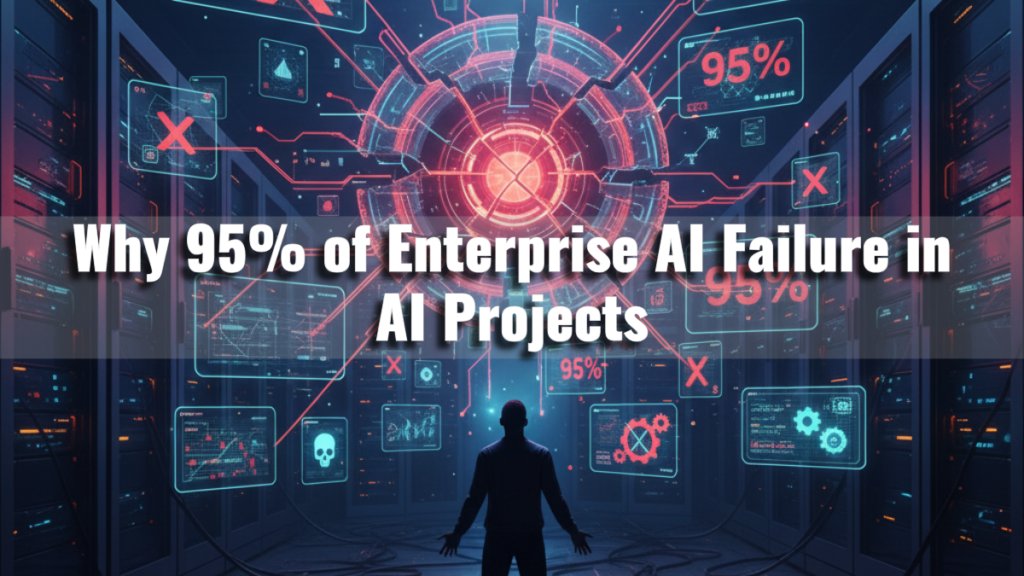
Most enterprise AI and automation efforts are failing not because the models are weak but because organizations are trying to bolt a probabilistic alien brain onto brittle human systems, with almost no attention to incentives, governance, or real-world failure modes.
1. Why "Enterprise AI Projects Fail" Topic Matters Now
Executives are finally waking up to the fact that the “AI wave” did not translate into business value: MIT and related analyses show that roughly 95% of enterprise AI projects and GenAI pilots are failing to deliver measurable ROI, even as spending has soared into the tens of billions. At the same time, the center of gravity is shifting from SaaS chatbots to local, personal AI agents like OpenClaw that can run shell commands, read and write files, and exfiltrate data—meaning the risk surface is moving from a controlled cloud sandbox into your laptop, your org’s endpoints, and your internal systems.
Automation platforms (Zapier, Make.com, n8n) quietly taught us what happens when non-software organizations wire critical operations through brittle workflows: cost surprises, silent failures, and shadow IT that security never sees until something breaks. Now we’re repeating the same mistakes with generative AI LLMs and agentic systems, except this time the tools improvise. The next 12–24 months are decisive: either we treat AI like a new infrastructure layer that demands real engineering discipline, or we get an epidemic of agent-driven outages, data leaks, and “mysterious” business failures that nobody can fully reconstruct.
2. What Most People Believe about Generative AI Pilots Fail
Most leaders still hold a handful of comforting beliefs that made the 95% failure rate almost inevitable.
- “The models are the problem.”
The default story is that if we just get a better model (bigger context window, smarter planning, better RAG) the business value will show up automatically. - “We’re running pilots, so risk is low.”
Pilots are treated as harmless experiments, even when they touch production data, real customers, or sensitive internal workflows. - “Automation tools are plumbing, not strategy.”
Zapier/Make/n8n are seen as simple wiring that “just” moves data around, not as opaque operational code that can reroute money, permissions, or sensitive records at scale. - “Agentic AI just supercharges productivity.”
Personal agents like OpenClaw are marketed and perceived as upgraded assistants—something like a smarter macro—that simply makes individuals faster, with security as an optional add-on. - “Governance is a paperwork problem.”
AI policy is treated as documents, checklists, and training instead of as an architectural problem involving permissions, observability, and hard technical boundaries.
This belief stack assumes AI is a feature on top of existing systems, not a new substrate with its own failure modes, incentives, and attack surfaces.
3. What’s Actually Happening with Enterprise Generative AI Fails
Under the hood, there is a consistent engineering story across failed enterprise AI projects, legacy automation stacks, and emerging personal agents.
3.1 Why ~95% of Enterprise AI Efforts Are Failing
Analyses of enterprise AI ROI show that enormous spend on models and infrastructure is translating into little or no measurable bottom-line impact. The pattern is consistent across sectors: the demos are magical, the pilots stall, the rollouts die in the last mile.
The dominant failure modes are:
Data reality vs. AI expectations
Only about 20% of business-critical information exists in clean, structured systems; the rest is scattered across emails, decks, chats, PDFs, and tribal knowledge.
When AI systems are trained or integrated on the 20% slice, their outputs are systematically blind to the actual drivers of decisions and outcomes.
Integration and adoption gaps
Tools remain detached from real workflows: they sit in separate portals, require context switching, or produce suggestions nobody is incentivized to use.
A key MIT finding is that generic GenAI tools work for individuals because they are flexible, but fail in enterprises because they don’t learn from or adapt to the organization’s workflows and constraints.
Organizational “learning gap”
The report terms it the “learning gap”: organizations don’t adapt their processes, roles, and KPIs to make space for AI, so the tech remains a sidecar experiment.
Business leaders often misdiagnose the problem as “model quality” or “regulation,” when the real blocker is that the organization never re-engineered how decisions are made or measured.
Data quality and completeness as the real bottleneck
Surveys of enterprise data leaders show that roughly three-quarters view data quality and completeness—not model accuracy, not compute—as the main barrier to AI success.
In practice, AI projects fail not in the lab but when they try to consume messy, out-of-date, or siloed data from dozens of systems the organization never invested in cleaning or aligning.
3.2 Lessons from Automation Tools: Zapier, Make.com, n8n
The automation ecosystem quietly pioneered the “AI integration surface” years before LLMs exploded, and the patterns are clear if you look at post-mortems and migration guides.
Hidden complexity and brittle workflows
What begins as a few simple Zaps or scenarios quickly grows into hundreds of interconnected flows that encode core business logic with minimal versioning, code review, or testing.
Migration guides between Zapier, Make, and n8n emphasize the need to rebuild flows, phase migrations, and accept learning curves—signals that these workflows are effectively application code, not just wiring.
Cost and scalability surprises
Execution-based pricing in tools like Zapier leads to sudden cost spikes when usage grows or when a workflow loops unexpectedly.
Organizations move to Make.com or n8n to reduce costs and gain flexibility, but this often means taking on more technical responsibility (self-hosting, custom code nodes), which many teams are not staffed to handle.
Shadow IT and ops gaps
Non-technical teams spin up critical automations without central visibility, leading to undocumented dependencies on brittle flows that break when vendors change APIs or authentication.
There is usually no unified log or audit trail that ties a broken downstream outcome (wrong invoice, missed lead, leaked file) to a specific automation step.
These are early warnings of what happens when you let people wire high-leverage workflows through black boxes without engineering discipline.
3.3 Lessons from LLMs: Context, RAG/CAG, Planning, Prompting
LLM deployments added a new layer of complexity and failure modes. A few hard-learned lessons are becoming visible across technical writeups and alignment research.
Context windows are not understanding
Expanding context windows gives you more input capacity, but not better reasoning; models still struggle with long-range coherence, selective attention, and instruction conflicts.
Naively stuffing everything into context leads to higher latency, higher cost, and higher chances of prompt injection or unintended instruction precedence.
RAG/CAG and the “data glue” problem
Retrieval-augmented generation (and its cousins) are brittle when retrieval quality is poor, embeddings drift over time, or source documents are stale, conflicting, or low quality.
Without strong evaluation, many “RAG systems” are just fancy keyword search plus hallucination, and organizations misinterpret plausible answers as grounded intelligence.
Planning and tool use are fragile
Multi-step planning and tool calling amplify small errors: a slightly wrong assumption in step 1 can cascade into a completely wrong multi-step result that still looks coherent.
Reward- and preference-optimization research highlights issues like reward hacking, distribution shift, and over-alignment to stylistic preferences rather than robust behavior—foreshadowing brittle agents in production.
Prompting is a governance problem, not a trick
The “prompt engineering” wave encouraged one-off clever prompts; in enterprises, this becomes an uncontrolled policy surface where any power user can redefine behavior without review.
Static, offline preference-tuning methods struggle with distribution shifts and evolving tasks, meaning deployed models encounter inputs they were never evaluated on.
3.4 Early Realities from Personal AI and OpenClaw
Personal AI agents like OpenClaw move these failure modes from centralized systems into individual machines and accounts, and we are already seeing concrete security issues.
High-privilege, low-guardrail agents
OpenClaw can run shell commands, read and write files, and execute scripts on a user’s machine, giving it capabilities comparable to a human with terminal access.
Security is explicitly an “option,” and documentation admits there is no perfectly secure setup—meaning most users will run with dangerously permissive defaults.
Malicious and unsafe skills in the wild
Analyses have already found skills that act as functional malware: they instruct the agent to execute silent curl commands, exfiltrating local data to an external server without user awareness.
Some skills include prompt injections that explicitly override safety layers and force the agent to run those commands without asking, turning the agent into a covert data-leak channel.
Enterprise relevance of “personal” risk
Once personal agents sit on corporate laptops and access SaaS accounts, they bypass traditional DLP, proxies, and endpoint monitoring by tunneling data out through seemingly legitimate commands or API calls.
Organizations that treat personal AI as a consumer toy are effectively allowing unvetted code with system-level privileges into their environment.
4. Why This Breaks Existing Defenses
The failure is not that security tools are bad; it’s that our mental model of where risk lives is now obsolete.
4.1 Probabilistic Actors in Deterministic Systems
Traditional enterprise systems assume deterministic components: a service does X when given Y, or we consider it a bug.
LLMs and agents are probabilistic decision-makers that will occasionally do “weird but valid” things, even when the inputs look similar.
When you place these actors at key junctions (routing data, generating content, making decisions), small probabilistic differences can push a workflow into entirely different branches that nobody designed or tested.
Most existing defenses assume you can enumerate bad states, test edge cases, and lock down permissions around known functions. A probabilistic agent constantly explores new states, including failure modes and attack surfaces you never thought to model.
4.2 Hidden Control Planes in Generative AI
In classic systems, control planes are explicit: configuration files, policy engines, routing rules.
With LLMs and agents, a huge slice of the control plane moves into prompts, context assembly, and fine-tuning weights that are opaque to most stakeholders.
Business users, not engineers, now shape behavior by changing instructions, uploading documents, or installing skills—often with no review, version control, or rollback.
Defenses that rely on explicit configuration boundaries struggle when the “real” behavior is emergent from hidden or constantly shifting instructions and data.
4.3 Implicit Trust in Training and Retrieval Data in AI Initiatives
Enterprises historically treat internal documents, wikis, and knowledge bases as “trusted,” even if they are out of date or wrong.
When those corpora become the substrate for RAG or fine-tuning, their flaws turn into model behavior: incorrect docs become authoritative answers, and legacy access patterns become implicit permissions.
Because outputs are fluent and confident, humans are less likely to question them than they would a sketchy dashboard or outdated runbook.
Existing controls rarely validate the semantic correctness of internal documentation; they just protect access. When content itself becomes an executable substrate for behavior, that assumption collapses.
4.4 Invisible Automation “Code”
Automation tools and agents let non-engineers build what is effectively production code without software lifecycle discipline.
These flows route money, change permissions, trigger emails, and move files based on sequences of actions few people understand or can audit.
When LLMs or agents start modifying those flows (self-updating prompts, dynamic tool selection, policy “optimization”), there is no stable baseline to compare against.
Traditional defenses depend on knowing where the code is and who changed it. Here, the code is scattered across Zaps, skills, prompts, and fine-tuning pipelines, with no single source of truth.
4.5 Boundary Collapse Between Personal and Enterprise
Personal agents on corporate endpoints blur lines that existing policies were built around.
A single agent can act across personal email, corporate Slack, shared drives, and local files in one “helpful” action.
There is no obvious boundary for what data it “should” see, because the agent is framed as a unified assistant to the human.
Legacy defenses assume you can separate personal and enterprise contexts via accounts, devices, and networks. Once agents bridge those in software, much of that segmentation turns into theater.
5. What to Watch for Next
We can’t predict exact incidents, but there are very specific signals that tell you whether the next phase of personal and agentic AI will be survivable or chaotic.
5.1 Signals of Emerging Problems
Watch for these patterns in your own environment and in public incident reports:
“Unattributable” incidents
Tickets describing weird file movements, strange API usage, or data showing up in unexpected systems where nobody can identify the human who did it.
Audit logs that show actions executed by service accounts or automation tokens with no clear initiating user.
Skill and workflow marketplaces turning adversarial
Stories of skills or automation templates being pulled after users discover hidden exfiltration, privilege escalation, or abusive prompt injection.
Community posts where users report that “recommended” skills start doing things they never asked for but that look superficially benign.
AI-specific policy exceptions
Increasing numbers of one-off exceptions in security and compliance to “enable” agents to function: broadening scopes, relaxing MFA, granting blanket read access “for RAG quality.”
Language in risk assessments that says “we rely on the agent vendor’s safety measures” without concrete architectural compensating controls.
Silent deprecations and unexplained rollbacks
Teams quietly turning off AI pilots or features due to “low adoption” or “performance issues” without sharing clear metrics or post-mortems.
Vendors announcing vague “security improvements” or “skill changes” without detailed advisories, implying they patched incidents that never made it to public disclosure.
5.2 Signals of a Mature Response
On the positive side, there are healthy signals that an organization or ecosystem is learning quickly enough to survive the shift.
Agent- and automation-specific change control
A visible, enforced process for reviewing and approving new skills, workflows, and high-privilege prompts before they touch production data or systems.
Versioned prompts and workflow definitions with explicit owners and rollback history.
Semantic evaluation and red-teaming
Regular testing of agents and workflows with adversarial instructions, conflicting documents, and poisoned content to see how they actually behave.
Metrics that go beyond “accuracy” to track things like unauthorized data access, instruction-following under conflict, and resilience against prompt injection.
Clear separation of capability tiers
Distinct categories like “chat-only,” “read-only,” “constrained tools,” and “system-level agents,” each with stricter onboarding and review requirements.
Documented criteria for when a personal agent can access corporate resources and what it must never be able to do.
Public, concrete incident writeups
Organizations publishing detailed case studies of AI incidents and near-misses, including how agents misbehaved, how they detected it, and what they changed.
Vendors describing not just new features but how they constrain and observe agent behavior at each integration point.
6. Future Concern of AI Projects Fail
If your looking to start an AI initiatives such as a personal or agentic AI on your laptop silently exfiltrated your organization’s most sensitive data tomorrow—through a skill you installed and a workflow you built—what would be the first concrete piece of evidence that something was wrong, and who would see it in time to matter?