Anthropic’s Claude watermarking program is not only about identifying AI-generated content today. It establishes precedents that can be expanded tomorrow.
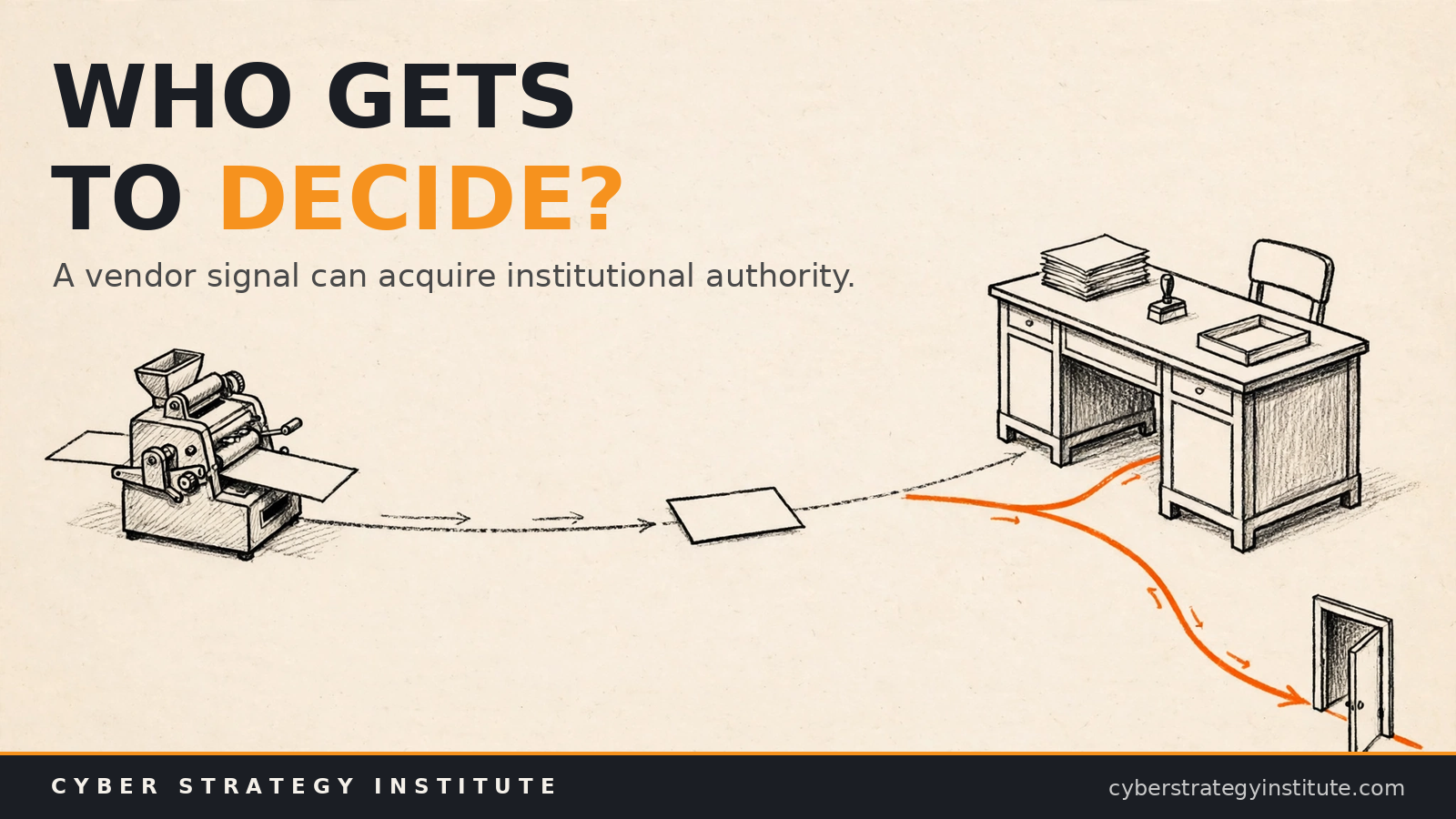
A vendor-controlled watermark leaving the lab and entering institutions. Conceptual illustration.
Anthropic’s Watermark Is Not the Claim. It’s the Precedent.<
Key quote: “A narrow exception becomes a presumption. The presumption becomes a standard. The standard becomes an enforcement mechanism. That is the precedent ratchet.”
Anthropic’s Claude watermarking program is not only about identifying AI-generated content today. It establishes precedents that can be expanded tomorrow — and precedents, unlike features, do not stay where you put them.
The deeper issue begins the moment a vendor-controlled signal leaves the AI system and enters a school, an employer, a publishing platform, a courtroom, or a government process. I learned through military command and control that a signal is never merely data once it can trigger a decision. It becomes power when someone can use it to classify, investigate, deny, suppress, punish, or exclude.
Consider the progression, because it has happened before with other signals and it will happen again.
Jurisdictional precedent: a requirement originating in one jurisdiction becomes the global product default. Companies already regionalize infrastructure, access, data, and contracts. Global deployment is a governance choice, not merely a technical outcome.
Attribution precedent: the provider marks content its model generated or processed. The mark may not legally determine authorship — but that does not control how others interpret it.
Institutional precedent: “AI was involved” becomes a classification applied to writers, students, employees, developers, and businesses.
Legal precedent: a court accepts the vendor-controlled signal in one narrow case. That decision influences the next case, the next contract, the next regulation, the next platform rule.
A narrow exception becomes a presumption. The presumption becomes a standard. The standard becomes an enforcement mechanism. That is the precedent ratchet — and it only turns one direction.
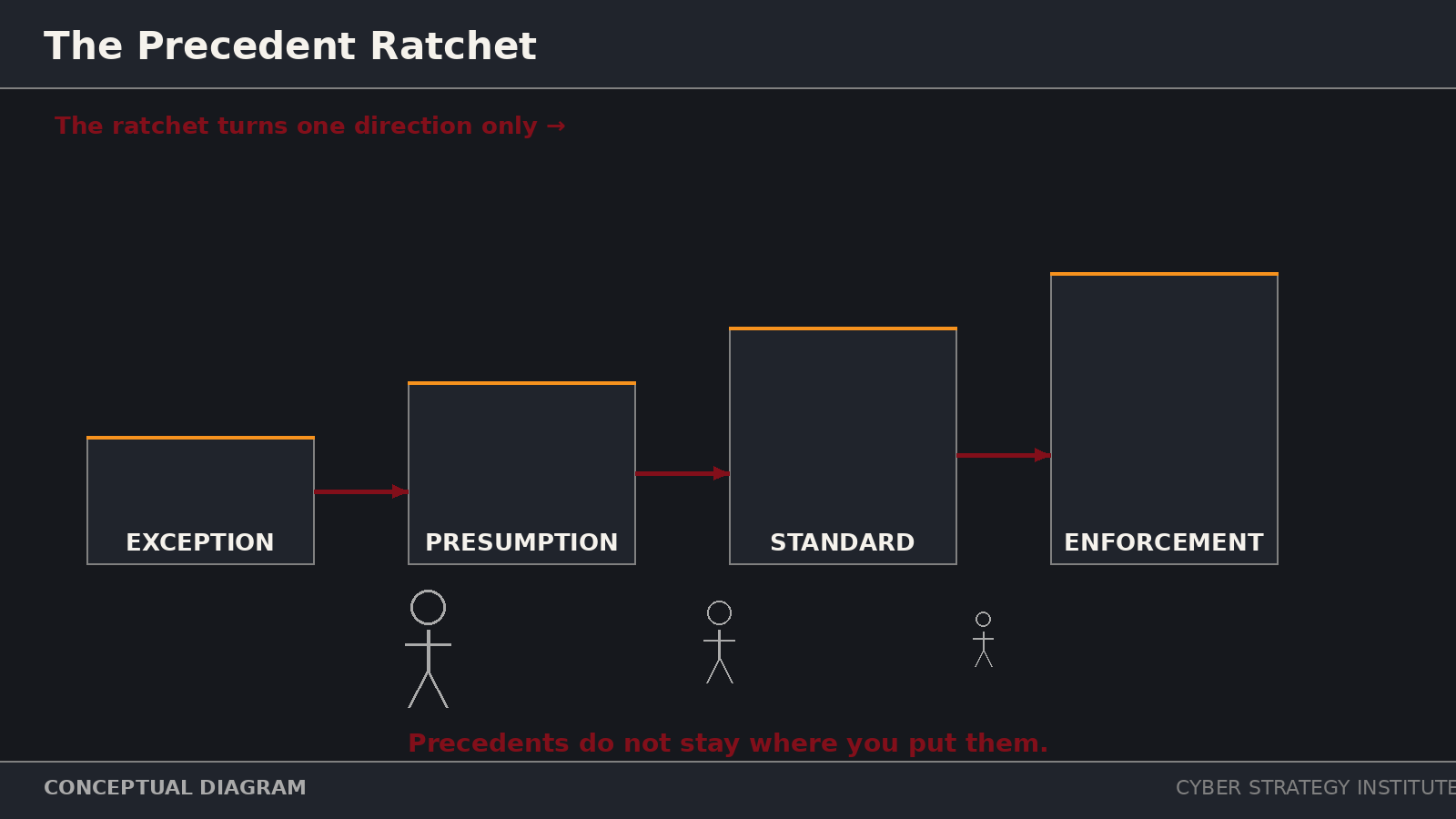
The precedent ratchet — a narrow exception turning into an enforcement mechanism. Conceptual diagram.
The Sovereignty Cascade
Key quote: “AI systems may operate agentically, but they are not the rights-bearing principal. The human must remain the rights holder and protected party.”
Under the Cognitive Sovereignty Framework, the cascade runs: Observation → Classification → Attribution → Institutional Judgment → Consequence → Self-Censorship → Dependency.
Each stage feels reasonable in isolation. Together they describe a transfer of standing: the human, who should remain the rights holder and protected party, gradually becomes the subject of a vendor-controlled classification system they cannot inspect, contest, or escape. Cyber Strategy Institute applied its Cognitive Threat Severity Scoring model to this architecture — and the structural finding is that the danger is not the watermark’s accuracy. It is the watermark’s authority: who gets to wield it, against whom, with what recourse.
AI systems may operate agentically, but they are not the rights-bearing principal.
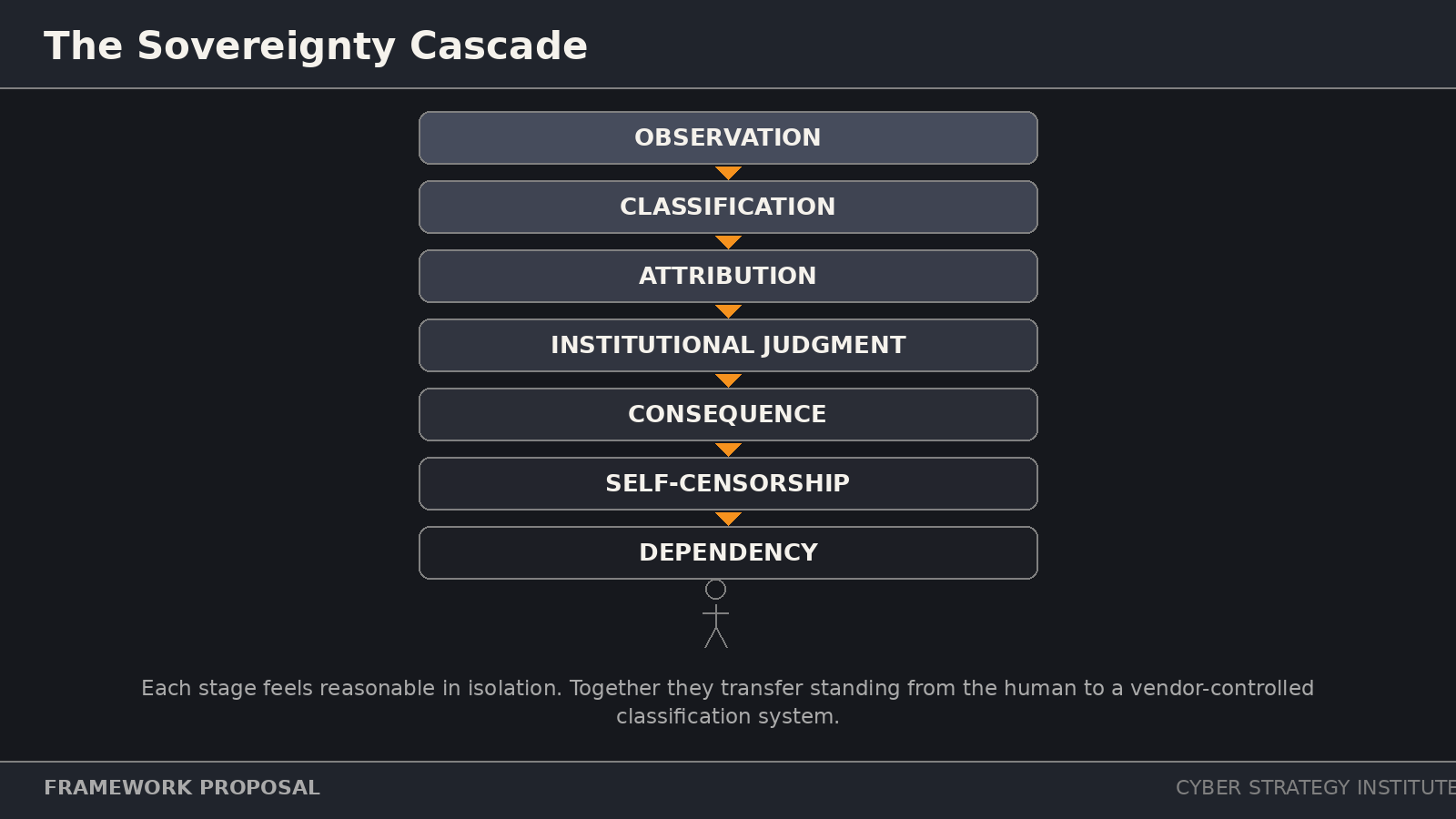
The cognitive sovereignty cascade from observation to dependency. Framework proposal.
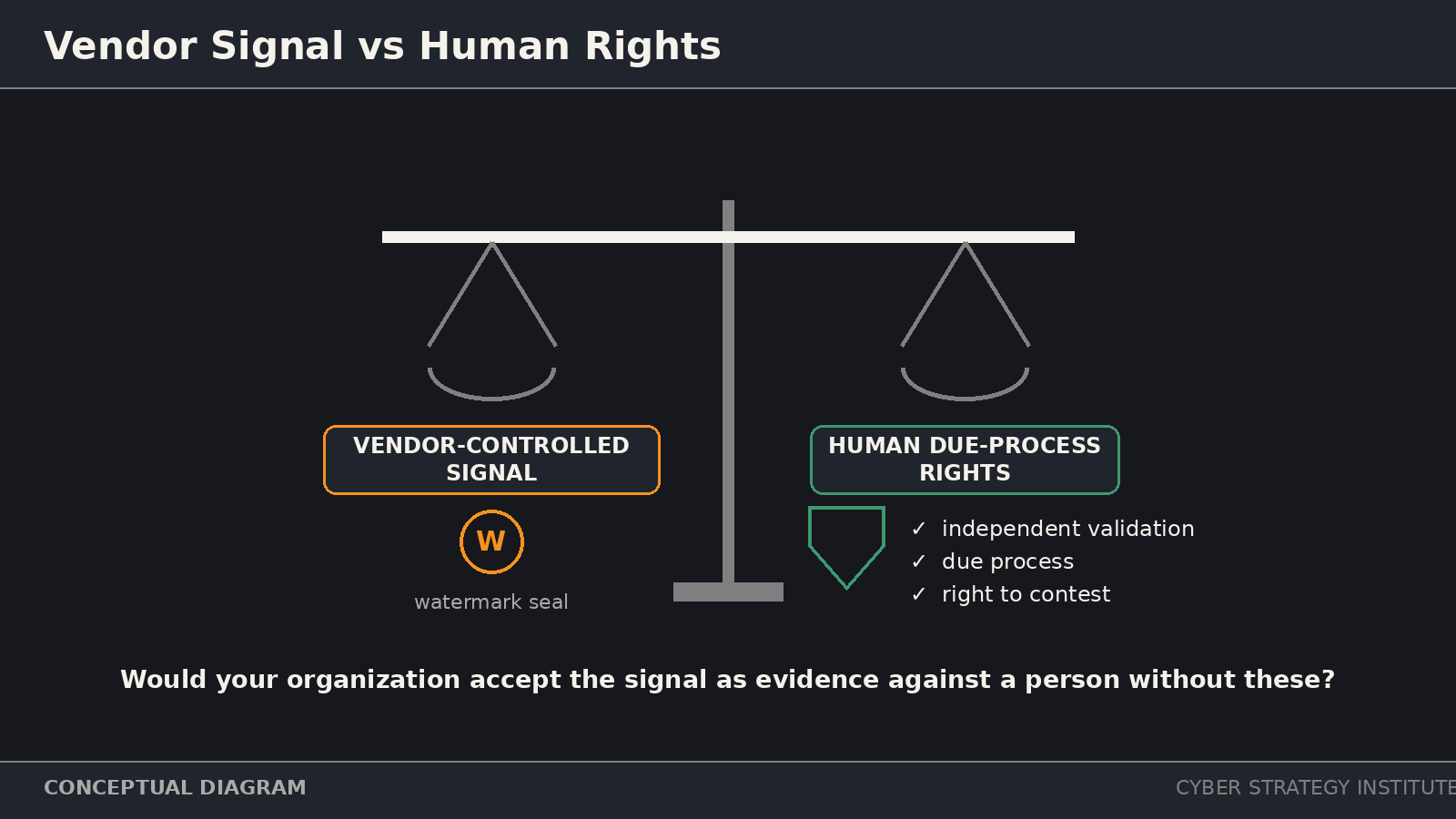
Balancing a vendor-controlled signal against human due-process rights. Conceptual diagram.
So here is the question every institution adopting detection signals should answer before the ratchet turns: would your organization accept a vendor-controlled watermark as evidence against a person — without independent validation, without due process, and without a meaningful right to contest it?
If the answer is uncomfortable, that discomfort is the point. Answer it now, while the precedent is still narrow.
Find your exposure first.
Free AI governance assessment — instant score, no sales call required.
[Score Your AI Risk in 8 Minutes] [Book a Strategy Briefing]