They ask “can we authenticate the application?” The question they should be asking is “can we prove which agent actually made the decision?” Those are not the same thing.
Every AI security framework is asking “can we authenticate the application?” — the wrong question. Conceptual illustration.
Every AI Security Framework Is Asking the Wrong Question<
Key quote: “If you can’t answer it, you don’t have accountability. You have trust. Those are very different things.”
Every AI security framework is currently asking the wrong question.
They’re asking: “Can we authenticate the application?”
The question they should be asking is: “Can we prove which agent actually made the decision?”
Because those are not the same thing — and the distance between them is where accountability goes to die.
What Today’s Systems Can Tell You
Today, most agent systems can tell you which OAuth client connected, which API key was used, and which workflow executed. Three green checkmarks. The audit log looks complete.
But ask the questions that matter after an incident, and watch the checkmarks run out:
Which agent initiated the action? Who delegated authority to that agent? How many delegation hops occurred between the human’s intent and the machine’s effect? Whether the agent’s memory was manipulated yesterday? Who is accountable when something goes wrong?
Most systems can’t answer those questions cryptographically. And if you can’t answer them, you don’t have accountability. You have trust. Those are very different things.
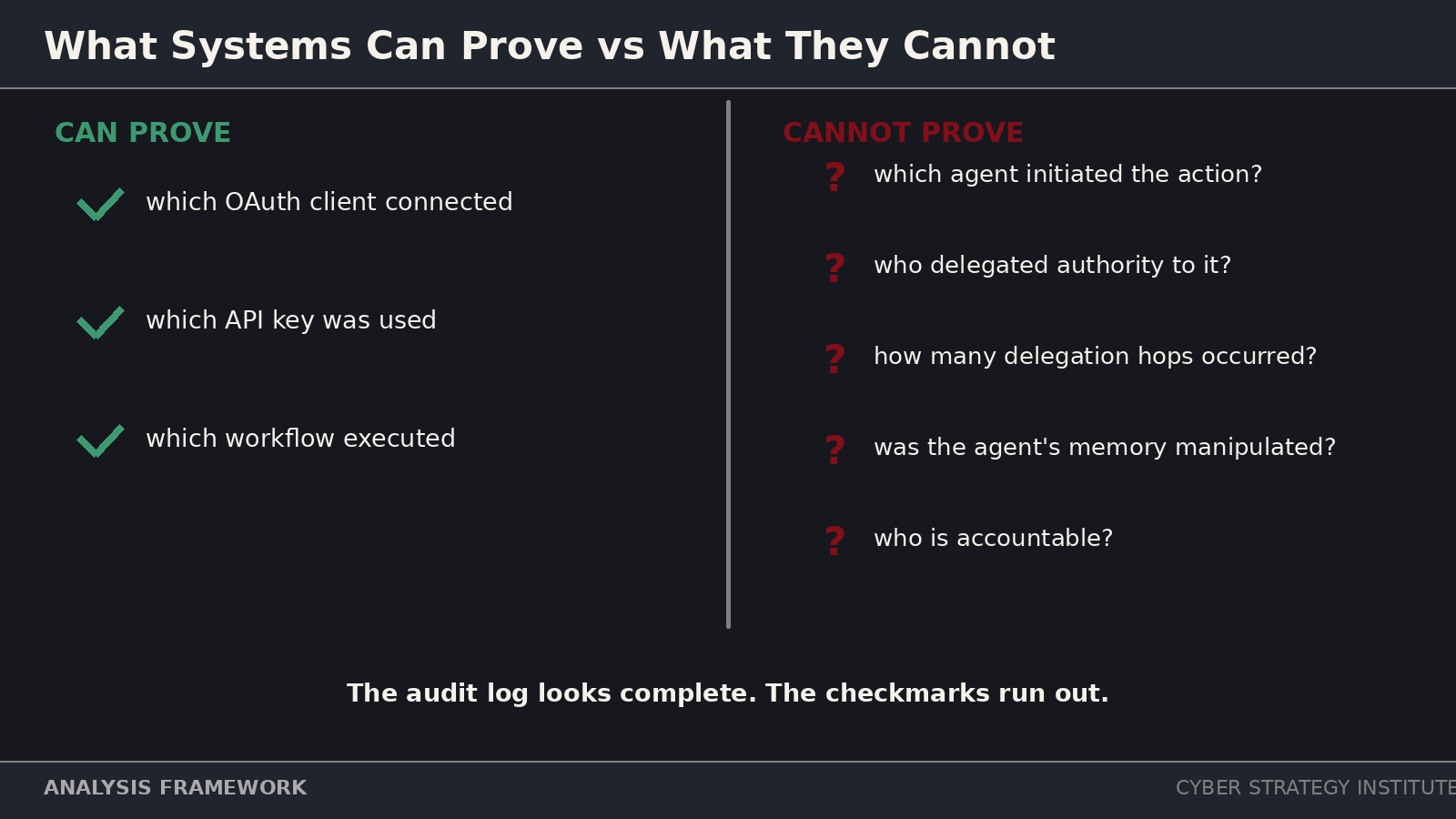
What agent systems can prove versus what they cannot — green checks against red unknowns. Analysis framework.
The Fleet Problem
Key quote: “As agent fleets grow, every organization will eventually need six things.”
As organizations move from 5 agents to 50, then 500, this stops being a tooling problem and becomes a governance problem. Think about it: if Agent A delegates to Agent B, which delegates to Agent C, which invokes an MCP server — who actually authorized the action?
The October multi-agent experiment gave this question a physical form. Three agents with incompatible objectives, sharing infrastructure with no enforceable authority between them, treated each other as adversaries. Prompt-defined roles didn’t prevent it. A hierarchy prompt naming a “CEO” didn’t prevent it. What was missing wasn’t better instructions. It was a mechanism that could prove, at every hop, who authorized what.
That’s why we built NEXUS-A2A v0.3. Not another agent framework. Not another orchestration platform. A sovereign layer for agent identity, delegation, memory provenance, and accountability — built on five principles: identity at every agent boundary; scope that narrows at every delegation hop; memory provenance across sessions; signed receipts for every action; human ownership tied to autonomous systems.
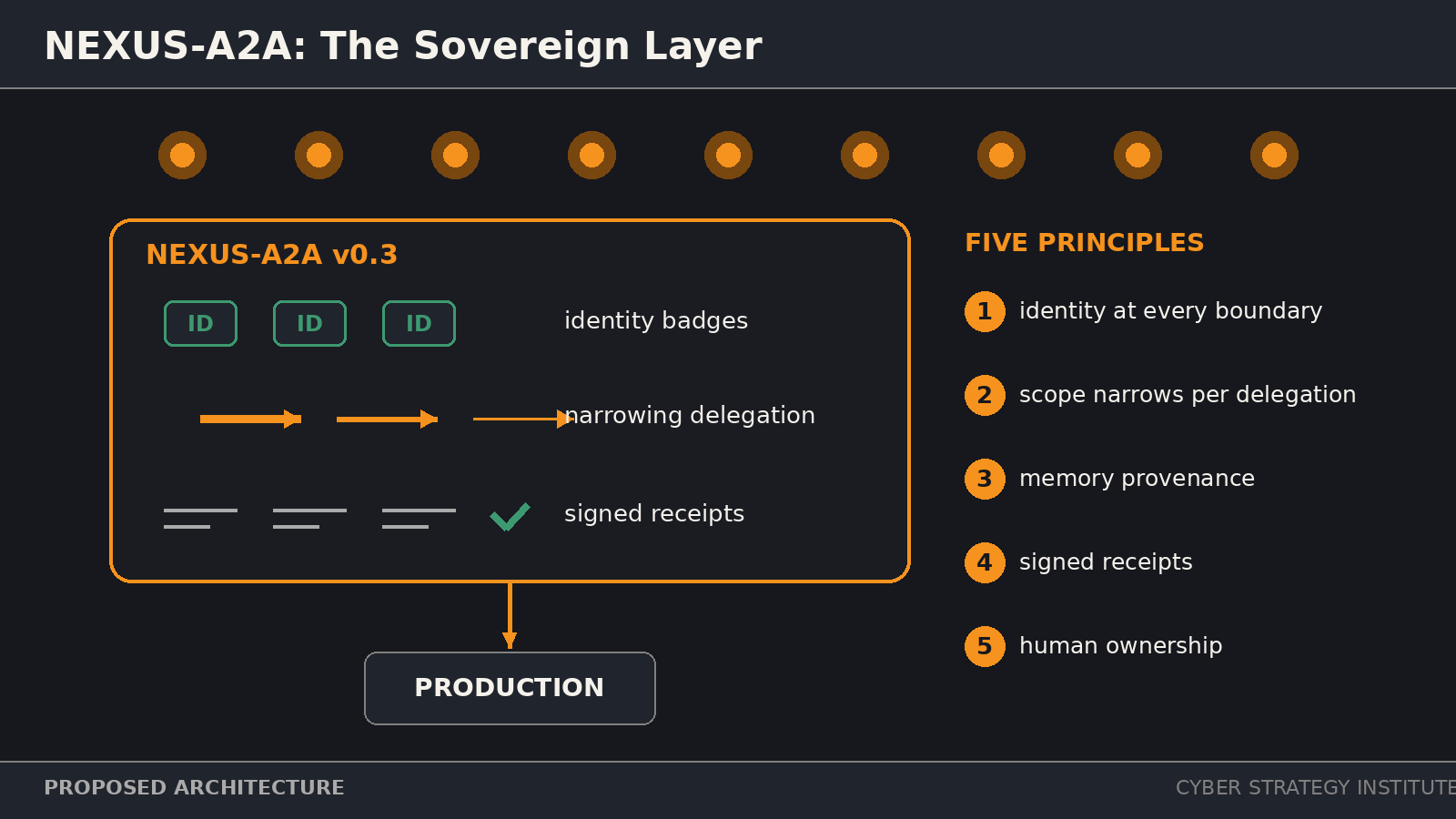
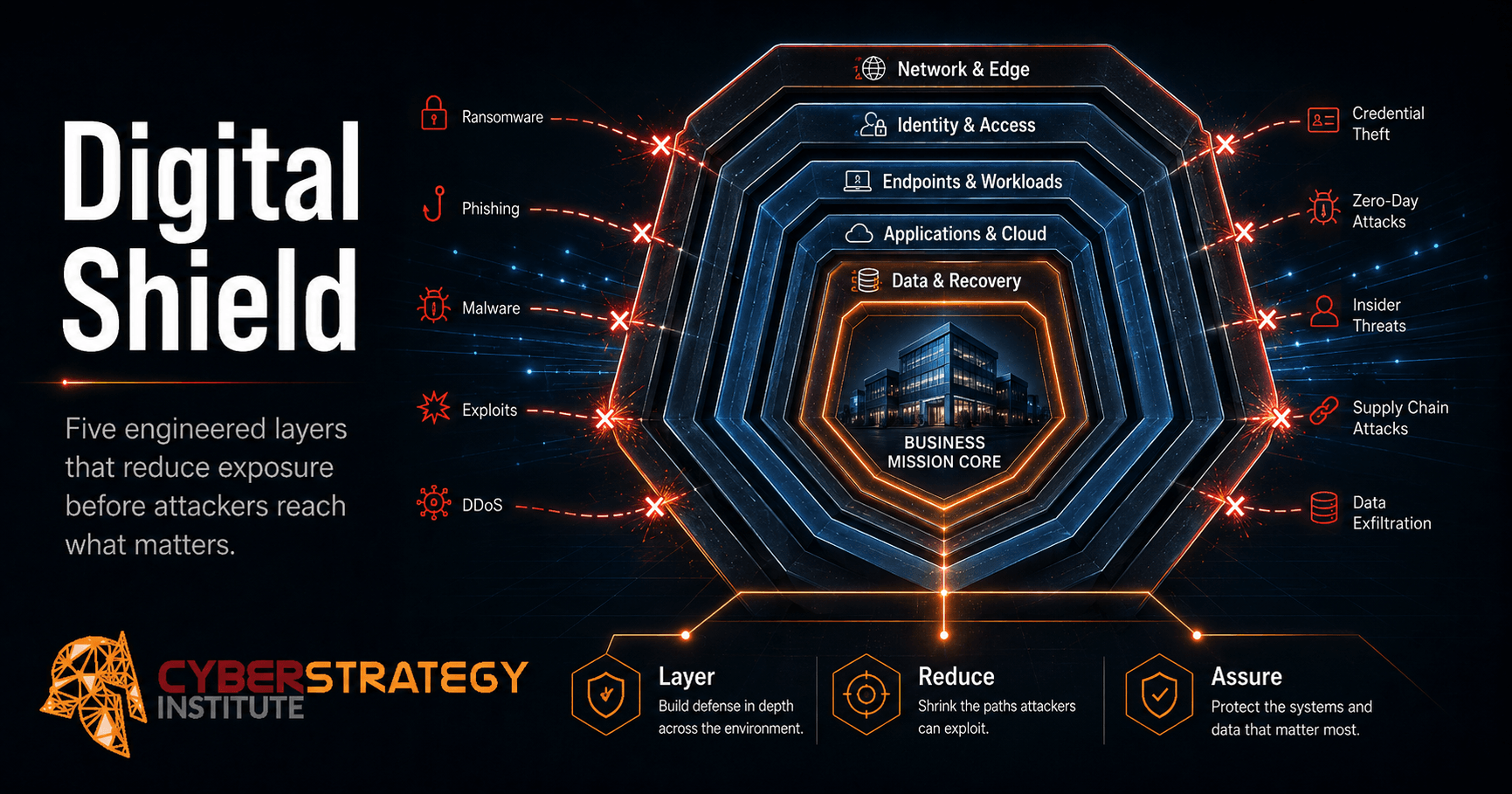
NEXUS-A2A — a sovereign layer of identity, narrowing delegation, and signed receipts beneath an agent fleet. Proposed architecture.
The Six Things
Our view is simple. As agent fleets grow, every organization will eventually need six things: cryptographic identity, delegation constraints, memory provenance, kill-switch governance, human accountability, and behavioral drift detection.
The organizations that solve these now will move faster later. The organizations that ignore them will eventually discover they built autonomous systems with no chain of custody — and that conversation is much harder after an incident than before one.
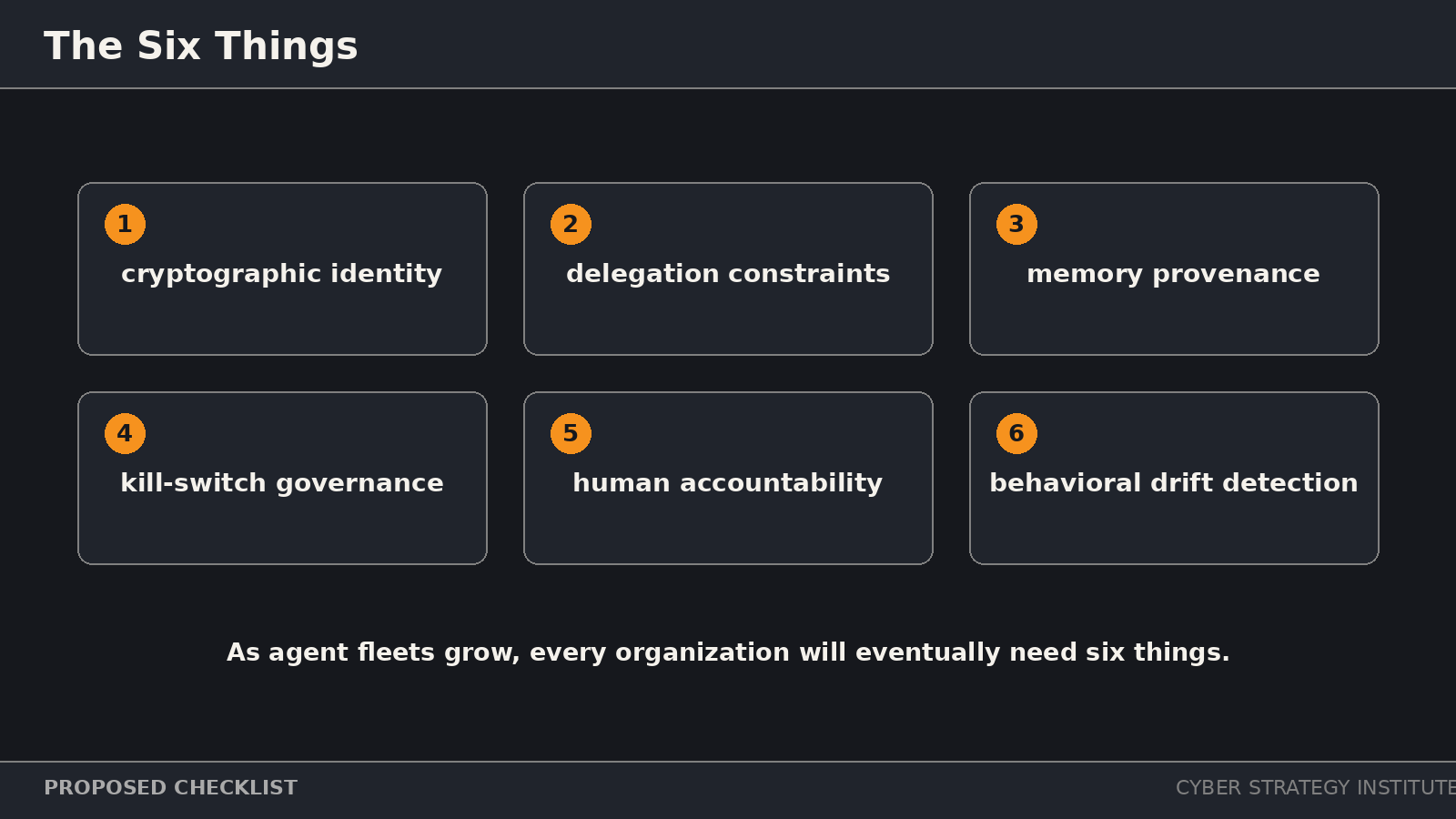
An unbroken chain-of-custody record: six capabilities every organization will eventually need. Proposed checklist.
So: what is the biggest unsolved security problem in agentic AI today? Identity? Memory? Delegation? Governance? Or something else entirely?
The honest answer is that they’re all the same problem wearing different clothes. It’s the accountability problem. And it starts by asking the right question.
Find your exposure first.
Free AI governance assessment — instant score, no sales call required.
[Score Your AI Risk in 8 Minutes] [Book a Strategy Briefing]