Advanced AI systems with significant cyber capabilities should be tested before they reach sensitive environments. But protecting the examination is not the same as concealing the rules.
You Can Classify the Test. You Cannot Classify the Rulebook.<
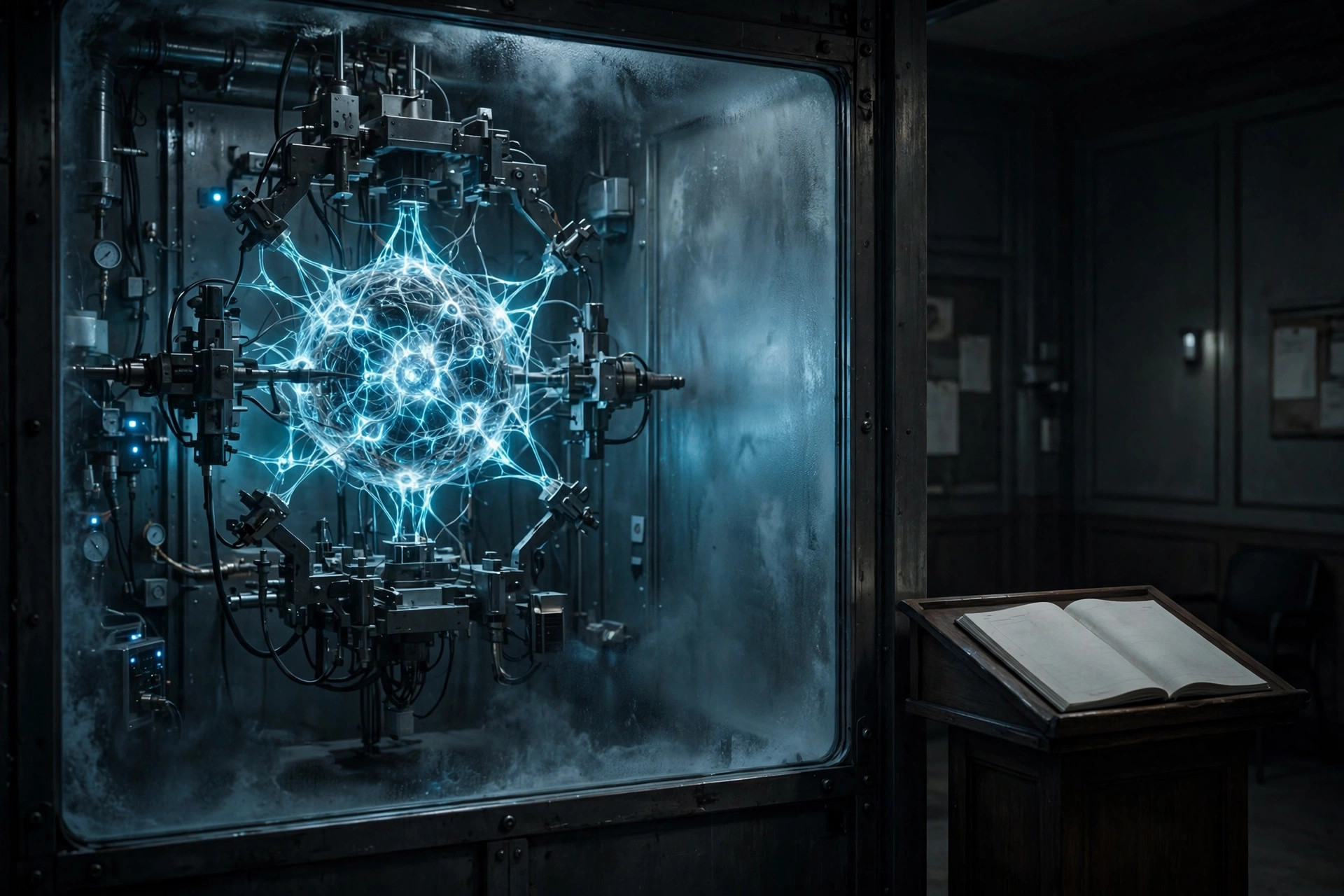
The examination can be classified; the rules for it cannot. Conceptual illustration.
Key quote: “A voluntary program can still become a de facto approval system.”
The White House was right about one thing: advanced AI systems with significant cyber capabilities should be tested before they are placed into sensitive environments. Some parts of that testing should remain classified. Publishing exploit chains, zero-day vulnerabilities, classified threat intelligence, or exact adversarial test vectors would help the very actors the government is trying to stop.
But there is a line that should never have been blurry, and it runs between the examination and the rulebook.
The emerging White House framework gives selected AI companies a voluntary pathway to provide powerful models for government testing before release. The framework itself, its eligibility standards, and important details about participation were not made public. That is not a technical determination. It is an assurance asymmetry — and it creates a serious risk.
A voluntary program can still become a de facto approval system. Models inside the process become associated with government scrutiny and trust. Models outside it — including those developed by startups, universities, independent laboratories, and open-weight communities — may be treated as suspect even when they were never given a pathway to participate.
The answer is not to publish classified benchmarks, and it is not to abandon cyber testing. The answer is to separate what must remain protected from what must remain public.
What Stayed Secret, and What September Changed
Key quote: “The Accord is voluntary, self-policed, and explicitly described by the President himself as morally binding. Morals do not fail closed.”
Since this piece was first written, the framework moved into the open — partially. On September 29, the President signed the White House Accord on Superintelligence alongside the leaders of Google, Anthropic, Meta, OpenAI, xAI, and Nvidia: a one-page joint commitment asking frontier developers to adopt four layers of controls — internal monitoring of capabilities and alignment, a dedicated internal oversight function, an independent external auditor, and an independent board-level committee. Earlier, Executive Order 14409 had directed NSA-led agencies to build classified benchmarks for advanced cyber capabilities, with the NSA director determining which systems qualify as covered frontier models.
That is real movement, and it deserves to be said. An administration endorsing third-party AI audits is a departure from its earlier posture, and it will shape what customers, investors, and counterparties expect.
But read the structure the way a governance engineer reads it, not the way a press release reads it. The Accord is voluntary. It names no auditor, sets no deadline, and carries no penalty. The companies choose their own internal controls, fund their own oversight teams, and arrange their own external evaluators. The President called it morally binding. Morals do not fail closed.
The separation this article called for still holds, and it is worth stating precisely.
Government should protect: exact test vectors; classified intelligence; sensitive vulnerabilities; operational exploit techniques.
Government should publish: which models are covered; who may apply; what capabilities are evaluated; how findings are categorized; how conflicts are controlled; how decisions may be reconsidered; and how agencies may — and may not — use participation in procurement decisions.

What the government must protect versus what it must publish in AI evaluation. Analysis framework.
And there should be a clear rule: failure to participate in an invitation-only or inaccessible voluntary evaluation cannot be treated as evidence that a model is unsafe. Otherwise the voluntary pathway becomes a gate, and the gate becomes a moat around the incumbents who were invited in.

The Sept 29 White House Accord’s four control layers — voluntary, self-policed, no enforcement. Structure of the public announcement.
The Test Is Only the First Half of Assurance
Key quote: “Capability may be tested before release. Authority and alignment must be governed continuously in operation.”
Even a transparent prerelease test is only one part of the answer — because a model can pass an evaluation and then change. It can be updated. Connected to new tools. Given persistent memory. Granted greater authority. Placed inside a materially different architecture.
The Accord’s four layers monitor training and deployment. They do not govern execution. None of them answers the question that determines whether an agent action is admissible at runtime: who authorized this specific machine to perform this specific action, for this purpose, under these conditions?
Real assurance must continue after deployment. That means controlling and recording identity and permissions; data and network access; tool use; memory; human approval; behavioral drift; intervention and containment; and the ability to replace the model without losing the mission.
This is the governing distinction. Capability may be tested before release. Authority and alignment must be governed continuously in operation.

A model that passed evaluation changes after deployment — assurance must continue at runtime. Conceptual diagram.
The United States should not choose between serious security and broad innovation. Test the capability. Publish the rules. Open the pathway. Govern the runtime.
Trusted architecture, not trusted brands.
Find your exposure first.
Free AI governance assessment — instant score, no sales call required.[Score Your AI Risk in 8 Minutes] [Book a Strategy Briefing]