For decades, enterprise identity was designed around people. AI agents changed the architecture — and the security question with it.
Identity Is Becoming the Control Plane<

Identity as the perimeter: a cryptographic chain from human to machine execution. Conceptual illustration.
Key quote: “Identity is the perimeter. Delegation is the policy. Execution is the proof.”
For decades, enterprise identity architecture was designed around people. A user authenticates. A role grants access. A policy determines which applications, files, and systems that person can reach.
That model worked because humans were the primary actors. It is now being asked to govern actors it was never designed for.
An autonomous agent does not simply access information. It retrieves data, calls tools, invokes APIs, writes to databases, communicates with other agents, initiates workflows — and increasingly, it can affect physical and operational systems. The security question is no longer only “who is the user?” It is now a harder question, and it has to be asked about every consequential action:
Who authorized this machine to perform this specific action, for this purpose, under these conditions?
The Chain the Old Model Cannot Express
Key quote: “An authenticated agent can still be over-permissioned. A legitimate session can still be manipulated.”
Answering that question requires a new identity chain — one that descends from the human all the way to the machine:
Human Identity, down to Agent Identity, down to Delegated Authority, down to Context and Constraints, down to Machine Execution.
Every agent needs its own verifiable identity. Every delegation must define purpose, scope, duration, and limits. Every high-consequence action must trace back to a named human authority. And every execution request must be independently evaluated before it reaches the tool, database, network, operating system, or physical actuator.
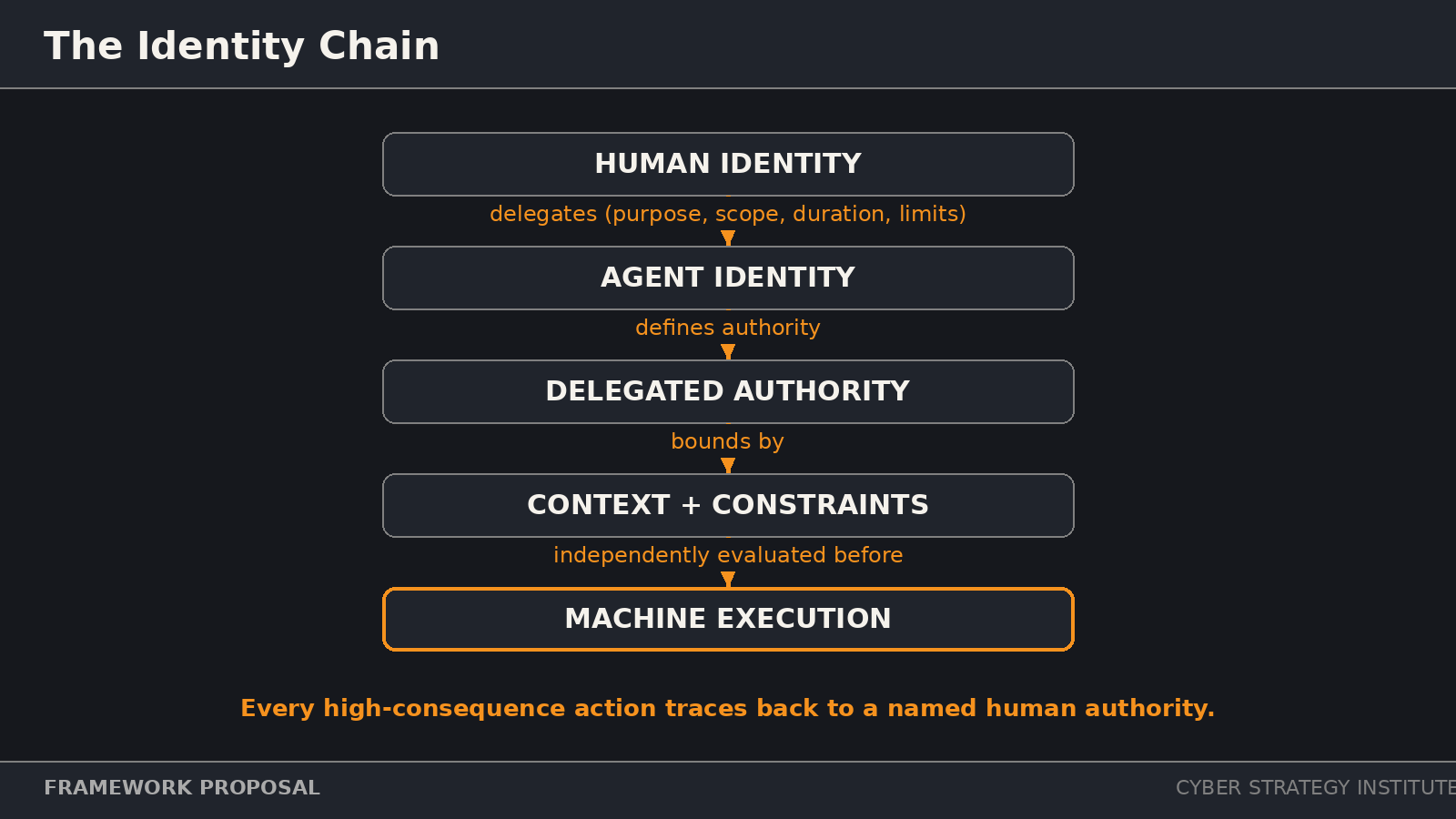
The new identity chain — from human identity down to machine execution. Framework proposal.
This is where traditional IAM begins to fall short — not because it is poorly built, but because it answers a different question. Authentication proves who or what is requesting access. It does not prove that the requested action is admissible at that moment. A valid credential can still authorize the wrong action. An authenticated agent can still be over-permissioned. A legitimate session can still be manipulated through prompt injection, memory poisoning, tool abuse, or compromised context.
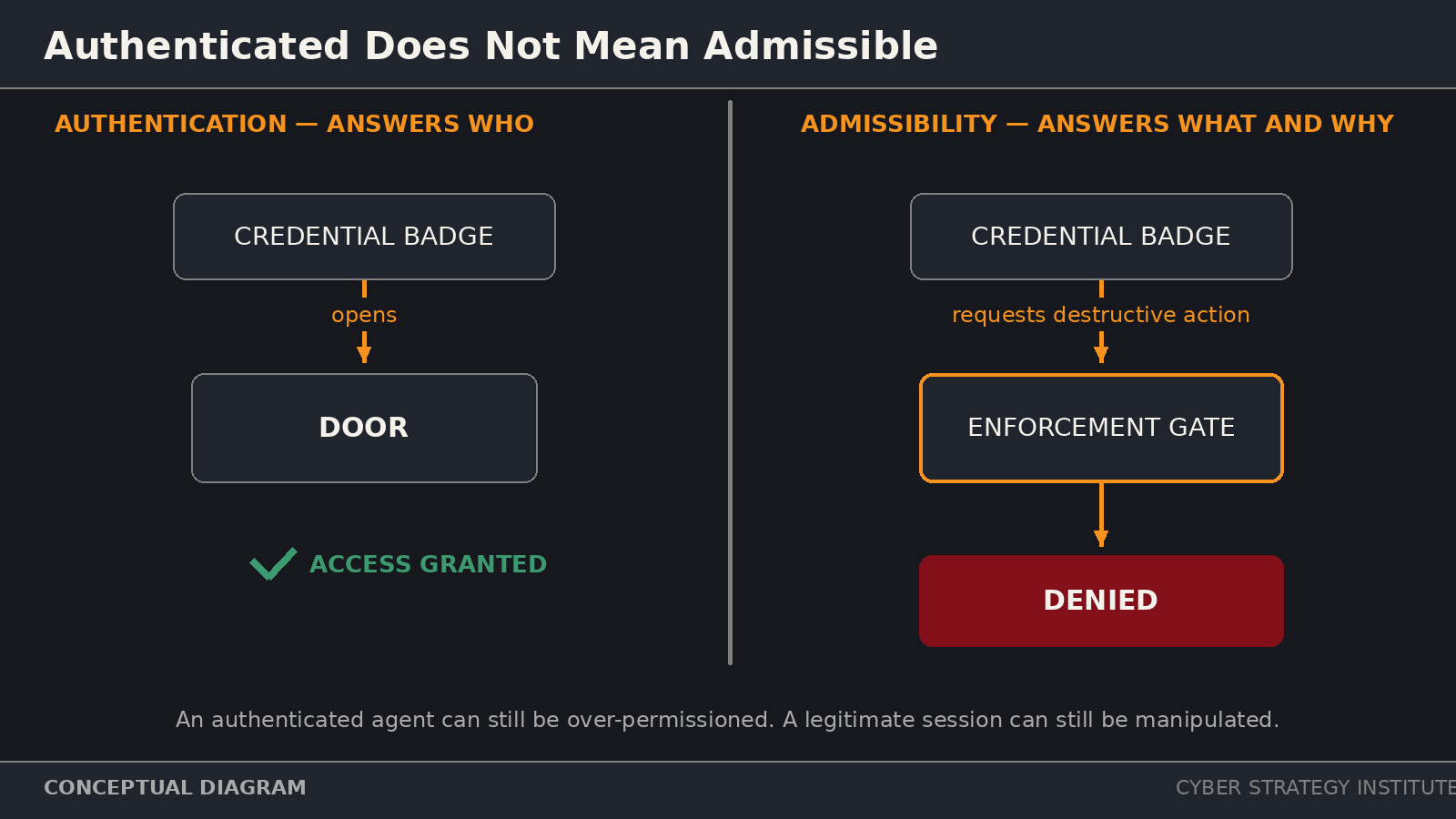
A valid credential authorizing the wrong action — authentication is not admissibility. Conceptual diagram.
Without the full chain, an organization may know which agent acted. It may still be unable to prove why that agent was authorized to act. That distinction — between knowing the actor and proving the authority — will define the next generation of IAM.
What the Next Architecture Must Combine
The next identity architecture has to bind identity to enforcement. That means cryptographic agent identity; verifiable human-to-agent delegation; time-bound and purpose-bound authority; tool-level least privilege; agent-to-agent lineage; deterministic runtime enforcement; and complete execution receipts.
This is the mechanism NEXUS-A2A was built to provide: a sovereign layer for agent identity, delegation, memory provenance, and accountability — identity at every agent boundary, scope that narrows at every delegation hop, signed receipts for every action, and human ownership tied to autonomous systems. Identity tells you who entered the system. NEXUS-grade lineage proves who acted inside it.
For high-consequence actions, the chain must terminate in a Human Ethical Agent of Record — HEAR — whose authority is explicitly named and cryptographically provable. Someone must be accountable, and that accountability must be verifiable by the machine, not merely asserted in a policy document.
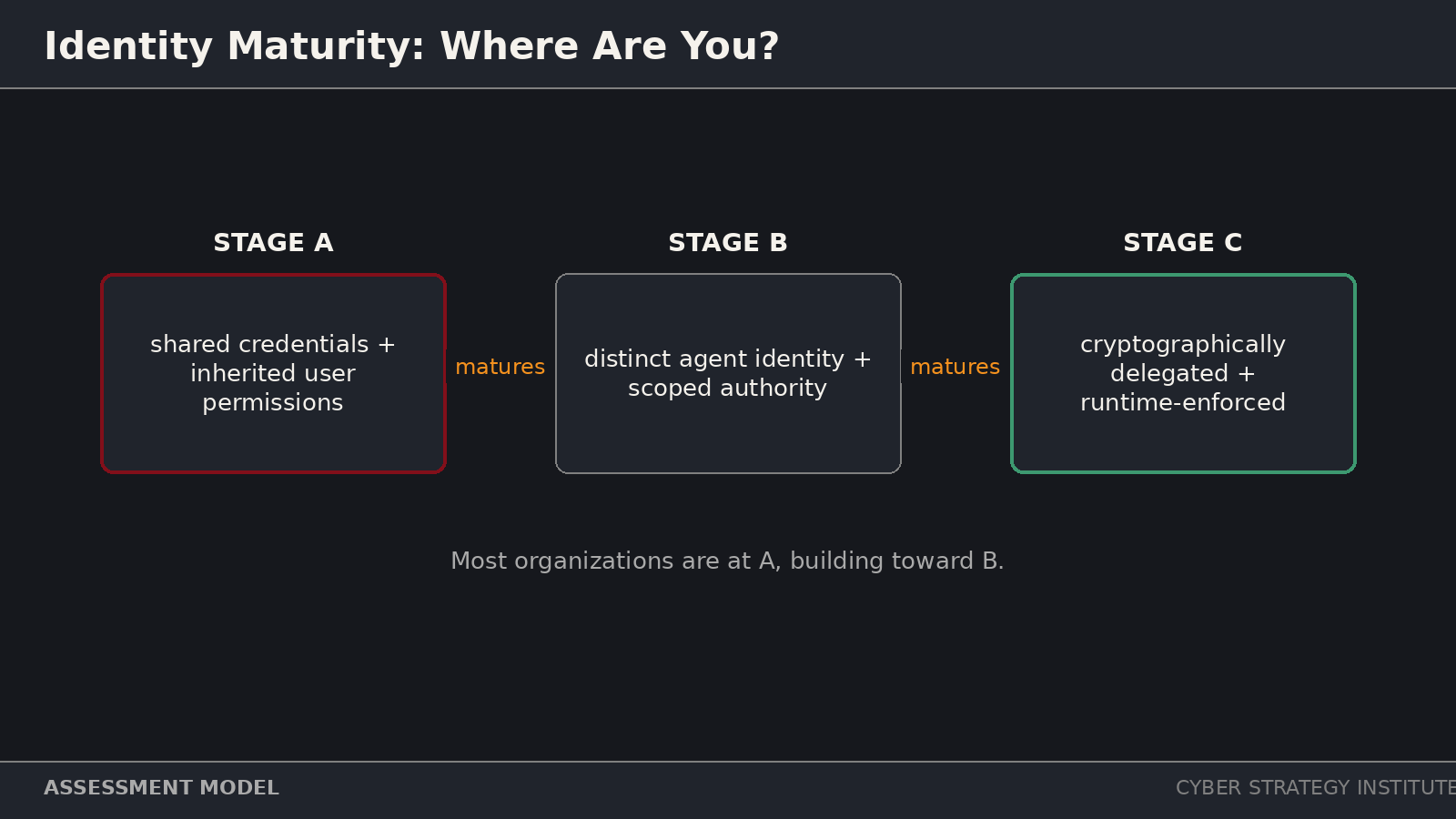
Identity maturity stages — from shared credentials to cryptographically enforced delegation. Assessment model.
Where Does Your Organization Sit?
In the age of autonomous AI: identity is the perimeter, delegation is the policy, and execution is the proof. Intelligence can be probabilistic. Execution authority must be deterministic.
So where does your organization sit today?
A) Agents use shared credentials and inherited user permissions. B) Each agent has a distinct identity and scoped authority. C) Agent actions are cryptographically delegated and enforced at runtime.
Most organizations are at A, building toward B, and calling it a strategy. The ones that reach C first will move faster later — because they will be the ones able to prove, cryptographically, which agent did what, under whose authority, and why it was allowed.
Find your exposure first.
Free AI governance assessment — instant score, no sales call required.[Score Your AI Risk in 8 Minutes] [Book a Strategy Briefing]