
Three November announcements reported crypto losses in the billions. Almost none of that money is back with victims. That gap is the story.
Crypto reporting routinely collapses three realities into one number: what left, what a control stopped, and what victims got back. Different states, different denominators.
The Arcus ledger failed first
On the night of November 9, 2026, a newly created account on Arcus, a perpetuals exchange on Robinhood Chain, moved funds between its own subaccounts and watched its recorded balance inflate far past what it actually held, then withdrew against it. Arcus reported that 2,234,391 USDG left the protocol on chain before withdrawals were paused. The exchange’s November 10 incident report calls the defect an accounting error in subaccount transfers. CertiK, which traced nine BridgeVault payouts, attributes it to an integer underflow. Arcus has not published a full root-cause report or the code.
One control did work. About three minutes in, the bridge’s on-chain rate limit engaged and held back roughly $3 million in further requests, never paid out and later reversed. Arcus then covered the shortfall from its treasury, and stated no other user’s balance, position, or order was affected.
That is a real but narrow containment success. The shared withdrawal budget contained secondary exposure. It did not enforce balance conservation at the authoritative ledger, where the loss actually happened. Treasury coverage is not recovery. It is compensation. The withdrawn USDG stayed with the exploiter. Users were made whole by the company, not by getting the funds back. The dollar figure is approximate: CertiK notes the token count is not an independently valued dollar loss.
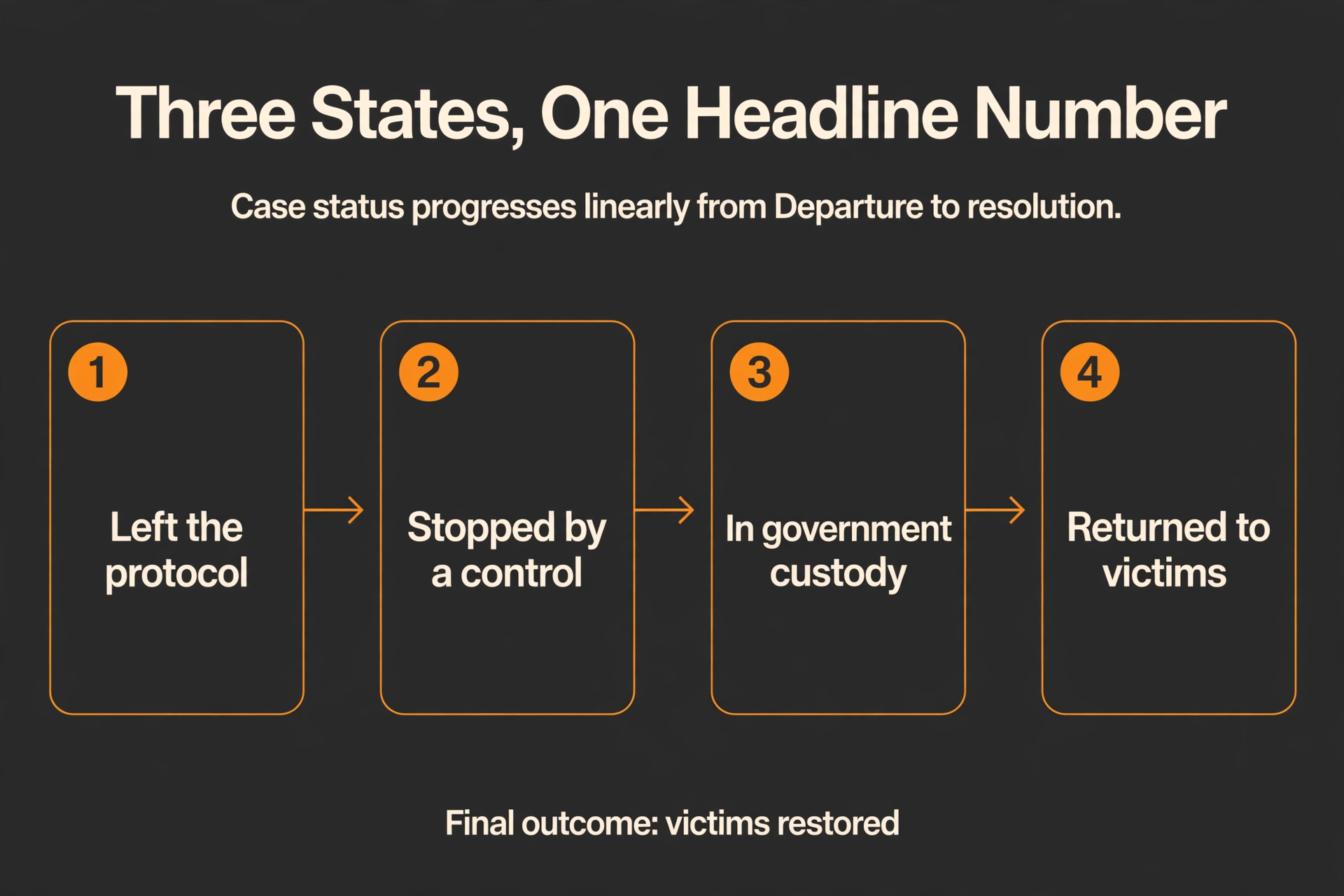
Conceptual diagram. The three recovery states in this article, drawn from the Arcus, DOJ, and Massachusetts cases, November 2026.
Two campaigns, two control surfaces
| Case | What left | What the control did | Recovery state |
|---|---|---|---|
| Arcus, Nov 9-10 | 2,234,391 USDG withdrawn on chain | Bridge rate limit held about $3 million in further requests, all reversed | Shortfall covered from the Arcus treasury; withdrawn funds not recovered |
| FaceStealer, 18 months to Nov 12 | More than $400 million stolen, per DOJ | FBI seized cloud infrastructure and 900+ victim webcam videos | Infrastructure disrupted; no stolen funds recovered |
| Binance theft, Oct 29 | More than $6 billion stolen, per DOJ | Government and private-sector efforts froze more than $2.7 billion | More than $1.2 billion of the frozen total under court authorization; no forfeiture or return announced |
| Massachusetts romance fraud, filed Nov 9 | 456,602 USDT in alleged proceeds | Funds traced to two wallets and seized before the filing | Forfeiture complaint filed; allegations unproven; claims resolved before any return |
On November 12, 2026, the Justice Department announced two separate actions against North Korean crypto theft, and they must never be merged. The first concerned FaceStealer, which the FBI says used surreptitiously recorded video and deepfakes in fake video calls to exploit trusted contacts and target open-source supply-chain personnel. DOJ reported more than $400 million stolen over 18 months. The FBI seized the cloud infrastructure behind it plus more than 900 webcam videos of victims.
Attempted maintainer targeting is a serious scenario for software supply chains. It does not by itself prove downstream package compromise, and no DOJ release here establishes that a package was poisoned or shipped.
The second action concerned the October 29 theft from Binance, attributed by the FBI to North Korean military hackers it calls TraderTraitor. DOJ reported more than $6 billion stolen, more than $2.7 billion frozen by combined government and private-sector efforts, and court authorization to seize or restrain more than $1.2 billion of that frozen total. The $1.2 billion is part of the $2.7 billion, not a further $1.2 billion on top. Adding them would double-count the same money. DOJ did not say how much is seizure and how much is restraint, and announced no completed forfeiture or return timeline. Binance separately stated on November 13 that it had replaced the affected assets using more than $6.34 billion in company resources. Like the Arcus treasury payment, that is the company covering the loss, not the stolen funds coming back.
Custody is not restitution
The smallest case may be the most instructive. On November 9, 2026, the U.S. Attorney’s Office for the District of Massachusetts filed a civil forfeiture complaint for 456,602 USDT, case 26-cv-15037, allegedly the proceeds of romance fraud that began on dating sites and Facebook, moved victims onto fake trading platforms, then demanded unlock fees when victims tried to withdraw. The complaint names two wallets holding about 398,889 USDT and about 57,704 USDT.
The filing is a legal milestone, not a new seizure and not a completed victim payout. The funds were already traced to the two wallets and seized before the complaint was filed. The complaint’s claims are allegations, not proven facts. Civil forfeiture lets third parties assert ownership claims first, and those claims must be resolved before the property can be forfeited and returned. A reader who sees “456,602 USDT” next to “forfeiture” and concludes victims have been repaid has skipped the process in between.
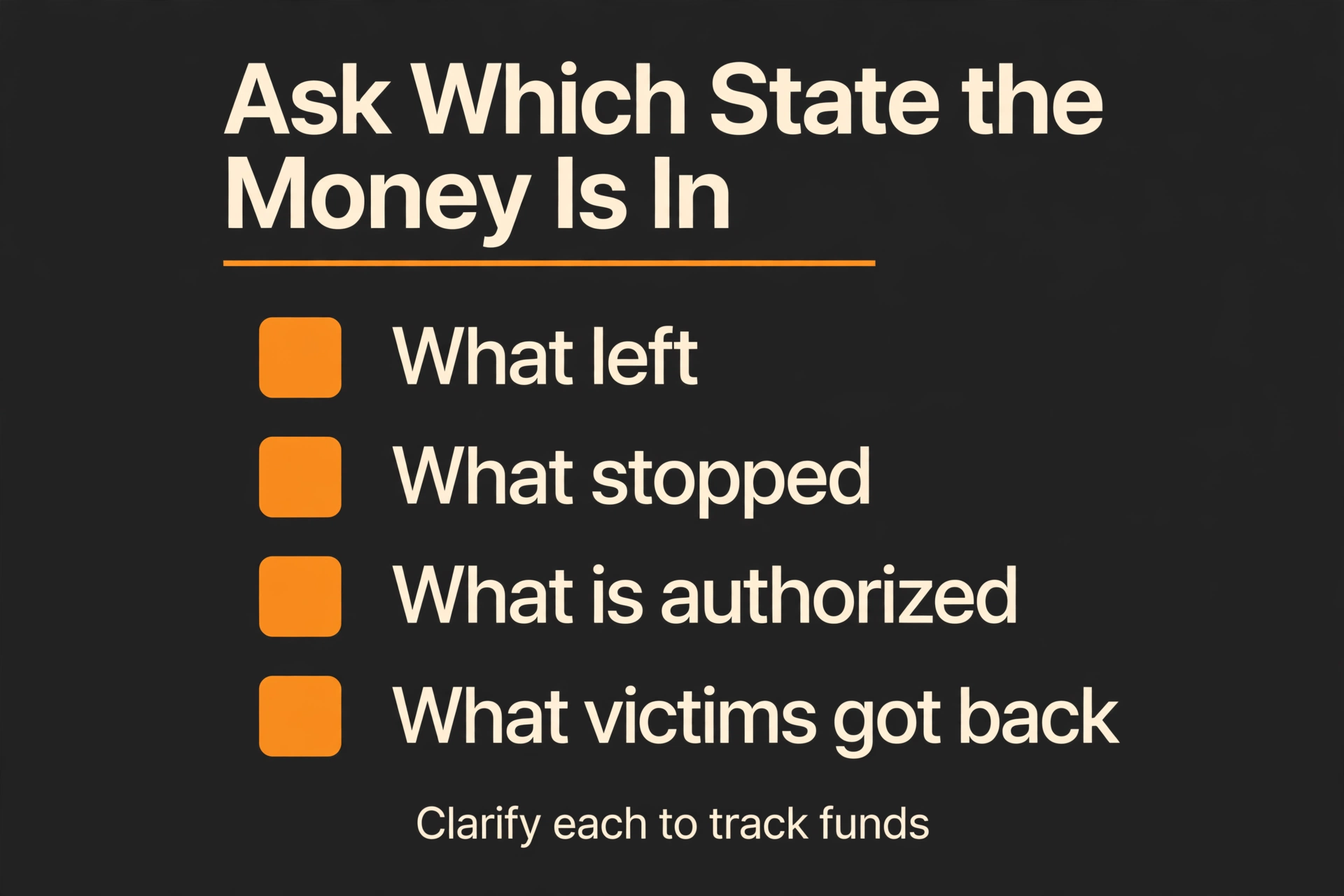
Checklist. Four questions for the next incident report, based on the three cases in this article.
What to record from now on
CRYPTOShield v2.0 gives teams two rules against exactly this confusion. First, keep the Composite Threat Risk Score suspended. The framework suspended the historical CTRS because its multipliers and ranges conflicted, and now asks teams to report qualitative severity alongside evidence quality instead of one blended number. A blended score hides the distinction this article is about.
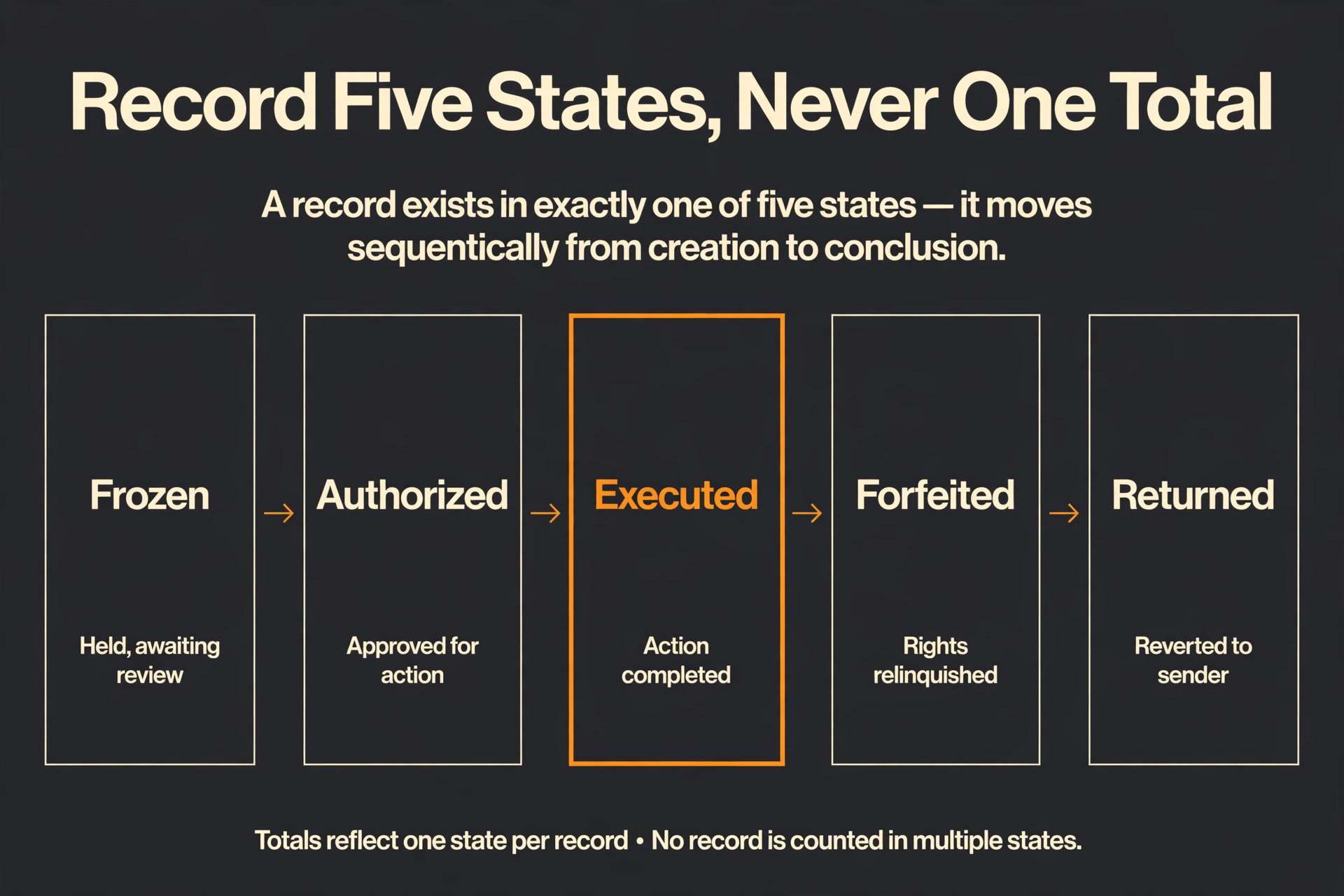
Proposed record layout. CRYPTOShield v2.0 recovery-state fields, each with its own date and denominator.
Second, track recovery states as separate fields, each with its own date and denominator. Frozen, seizure or restraint authorized, executed, forfeited, and returned to victims are five fields. A frozen total and an authorized total can overlap, as the Binance numbers show. A treasury payment is none of those fields; it belongs in its own column, labeled compensation.
The test for the next incident report is simple: how much left, what did the control stop, what legal state is the money in, and what have victims actually got back? Answer only the first and it has reported a loss. Answer all four and it has reported an incident.
Sources
- Arcus incident report, November 10, 2026, via Crypto Briefing, CryptoCompass, and dev.to summaries. CertiK analysis of the nine BridgeVault payouts.
- U.S. Department of Justice, Office of Public Affairs, “Justice Department Announces Actions to Disrupt North Korea’s Massive Theft of Cryptocurrency,” November 12, 2026.
- U.S. Attorney’s Office, District of Massachusetts, civil forfeiture complaint, case 26-cv-15037, November 9, 2026.
- CRYPTOShield v2.0 framework controls CS-DFI-05, CS-SOC-04/05, CS-FRD-01, OCM-11, WKS-12, CFD-02/04/07.



