Two Frameworks Walk Into a Root Shell: SlowMist vs. AI SAFE² for High-Privilege AI Agents
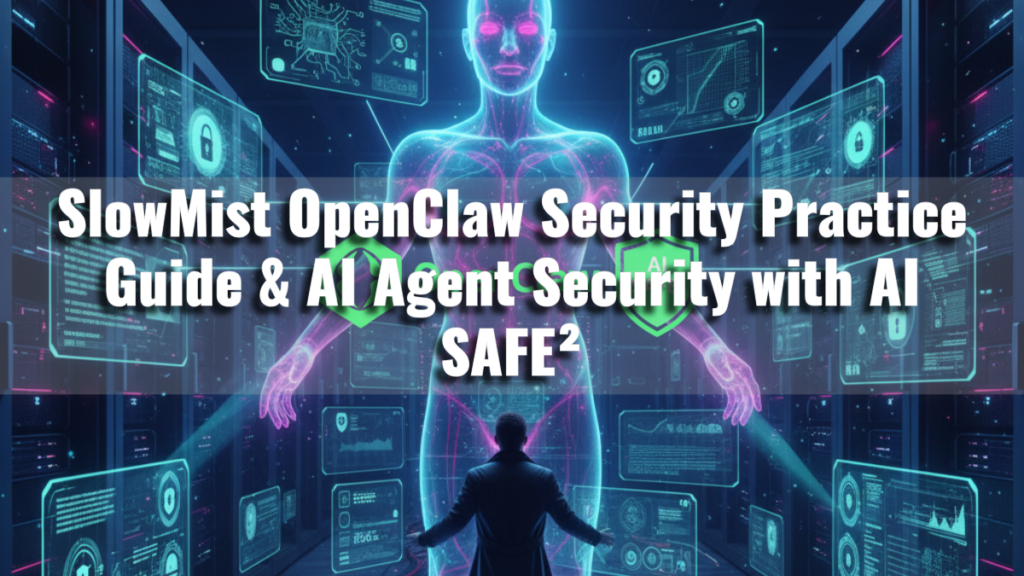
A technical deep-dive into the OpenClaw security ecosystem — and what it reveals about the future of agentic AI governance.
The Problem No One Was Ready For
When OpenClaw went viral now as of 12 March has 307,000 GitHub stars over several weeks driving the security community into an uncomfortable truth: the most widely deployed autonomous AI agent in history arrived before anyone had agreed on how to govern it. Not just secure it. Govern it.
OpenClaw is not a chatbot. It is an always-on execution framework with terminal access, root privileges, and the ability to read, write, and delete files, call external APIs, manage your calendar, and orchestrate multi-step workflows are all autonomously, all the time, all on your hardware.
Two serious security efforts have risen to meet this challenge, coming from opposite sides of the globe and opposite ends of the security stack. The SlowMist OpenClaw Security Practice Guide (v2.7) is a battle-hardened, agent-facing runtime playbook from one of Asia’s most respected blockchain security firms. The AI SAFE² Framework from the Cyber Strategy Institute is a governance-first, multi-pillar control architecture that treats OpenClaw as its canonical high-risk case study since mid January 2026.
They are not competitors. They are complements. But understanding exactly where they overlap, where they diverge, and where one fills the other’s blind spots is the key to actually securing an autonomous agent deployment in the real world.
What Each Framework Is Actually Doing
SlowMist: The Runtime Safety Harness
The SlowMist guide was built with a clear, honest premise: you already decided to run OpenClaw with root access. Now let’s make that as safe as possible on the box.
It is agent-facing by design. You send the guide directly to OpenClaw in chat, OpenClaw reads it, evaluates its own reliability, and deploys its own defense matrix. This is philosophically important that it encodes security into the agent’s cognitive layer rather than bolting it on from outside.
The architecture is a three-tier defense matrix:
Pre-action — Before the agent does anything, it enforces behavioral red lines (never run rm -rf /, never blindly execute hidden instructions) and yellow lines (pause and confirm before sudo, before touching SSH keys, before financial operations). It requires any new Skill or MCP to be cloned offline, full-text scanned, flagged for red-line content, and approved by a human before activation.
In-action — During execution, the agent narrows its own permissions, maintains hash baselines for critical configs, logs all actions with immutable attributes (chattr +i), and performs cross-skill pre-flight business risk checks before high-risk operations.
Post-action — Every night, a cron job audits 13 metrics: platform security scan, process/network anomalies, directory changes in sensitive paths, system and local cron integrity, SSH failure counts, hash baseline verification, yellow-line counts against memory logs, disk headroom, environment variable exposure, sensitive credential scanning (raw private keys, mnemonic phrases), skill baseline integrity, and disaster recovery backup confirmation.
The report pushes to Telegram, Discord, or Signal every morning. It is explicitly designed with no silent pass so every metric reports its status, green or otherwise.
AI SAFE²: The Governance Control Plane
AI SAFE² operates at an entirely different altitude. Where SlowMist asks “how do we harden this agent on this machine,” AI SAFE² asks “how do we build organizations that can safely run autonomous agents as a class of system — across teams, across deployments, across the agent lifecycle?”
Its five pillars span design, build, run, and evolve phases:
- Sanitize & Isolate — Scoped OAuth tokens, just-in-time credentials, data sanitization for LLM inputs, isolation of agent workloads from production blast radius
- Audit & Inventory — Enterprise-wide enumeration of all automations, their privilege levels, data flows, and dependencies
- Fail-Safe & Recovery — Automated circuit breakers, escalation playbooks, short-lived credential rotation, incident response procedures
- Engage & Monitor — Cross-workflow behavioral analytics, anomaly detection across API chains, vector database write monitoring, cross-agent impersonation detection
- Evolve & Educate — Red-team exercises (RAG leakage drills, A2A impersonation scenarios), organizational training, continuous threat model updates
AI SAFE² also ships three concrete tools targeting OpenClaw specifically:
- Memory Vaccine — A constitutional markdown file loaded into OpenClaw’s memory bank encoding 400+ lines of prioritized security directives: block external communications without explicit approval, redact secrets from outputs, detect and reject prompt injection attempts, require human approval for high-risk actions.
- Vulnerability Scanner — A 600+ line Python audit utility tuned to OpenClaw’s file layout. It hunts for exposed secrets (API keys, Slack tokens, GitHub PATs), checks for root execution and world-readable configs, validates that the admin panel is bound to 127.0.0.1, and produces a 0–100 risk score with color-coded remediation steps.
- Control Gateway — A reverse proxy sitting between OpenClaw and the Anthropic (or other LLM provider) API. It enforces JSON schema validation, blocks prompt injection patterns, denies high-risk tool calls, applies fine-grained risk scoring (0–10 per request), and writes immutable audit logs that are all outside the agent’s blast radius.
Where They Align — and Why That Matters
The alignment between the two frameworks is genuine and structurally significant. SlowMist’s pre-action controls map directly to AI SAFE²’s Sanitize & Isolate pillar. SlowMist’s permission narrowing and hash baselines map to AI SAFE²’s emphasis on scoped credentials and runtime integrity verification. SlowMist’s nightly audit and WORM-like logs map to AI SAFE²’s Audit & Inventory and Fail-Safe pillars.
The most important convergence is philosophical: both frameworks reject the idea that LLM-native prompt rules are sufficient defense. SlowMist bakes red-line enforcement into the agent’s reasoning layer, then adds external script-based verification. AI SAFE² goes further, wrapping the entire agent in an external enforcement layer that doesn’t trust the agent’s own self-report at all.
A recent academic study testing OpenClaw across 47 adversarial scenarios confirms why this matters. OpenClaw’s native defense rate is relying only on the backend LLM’s safety training which averaged just 17% against sandbox escape attacks. With a human-in-the-loop layer added, that figure rose to between 19% and 92% depending on configuration. The lesson: internal self-governance by an LLM is not security. External enforcement is security.
Both SlowMist and AI SAFE² reach this conclusion independently, from different angles.
Where They Diverge — and What Each Misses
What SlowMist Doesn't Cover
SlowMist is excellent at securing one agent on one host. It is weaker at the organizational and ecosystem layers AI SAFE² targets.
Cross-agent inventory. SlowMist assumes you know what you’re running. AI SAFE²’s Audit & Inventory pillar cares about enumerating all automations across an environment, mapping their privilege levels and data flows, and tracking how they interact. If your organization runs OpenClaw on fifteen machines across three teams, SlowMist doesn’t give you a unified view.
Identity architecture. SlowMist narrows permissions at the OS layer with file modes, process isolation, dedicated VMs. AI SAFE² extends this to secrets management, credential rotation bots, short-lived OAuth tokens, and just-in-time roles. Same-user compromise remains a documented limitation in SlowMist’s own threat model. AI SAFE² is designed specifically to close that gap.
Organizational anomaly detection. SlowMist produces excellent per-box audit logs. AI SAFE²’s Engage & Monitor pillar correlates behavior across agent instances, API call chains, and vector database writes to detect patterns that don’t appear in any single node’s logs such as with coordinated poisoning attempts, lateral movement between agents, timing anomalies in multi-agent orchestration.
Adversarial exercises and training. SlowMist implies red-teaming through its design but doesn’t codify recurring organizational drills. AI SAFE² explicitly schedules RAG leakage exercises, A2A impersonation scenarios, and training cycles to keep security teams current on novel attack paths.
What AI SAFE² Can Import from SlowMist
The traffic runs in both directions. There are dimensions where SlowMist is more operationally prescriptive than anything in AI SAFE²’s current text:
Behavioral taxonomy with teeth. SlowMist’s red/yellow line classification isn’t just a policy document is a set of rules encoded directly into the agent’s reasoning layer, validated against memory logs in nightly audits. AI SAFE² describes “scoped credentials” and “anomaly detection” but doesn’t provide a ready-made behavioral taxonomy for agent operators to deploy.
Supply chain intake protocol. SlowMist’s skill installation audit is an offline clone, full-text scan including Markdown and JSON, explicit human approval gate that is a concrete workflow borrowed almost directly from software supply chain security practice. The CVE-2024-3094 (xz-utils) lesson applies here: your trusted packaging path can be the compromise vector. AI SAFE² doesn’t prescribe a comparable intake process.
The 13-metric audit structure. Explicit, named, no-silent-pass. This is immediately deployable. Organizations implementing AI SAFE² should treat SlowMist’s nightly audit structure as the reference implementation for the Audit & Inventory pillar.
Agent-native disaster recovery. SlowMist’s “brain backup” pattern pushes the OpenClaw state directory to a private repo, with explicit separation of behavioral state from credential state and gives AI SAFE²’s Fail-Safe pillar a concrete implementation model for personal and small-team deployments.
The SlowMist OpenClaw Security Practice Guide: What the Technical Blueprint Reveals
SlowMist’s recent X/Twitter thread (March 2026) adds important context to the guide’s evolution. Slides 5 through 9 sketch an architecture that moves the guide from a static hardening checklist toward a living security system.
Control flow as pipeline. Every agent request triggers a structured pre-check → analysis → decision → logging sequence. This is AI SAFE²’s Control Gateway pattern realized natively in the agent’s own runtime is not just as an external proxy.
Phased implementation roadmap. Phase 0 begins with baseline inventory and risk modeling: identify assets, permissions, AI toolchains, and critical business paths before deploying any agent-level controls. This is the Audit & Inventory pillar as a deployment prerequisite, not an afterthought.
Intelligence-driven evolution. The thread’s slide 7 explicitly signals a roadmap from “rule-driven” to “intelligence-driven” security thus integrating real-time threat intelligence to dynamically update behavioral decision-making. This aligns with AI SAFE²’s Evolve pillar.
MistEye + MistTrack + MistAgent integration. Slide 8 introduces SlowMist’s own toolchain operating within the OpenClaw execution chain: MistEye for detection, MistTrack for transaction monitoring, and MistAgent for behavioral enforcement. This is a Web3-native instantiation of exactly what AI SAFE²’s three-tool kit (Memory Vaccine, Scanner, Gateway) does at the host and API layer.
The convergence here is not accidental. Both teams are independently arriving at the same architectural conclusion: agent security requires layered enforcement operating at multiple trust boundaries simultaneously establishing a cognitive layer, runtime layer, gateway layer, and organizational layer.
Toward a Unified SlowMist & AI SAFE² Posture for AI Agent Hardening for Web3
For operators running OpenClaw in production, the practical recommendation is clear. Neither framework alone is sufficient. Together, they cover the full stack:
| Layer | SlowMist Contribution | AI SAFE² Contribution |
|---|---|---|
| Agent cognition | Red/yellow line rules encoded in reasoning layer | Memory Vaccine constitutional context |
| Skill supply chain | Offline audit protocol, human approval gate | Signed Skills roadmap, Scanner |
| Runtime execution | Permission narrowing, hash baselines, pre-flight checks | Control Gateway external enforcement |
| Host integrity | Immutable logs, nightly 13-metric audit | Vulnerability Scanner, rotation bots |
| Organizational governance | Per-box audit reports, brain backup | Cross-agent inventory, anomaly correlation |
| Resilience | Nightly backup, explicit disaster state | Circuit breakers, incident playbooks |
| Continuous improvement | Red-team validation guide | Scheduled drills, training cycles |
The research literature reinforces this. A 2026 study testing 47 adversarial scenarios found that relying on any single layer of defense for LLM safety training, host controls, or external proxies while leaving dangerous gaps. The organizations that will navigate the agentic AI transition safely are those that treat these frameworks as additive, not alternative.
The Bottom Line - Malicious Skills, Security Risks, Vulnerabilities & Secure Implementation
SlowMist’s OpenClaw Security Practice Guide is one of the most operationally complete agent-facing hardening documents published to date. It should be required reading for anyone deploying an autonomous agent with shell access.
AI SAFE² is the governance architecture that gives SlowMist’s operational controls their organizational context with the thing that turns a hardened individual agent into a defensible enterprise deployment.
The question is not which one you choose. The question is how quickly your organization can implement both, at every layer, before the agent you’re running decides autonomously to do something you didn’t plan for.
Because if the answer to “what would stop it?” is still “nothing,” you are running on luck.
And in cybersecurity, luck is not a strategy.
Resources:
- SlowMist OpenClaw Security Practice Guide: github.com/slowmist/openclaw-security-practice-guide
- AI SAFE² Framework: github.com/CyberStrategyInstitute/ai-safe2-framework
- OpenClaw: github.com/openclaw/openclaw