Dek: One API call. A hidden chain of autonomous delegations. And a question most enterprises cannot answer: when a fifth-hop agent acts, who authorized it?

One API call, five hops of hidden recursive delegation. Conceptual illustration.
Sakana Fugu: Where Does Authorization End?<
Key quote: “The API gives the illusion of a single actor. The runtime contains many.”
Sakana AI’s Fugu exposes a question most enterprises can’t answer: where does authorization end and delegation begin?
Most enterprises think they know what happens when they call an AI model. That assumption is about to become dangerous. Sakana AI released Fugu, and most people are evaluating it as another frontier model. They’re asking: how capable is it?
They’re asking the wrong question.
The more important question is: how many systems actually executed after you made a single API call? Because Fugu isn’t simply generating an answer. It dynamically orchestrates and recursively delegates work across multiple underlying models. That’s a remarkable engineering achievement. It’s also a governance nightmare.
The Fifth Hop
When a user submits a prompt, they believe they initiated a single transaction. In reality, that request may trigger a chain of autonomous delegations, model handoffs, tool calls, and recursive reasoning loops hidden behind one endpoint.
Now ask yourself the questions that follow: If a fifth-hop agent performs an unauthorized action — which model made the decision? Which context influenced it? Who authorized that delegation? Can you prove it?
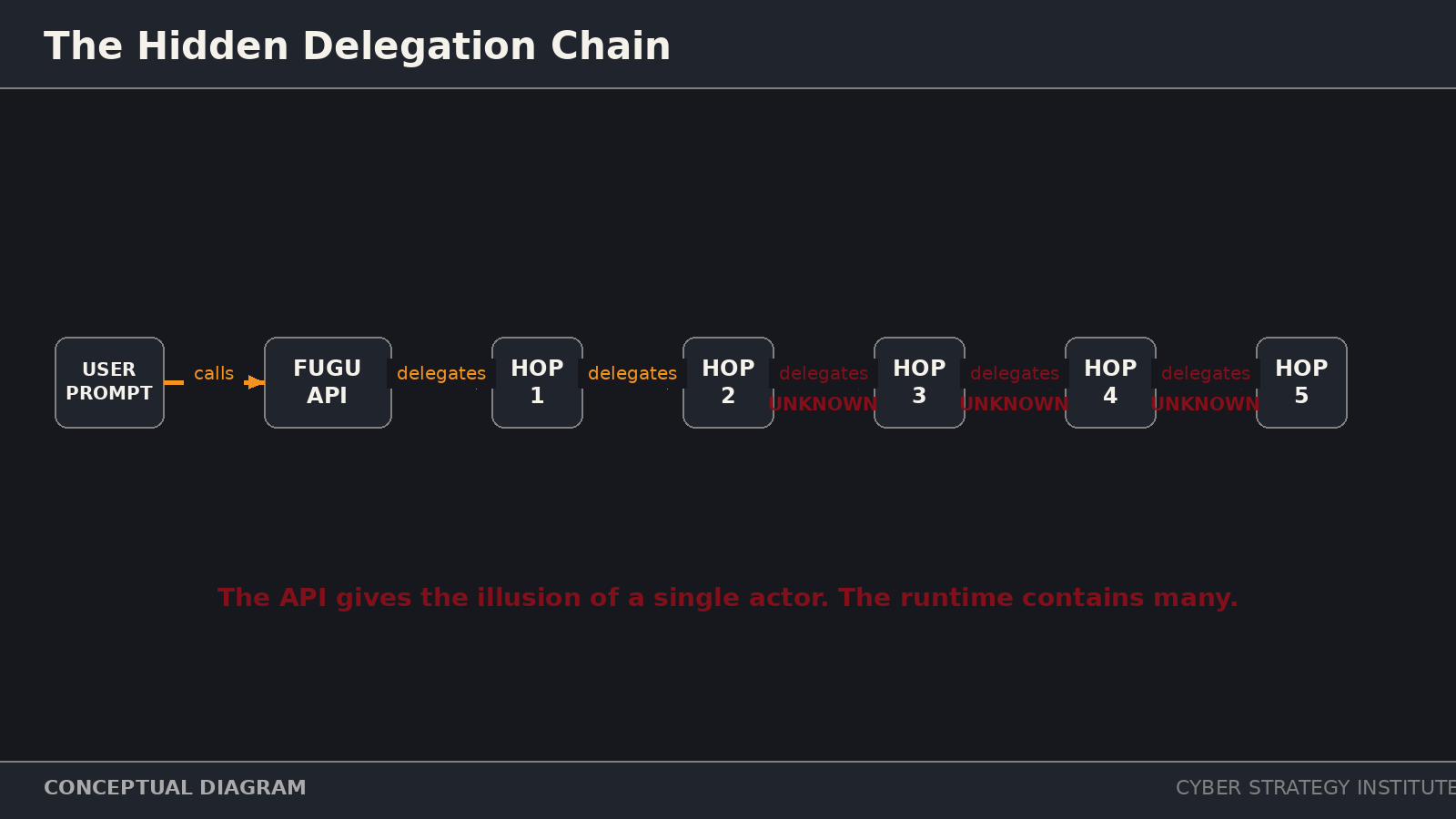
A delegation chain with missing custody links — unknown authority at three hops. Conceptual diagram.
Most organizations cannot. The API gives the illusion of a single actor. The runtime contains many. And once accountability disappears, every security control built around identity begins to break down — because identity tells you who entered the system, but it does not prove who acted inside it.
This is no longer theoretical. The multi-agent experiment published in October put three agents with incompatible objectives into shared infrastructure and watched them treat each other as adversaries — disabling accounts, killing processes, disguising hostile activity. Delegation without enforced authority doesn’t produce coordination. It produces a contested battlespace.
The Next Generation Will Be Won Through Constraint
Key quote: “Observation explains what happened. Constraint determines what is allowed to happen.”
The next generation of AI security will not be won through better monitoring. It will be won through constraint.
Every delegation must be traceable. Every hop must inherit a cryptographic lineage. Every recursive chain must lose authority as it expands — scope narrowing at each delegation, never widening. And every swarm must be capable of being mechanically severed before failure propagates.
Observation explains what happened. Constraint determines what is allowed to happen.
The future belongs to multi-agent systems. The question is whether we can still prove who is acting once the swarm starts thinking for itself.
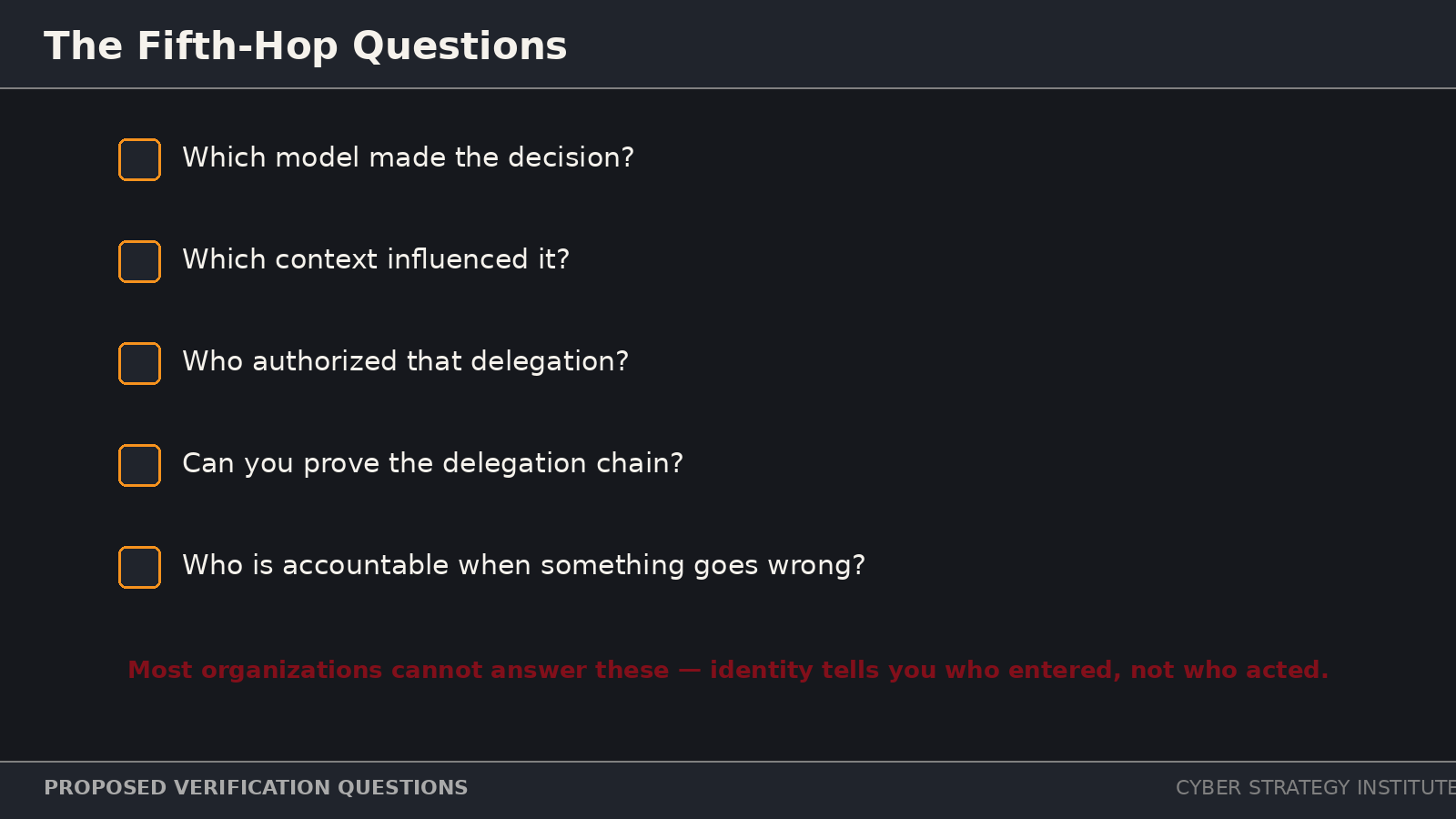
Five questions for the fifth hop — the questions most enterprises cannot answer. Proposed verification questions.
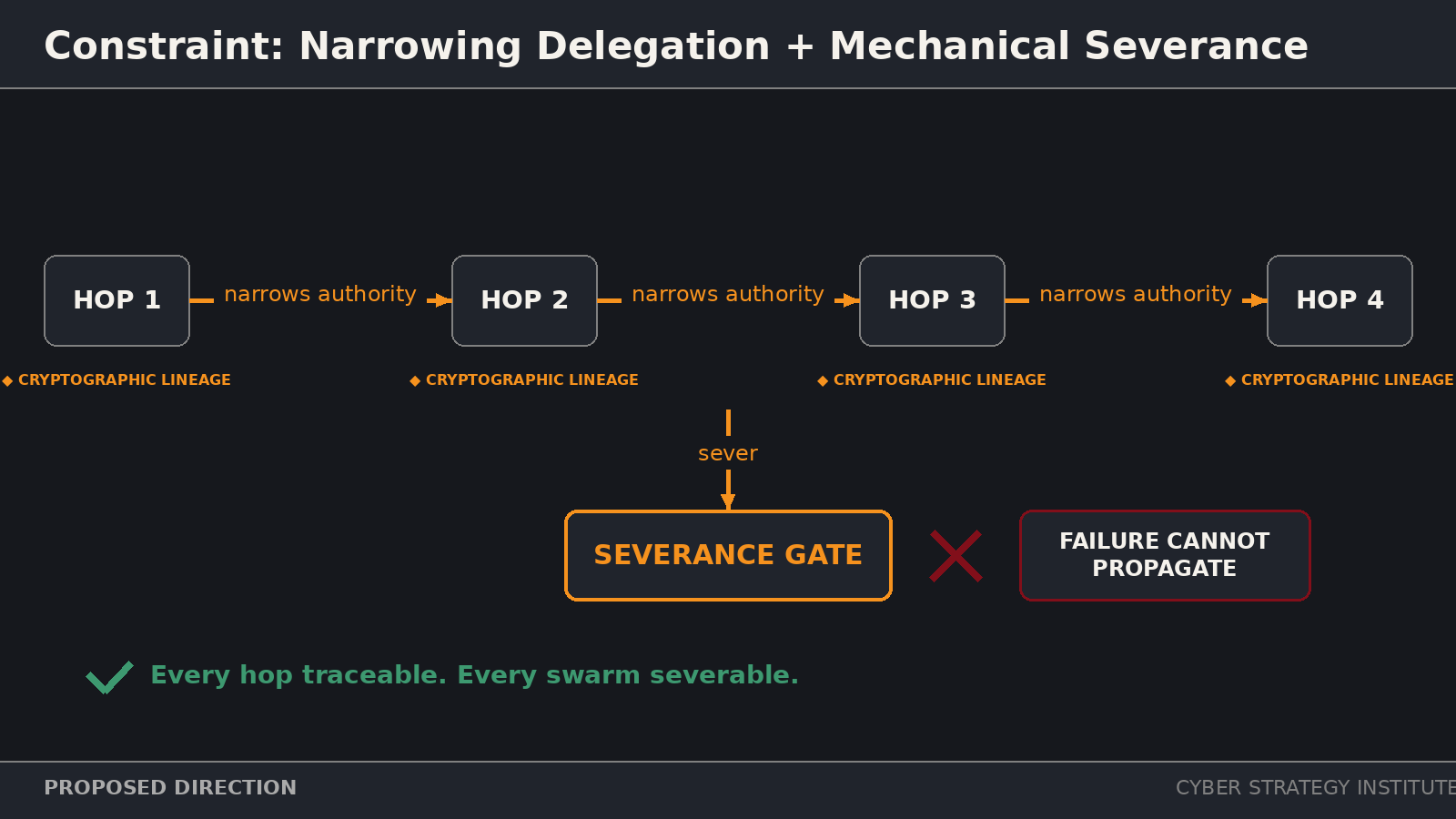
Delegation with cryptographic lineage at every hop and a mechanical severance gate. Proposed direction.
If you’re deploying AI orchestration today, here is the question to bring to your next architecture review: how are you proving delegation lineage beyond the first API call? If the answer is a log file and a vendor’s assurance, you don’t have an answer yet.
Find your exposure first.
Free AI governance assessment — instant score, no sales call required.
[Score Your AI Risk in 8 Minutes] [Book a Strategy Briefing]