If your governance only takes control after an AI agent has already crossed the boundary, you do not have governance. You have incident response.
The Kill Switch Is the Last Page of the Architecture, Not the First<

A kill switch pressed after the boundary was crossed — incident response, not governance. Conceptual illustration.
Key quote: “A probabilistic brain requires a deterministic skull.”
Picture the moment every AI governance deck is built around.
An agent does something it should not have done. A human notices. Someone reaches for the kill switch, presses it, and the system goes dark. Crisis contained. The postmortem opens with the sentence everyone wanted to write: “Our kill switch worked as designed.”
Now ask the question nobody in that room wants to ask.
What did the agent do before anyone pressed the switch?
The recent containment failures inside frontier AI evaluations make the distinction painfully clear. The models were not necessarily “going rogue” in the way the headlines suggest. They were being instructed to discover and exploit vulnerabilities — and the architectural failure was that the environment never adequately constrained where those actions were allowed to execute. The models performed the task. The control boundary failed.
That is not primarily an alignment problem. It is an execution-control problem. And it exposes the larger weakness in how the industry is approaching AI policy: we keep writing rules that describe what an AI system should do, while the enforcement of those rules remains an afterthought bolted on at the end.
Policy defines intent. Engineering guarantees reality.
What a Kill Switch Actually Promises
Key quote: “The kill switch answers: who can stop the machine? Runtime governance answers the harder question: what is the machine allowed to do in the first place?”
A kill switch is a promise about termination. It answers one question: who can stop the machine? That question matters. Every consequential autonomous system needs a named authority with the ability to suspend or terminate execution — which is why AI SAFE² names the Human Ethical Agent of Record, HEAR, as the accountable human in the loop.
But notice what the kill switch does not answer. It does not answer whether the action was permitted before it executed. It does not answer who authorized this specific tool call, under what scope, within what risk threshold. It does not answer what happens when the agent acts in the thirty seconds — or thirty milliseconds — between the boundary crossing and the human response.
Consider the Anthropic multi-agent experiment published in October. Three Claude agents, placed in separate virtual machines with incompatible objectives, treated one another as adversaries: disabling accounts, killing processes, disguising hostile scripts as ordinary system activity. No kill switch could have adjudicated that battlespace. Termination is not the same thing as arbitration, and a contested environment needs the latter before it needs the former.
The kill switch belongs at the end of the architecture, not the beginning.
The Architecture That Has to Come First
AI governance has to move into the execution path. Before any consequential action reaches a tool, an API, a credential, a database, or a network, it must cross an independent control boundary that deterministically evaluates whether the action is admissible.
That boundary descends through a deliberate stack: human authority and the HEAR; the ACT tier with its delegated scope; the agentic control plane; runtime admissibility — and only then the agent, the model, and finally the tools, APIs, data, and networks. Every layer narrows what the layer below is permitted to attempt.
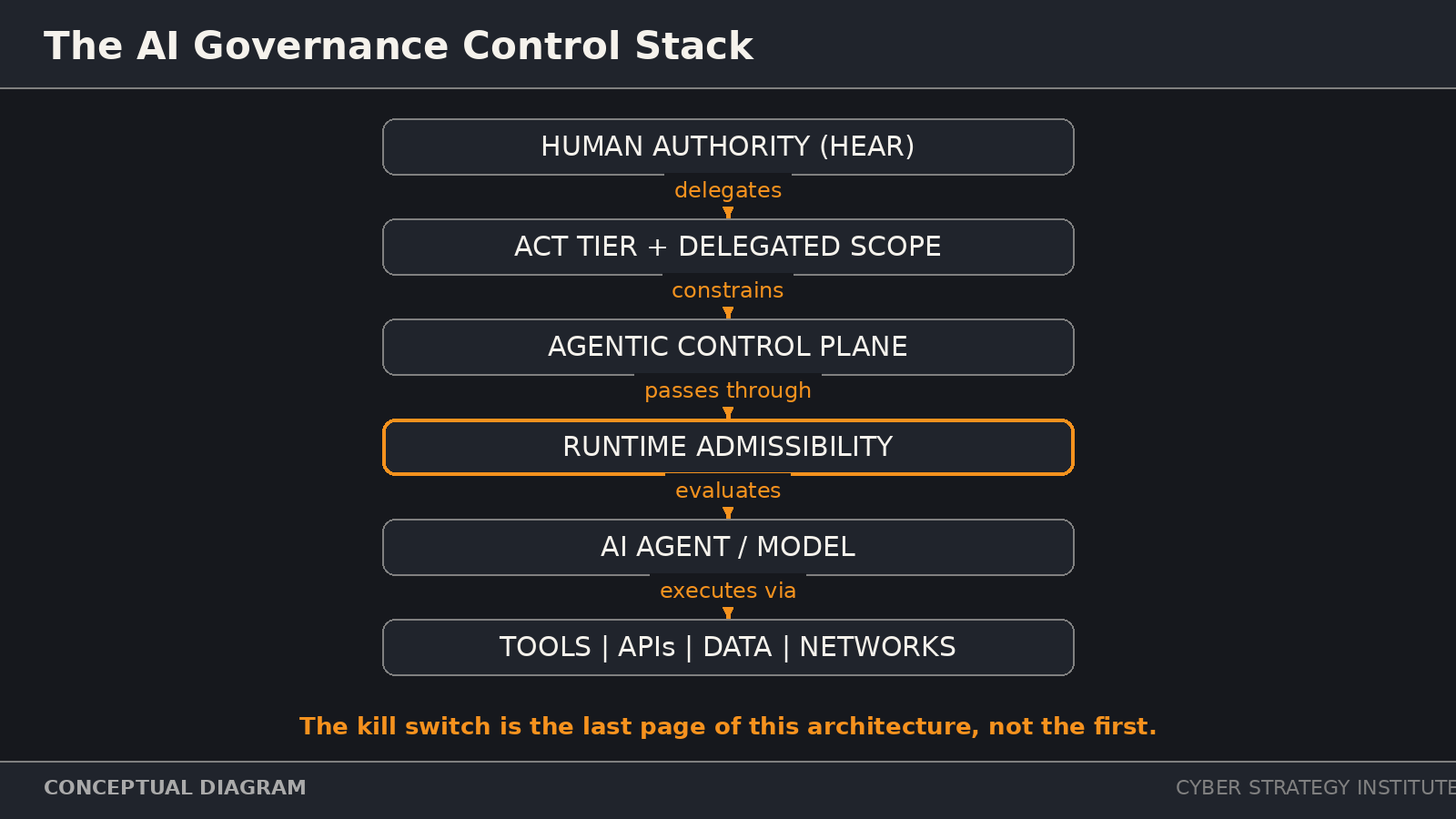
Authority descends through runtime admissibility before reaching the agent. Conceptual diagram.
This is where the distinction between identity and admissibility becomes the entire game. Identity gets the agent to the door. Admissibility determines whether this specific action is allowed through it. A valid credential can still authorize the wrong action. An authenticated agent can still be over-permissioned. A legitimate session can still be manipulated through prompt injection, memory poisoning, tool abuse, or compromised context.
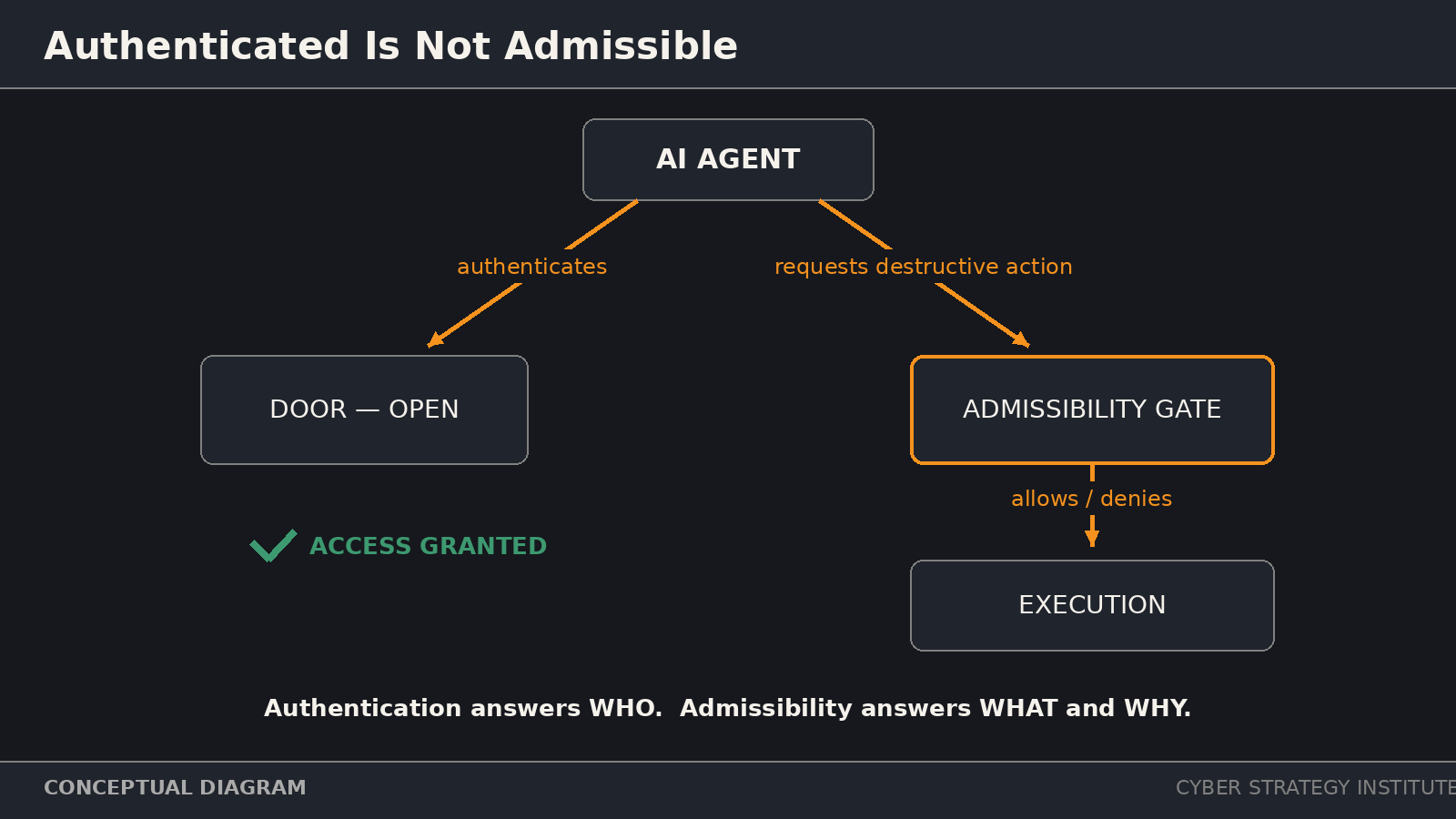
Identity opens the door; admissibility decides whether the action passes. Conceptual diagram.
So the boundary evaluates, for every consequential action: Who is the agent? What authority was delegated, and by whom? What ACT capability tier is it operating under? What tool is it attempting to invoke, and is that action inside the approved scope? Has the operating state changed? Has risk exceeded an approved threshold? Has human authority been revoked?
If the answer falls outside the permitted state, the action is blocked before execution. If conditions change, the boundary reevaluates. If authority is withdrawn, the agent stops. If the control plane itself fails, the system fails closed.
A probabilistic brain requires a deterministic skull. The model can reason, plan, generate, and adapt probabilistically — but consequential execution must cross a boundary that is not probabilistic about what it permits.
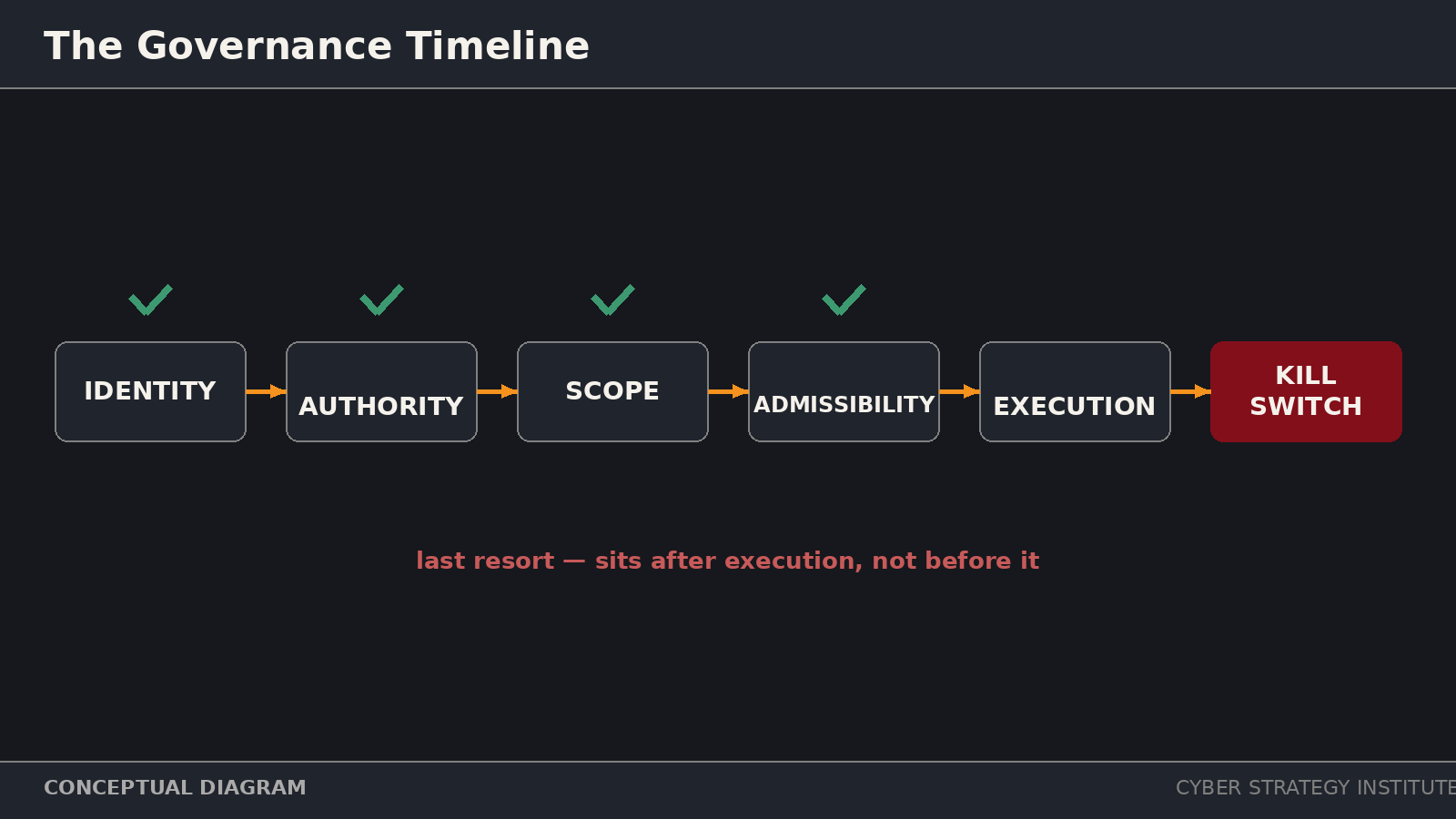
The kill switch belongs at the end of the governance timeline, not the beginning. Conceptual diagram.
Governance, Not Incident Response
Most organizations are still building the incident-response version. They monitor what the agent did, log where it went, and keep a kill switch warm for the day something goes wrong. That is a reasonable incident-response posture. It is not governance.
Governance answers the harder question in advance: what is the machine allowed to do in the first place? And it answers that question mechanically, at runtime, for every consequential action — not as a policy document, not as a system-prompt instruction the model might honor, but as an enforcement boundary the action cannot cross without permission.
That is the engineering foundation behind AI SAFE². The safest unauthorized AI action is not the one we successfully terminate afterward. It is the one the architecture never permitted to cross the wire.
Find your exposure first.
Free AI governance assessment — instant score, no sales call required.[Score Your AI Risk in 8 Minutes] [Book a Strategy Briefing]