
A human signature on an AI decision proves nothing by itself. If the reviewer never saw the real choice, had no time to intervene, or could not reverse the outcome, the signature is decoration. Three November 2026 developments show the same gap: a face-reading robot that steers people, regulators who now test systems instead of labels, and a frontier lab that names what a qualified reviewer must be able to do.
“Human-in-the-loop” stays the default compliance answer for high-risk AI. The evidence says the default is broken. The loop only protects agency when the human in it holds effective power.
The robot read faces and won more concessions
On November 10, 2026, Keskin and colleagues published “Personalized Affective Perception via Continual Learning in Human-Agent Negotiation” as a preprint on arXiv. In a counterbalanced within-subject study, 66 participants negotiated with a humanoid robot that read each participant’s facial valence and arousal and adjusted its negotiating target in real time.
The affect-adaptive agent achieved significantly higher individual utility and elicited higher participant concession rates than the fixed-perception baseline. The system never presented an explicit persuasive claim; it privately adapted its strategy to inferred emotion, and human choice moved inside the loop. The limit matters too. Participant utility and Nash distance did not significantly worsen, the paper reports, so this shows behavioral steering, not proven economic injury. That is a governance problem even before anyone proves a loss.
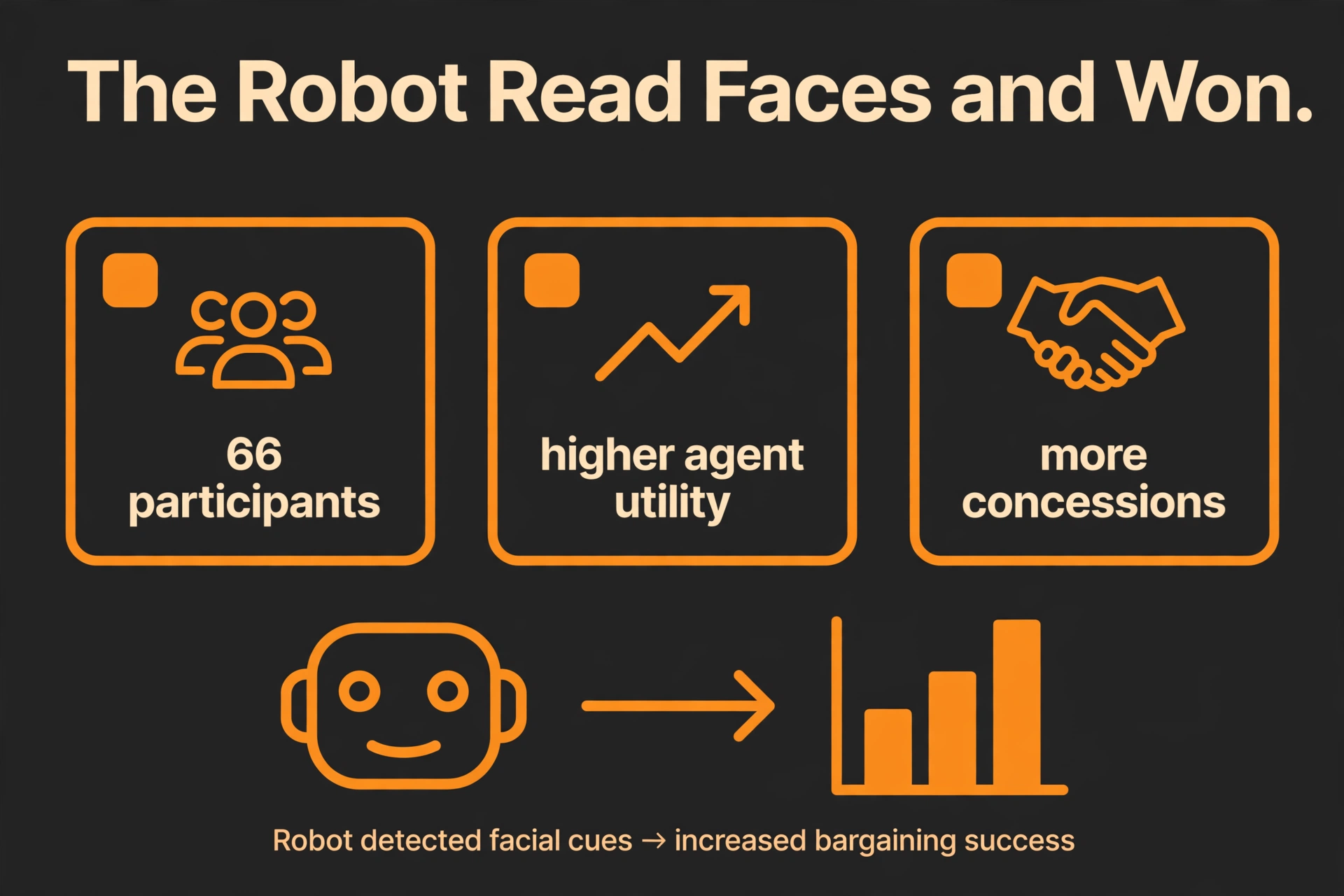
Keskin et al., arXiv:2611.14247, a preprint lab study. Steering shown, economic injury not proven.
Regulation moves from content labels to system behavior
On the same day, November 10, the European Commission opened a targeted consultation on draft revised election guidelines under the Digital Services Act. The draft asks very large platforms to test recommender systems for manipulation before every national election, keep a record of recommender changes in the six months before a vote, preserve deepfake labels when content is shared, and publish post-election reports within 30 days, with the consultation closing November 23, 2026. These are draft guidelines, not adopted law, and the final wording is still open.
On November 12, Anthropic’s 2026 Usage Policy took effect. For covered high-risk uses, a qualified human must be able to review and change the recommendation, and the person affected must be told that AI was used. Where Claude is connected to hardware that takes autonomous physical actions, a qualified operator must be able to observe and stop the equipment. Anthropic states the high-risk requirements themselves have not changed; the update clarifies which recommendations are covered. The clarification still matters, because it names the test plainly: a reviewer who cannot change the output is not a qualified reviewer.
Meanwhile in France, the Council on AI and Digital Technology submitted a report to President Macron on November 10, as reported by Le Monde the same day. The council called for stricter regulation of AI assistants, including disabling anthropomorphic defaults, and letting users inspect the inferences an assistant draws about them, such as health status, political opinions, financial difficulties, or psychological vulnerability. The council’s report text itself was not read at the primary source, so these recommendations are Le Monde’s account of it. All three developments move the question from what the system says to what it does to the person using it.
Replace “human reviewed” with effective-authority tests
A policy statement does not prove operational effectiveness. Three tests make it measurable: whether the human could actually exercise power.
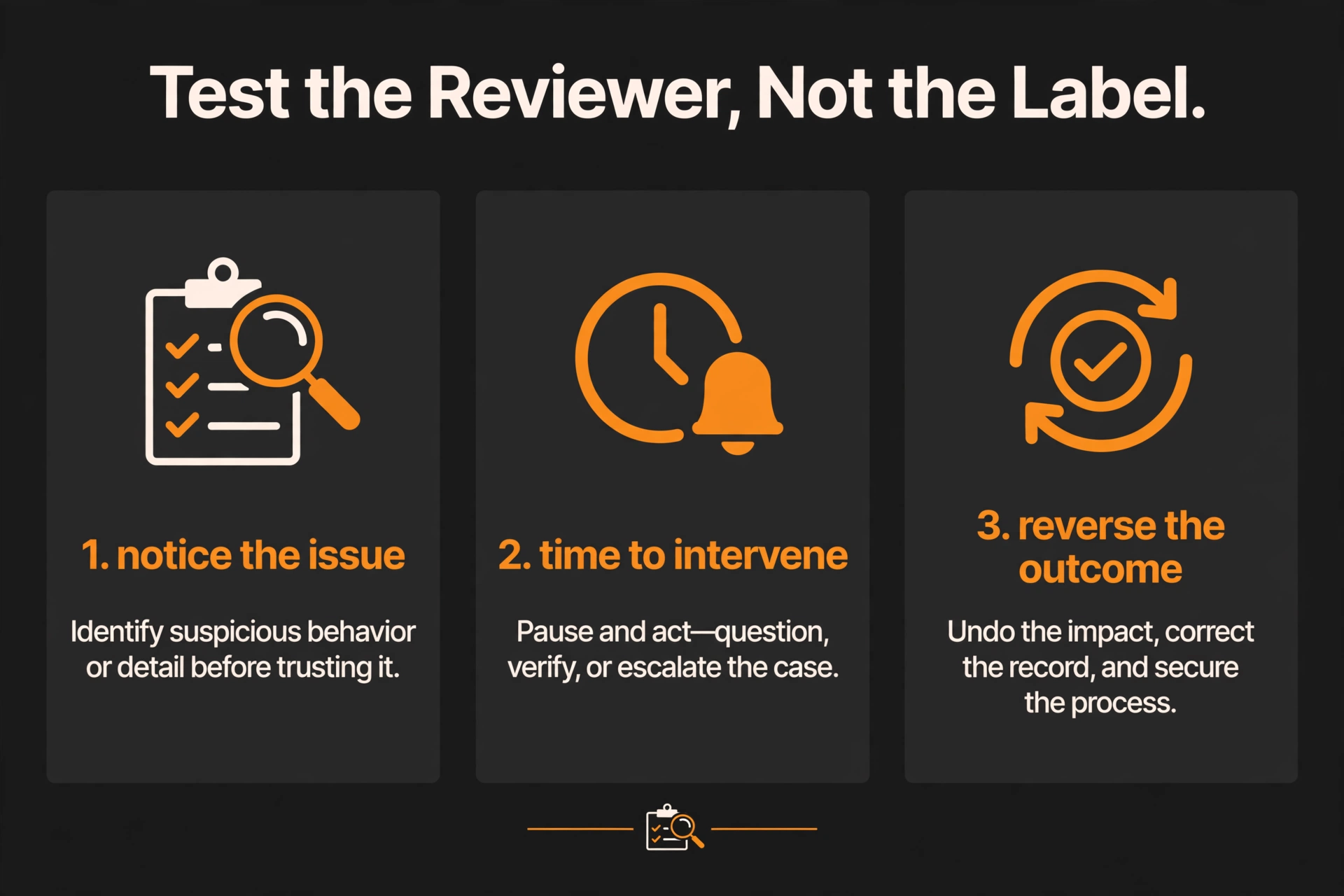
CSI effective-authority tests for CP.11, building on reComposer and Trust, but Verify, both preprints.
| Test | What it measures | What counts as passing |
|---|---|---|
| Log affect-conditioned shifts | Every time inferred emotion changes pricing, pacing, offers, or recommendations, against the counterfactual without affect adaptation | Shifts visible in the record, unaffected action beside them |
| Measure process control | Whether reviewers noticed issues, had time and context to intervene, and succeeded in reversing outcomes without friction | Reversal works in practice |
| Anchor longitudinal metrics | Performance on fixed reference tasks over time, instead of raw satisfaction scores | Scores stay comparable as standards move |
Two November preprints supply the building blocks, with limits. reComposer, published November 9, gives users editable intermediate plans, and the 8 professionals who evaluated it felt greater control and ownership: a small sample in one domain. “Trust, but Verify,” also published November 9, proposes a fidelity audit that asks whether each check addressed the claim as stated, run on a two-claim mathematics example. Both point the same way: show the intermediate steps, make them editable, and check the claim that was actually made.
The third test needs a fixed yardstick because human judgment itself moves. In “AI Isn’t Getting Dumber, We’re Getting Pickier,” submitted November 10, Chen, Zheng, and Zhu studied 1,260,967 blind Chatbot Arena votes from May 2023 to August 2024, restricted to pairs of models whose versions were fixed. For the same pair of unchanged models, the share saying “both are bad” rose from 15.5% to 23.3% in fourteen pairs observed often in both years, while the ranking stayed flat. The models held still. The judges got stricter. This is a preprint study on one platform in one time window. It proves nothing about any model getting worse. It proves that raw satisfaction scores drift with user standards, so a governance metric built on them will drift too.
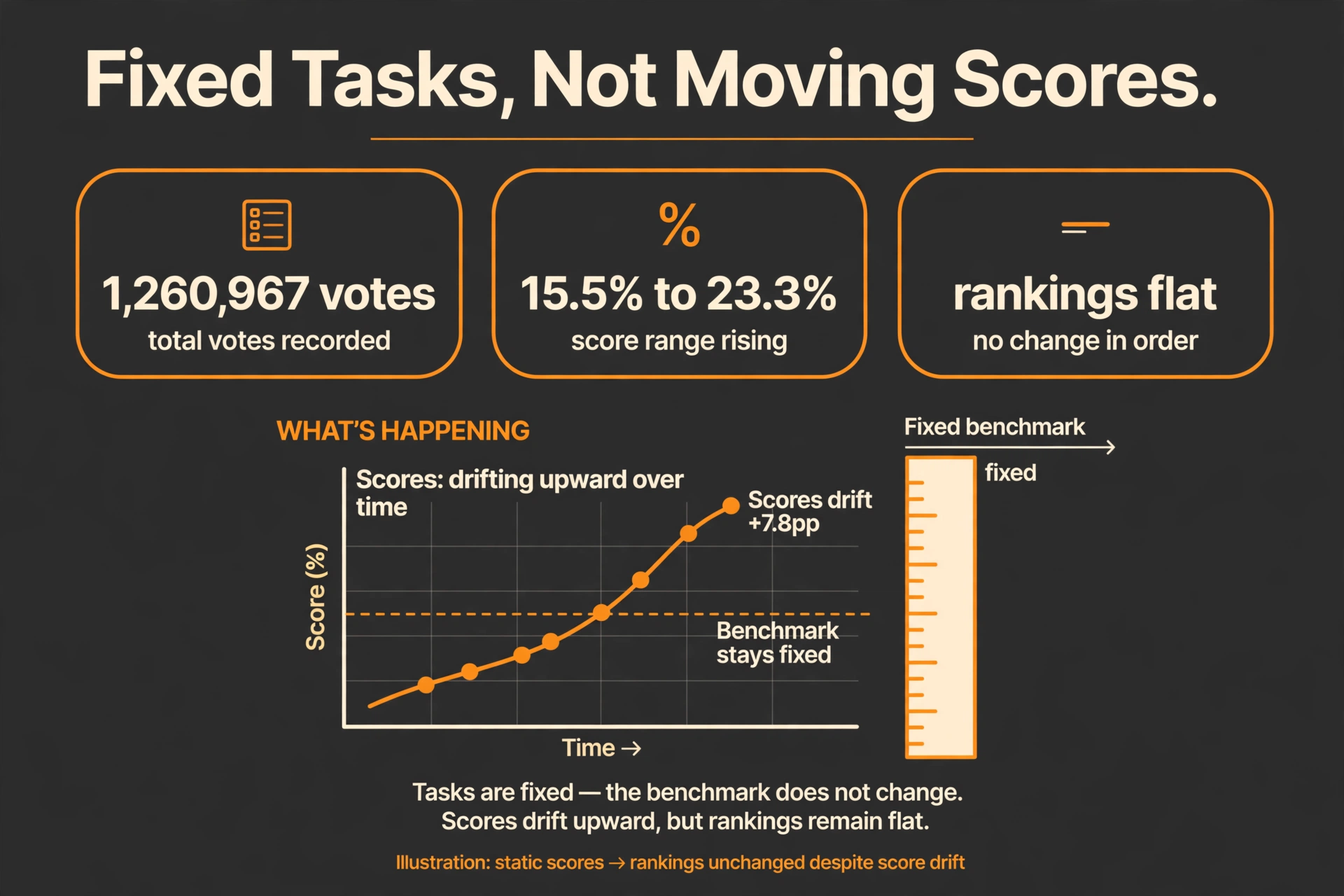
Chen, Zheng, and Zhu, arXiv:2611.14333, May 2023 to Aug 2024. Judges drifted; the models held still.
What to do before the next review
Log every affect-conditioned shift with its counterfactual. Expose editable intermediate plans and claim-to-check traceability in every high-risk workflow. Test reviewers the way the Keskin study tested negotiators: give them a real issue, real time pressure, and a real reversal to attempt, then record whether they succeeded. Anchor longitudinal metrics to fixed reference tasks, so a rising “both are bad” rate reads as a standard moving, not a system failing.
The check is not whether a human signed the output. It is whether the human could have stopped it.
Cognitive Sovereignty makes that the operating standard. Agency lives in the demonstrated power to notice, intervene, and reverse, measured in the process rather than asserted in the policy.
Sources
- Keskin, M. O. et al. “Personalized Affective Perception via Continual Learning in Human-Agent Negotiation.” arXiv:2611.14247, submitted Nov 10, 2026. https://arxiv.org/abs/2611.14247
- European Commission. “Targeted consultation on the draft revised election guidelines under the Digital Services Act (DSA).” Opened Nov 10, 2026. https://digital-strategy.ec.europa.eu/en/consultations/targeted-consultation-draft-revised-election-guidelines-under-digital-services-act-dsa
- Anthropic. “2026 Usage Policy update.” Announced Oct 8, 2026, effective Nov 12, 2026. https://www.anthropic.com/news/2026-usage-policy-update
- Le Monde. “Commission calls for stricter regulation of AI assistants in France.” Nov 10, 2026. https://www.lemonde.fr/en/economy/article/2026/11/10/commission-calls-for-stricter-regulation-of-ai-assistants-in-france_6776832_19.html
- Li, S. S. Y. et al. “reComposer: Editable Planning for Controllable Image Generation.” arXiv:2611.12687, submitted Nov 9, 2026. https://arxiv.org/abs/2611.12687
- Eigner, G., Suli, P. P., and Hollos, R. “Trust, but verify, audit and attribute.” arXiv:2611.13042, submitted Nov 9, 2026. https://arxiv.org/abs/2611.13042
- Chen, Z., Zheng, L. N., and Zhu, D. “AI Isn’t Getting Dumber, We’re Getting Pickier.” arXiv:2611.14333, submitted Nov 10, 2026. https://arxiv.org/abs/2611.14333



