
A gateway can pass every test you give it and still miss the attack. That is the verdict from a November paper that changes what teams should measure, and it is also the sentence most gateway marketing hopes you never read closely.
Take a gateway that scores 100 percent on every tool call it inspects. Every allow-or-deny decision correct, every log clean, every audit slide green. Now suppose nine of the fifteen routes an agent can use to act never cross that gateway at all. The gateway still reports 100 percent. The organization is still exposed on nine routes. That 60 percent figure is arithmetic on an example, not a measurement from the paper. The paper reports no accuracy percentage and no bypass rate. The example exists to show what the percentage hides. Accuracy is a score on inspected traffic, and inspected traffic is not the whole system.
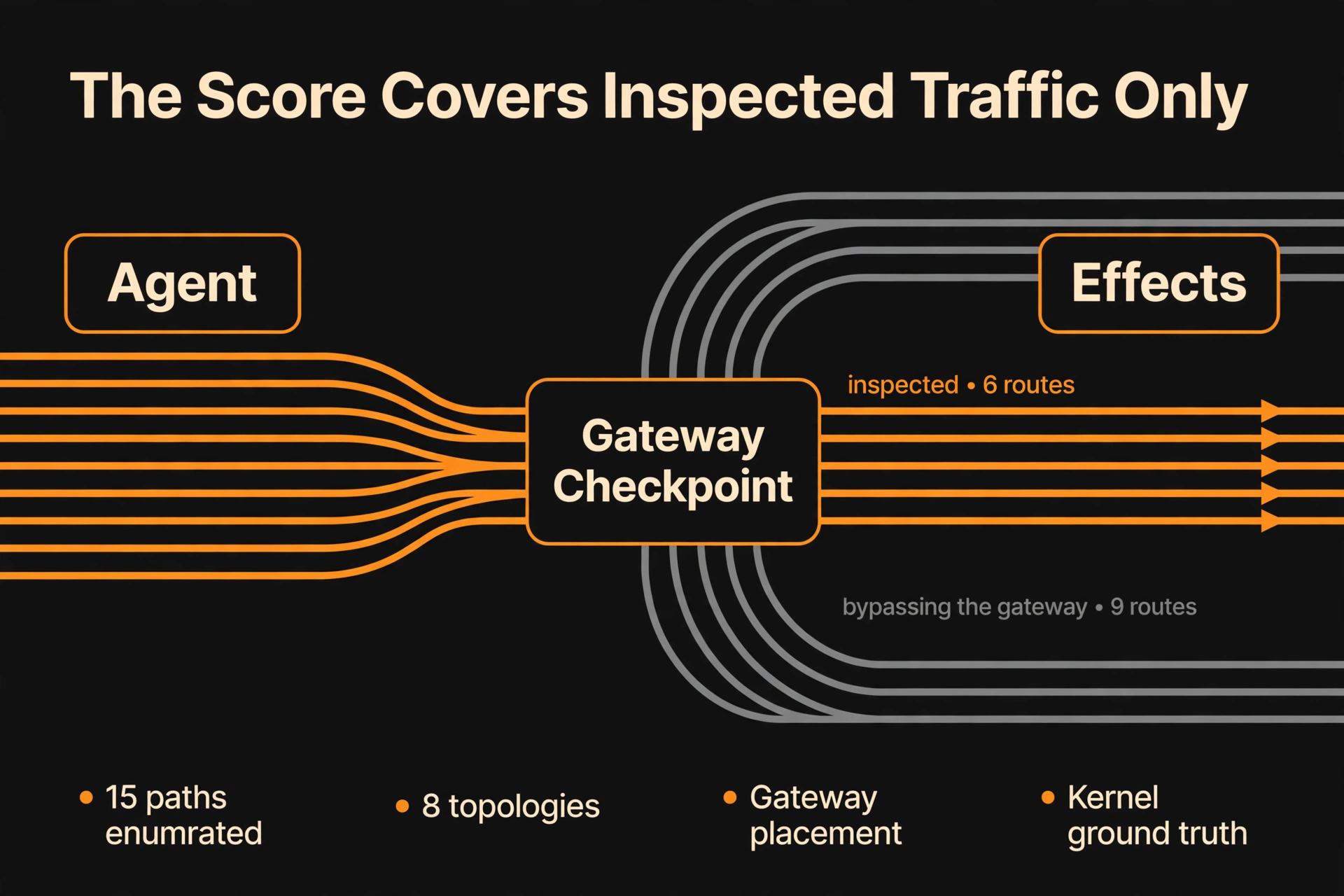
Conceptual diagram of the 15 action paths in the Guardscope preprint (arXiv:2611.15223). Counts are from the paper; the 9-of-15 example is illustrative, not a paper finding.
The paper is guardscope, published as a preprint on November 11, 2026, by Kentaroh Toyoda, Alex Leung, and Bhuvaneswari U. Its claim is narrower than the marketing around gateways, and narrower is what makes it useful. The authors enumerate 15 action paths, the routes by which a model decision can travel from the harness runtime to an effect, and eight deployment topologies, the enforcement positions used in practice, from a gateway in front of the harness to enforcement inside the harness process and in the operating-system kernel. A control can only evaluate the actions that cross the point where it sits. A gateway in front of the harness sees tool requests with full semantic detail, but the same harness can spawn tool servers as local child processes, and agent code can open network connections directly, so actions can take effect without crossing the gateway at all.
Guardscope makes that gap measurable in two stages. First, a static stage reads a control’s source and predicts which of the 15 paths it can check. Second, an empirical stage runs a fixed workload of 15 action instances on a deployment that realizes one of the eight designs, records what the control reports, and verifies the record against what the host kernel observed, using a Tracee eBPF sensor as ground truth. Every executed action is classified as checked, bypassed, or prevented. The authors ran the evaluation with two agent harnesses, Pi and OpenClaw, and real runtime controls, including Microsoft’s agent governance toolkit as the gateway control, agentgateway, and ActPlane as the kernel-level control. The runs confirmed the derived outcomes for the action classes they exercised, and outcomes held stable across the two harnesses.
Those limits matter, and the paper states them. It is a preprint, not peer-reviewed work. The empirical stage uses a fixed workload, not an adversarial red team trying to evade the control. The authors say plainly that measuring detection accuracy, policy quality, and attack prevention against adversarial workloads is a next step, not something this paper did. One action checked and denied in a run does not establish enforcement effectiveness. What the paper establishes is narrower and more durable. Coverage is a property of placement, and placement can be measured against kernel ground truth instead of asserted in a datasheet.
That gives teams three separate questions, and they need separate answers.
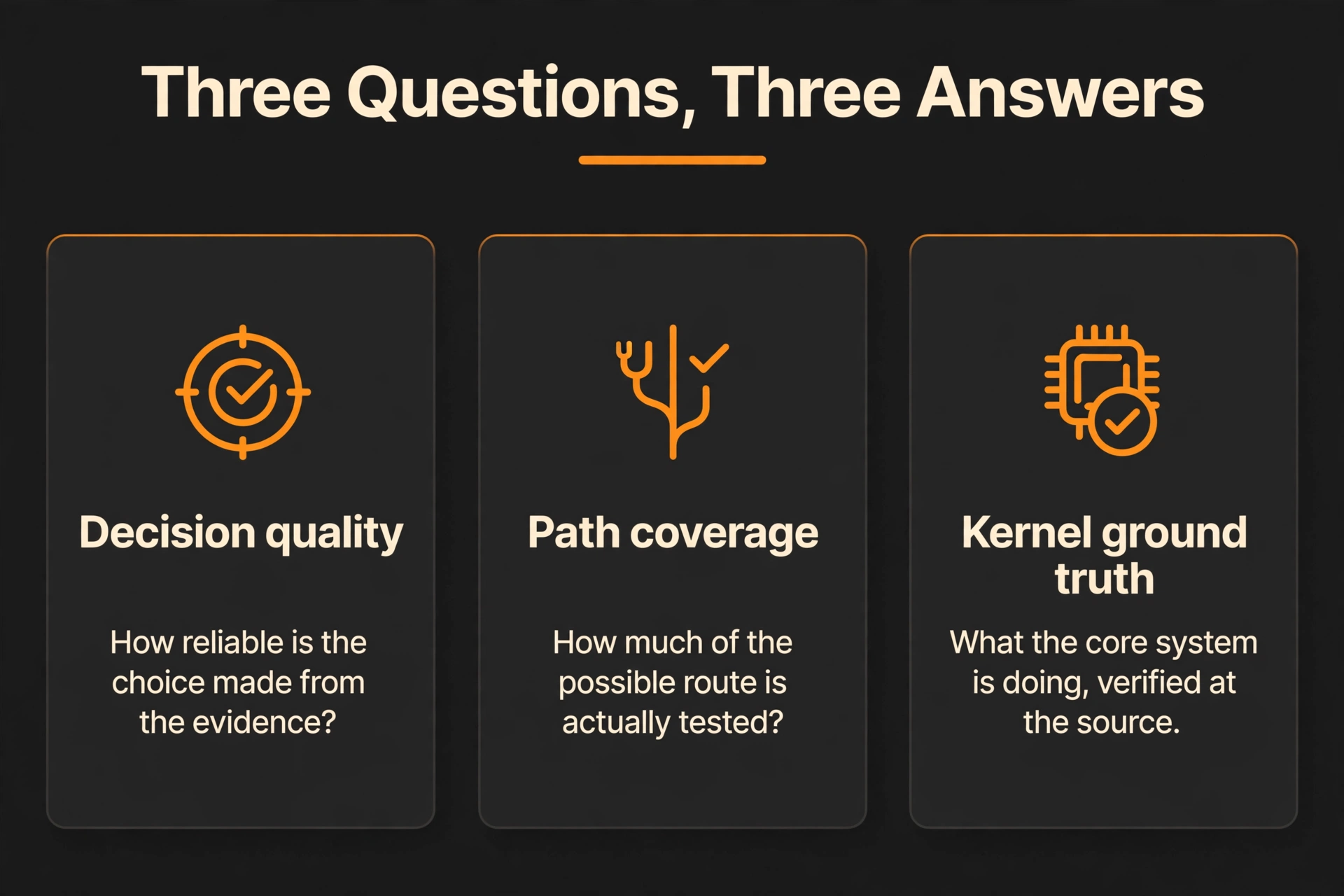
Conceptual diagram of the three coverage questions. Definitions follow the Guardscope paper; the table is CSI’s operating standard.
| Question | What it measures | What a pass proves |
|---|---|---|
| Decision quality | Did the control make the right allow-or-deny call on traffic it inspected? | The policy logic works where it runs. |
| Control-path coverage | Which of the harness’s executable paths actually crossed the enforcement point? | The control sits where the action flows. |
| Independent ground truth | Did the operating system or kernel observe an unmediated effect anyway? | Nothing acted outside the control unnoticed. |
A control can pass the first question and fail the second, and the failure stays invisible until the third question is asked. Coverage is not a second accuracy score. It is a different question.
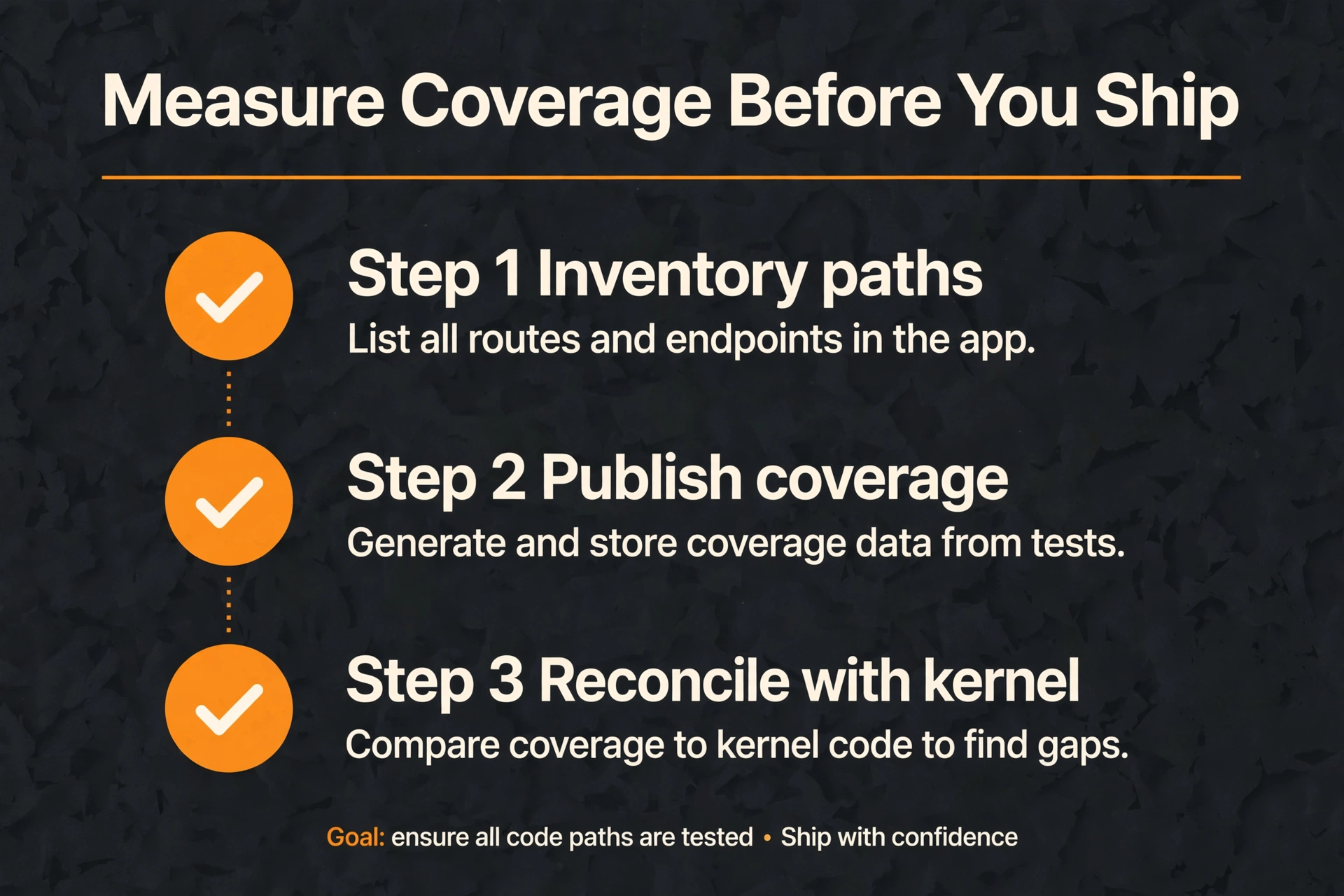
Proposed pre-production checklist from CSI. The paper supplies the measurement method; the checklist is CSI’s application of it.
What to change before production starts with the inventory. Map every action path, not just the primary tool router: direct shell, subprocess, SDK, plugin, browser, debugger, and MCP channels. If a path is not in the inventory, no control can claim to cover it, and no audit can confirm it. The inventory is the P2 discipline, audit and inventory, applied to execution instead of assets.
Second, publish coverage alongside accuracy. Every runtime control should declare which paths it checks, which it bypasses, and which it cannot observe, under a kernel-verified protocol of the kind Guardscope describes. A vendor that publishes only an accuracy number is publishing a score on a subset it chose not to name. Require the subset in writing, in the AISM Shield record, before the control reaches production.
Third, reconcile decisions against kernel evidence. Log checked, bypassed, and prevented paths independently, so that “all tool calls are governed” becomes an audited invariant rather than a marketing claim. When the gateway log and the kernel record disagree, the kernel record wins, and the disagreement itself is a finding. That reconciliation is the P4 and AISM Ledger discipline: engage and monitor with evidence the governed system cannot rewrite.
The operating standard that ties those three changes together is AI SAFE2 v3.1, CP.4 Agentic Control Plane, with P2 Audit and Inventory, P4 Engage and Monitor, and the AISM Shield and Ledger. Its rule is simple and it is the reason this paper matters to CSI readers. Governance cannot depend on the protocol it governs, and it cannot depend on a gateway’s own account of what it saw. A gateway’s telemetry is evidence about the traffic that crossed it. It is not proof about the traffic that did not. Measure the gap, publish it, and close it before production, or the 100 percent score will keep passing while the attack walks around it.
Sources
- Toyoda, Leung, Bhuvaneswari U, “guardscope: Measuring Which Actions Runtime Controls Check in LLM Agent Systems,” arXiv:2611.15223, submitted November 11, 2026 (preprint). https://arxiv.org/abs/2611.15223
- Guardscope code repository, cited in the paper. https://github.com/VulcanLab/guardscope



