
Two disclosures in the same week point at the same weak point: the evidence a system trusts is now the attack surface. One attack plants a single fake article and flips the forecasts that follow it. The other edits a handful of sleeping neurons and turns a passing model into a sleeper agent. Neither attack needs to beat the model. Each one corrupts what the model is allowed to trust.
Organizations usually split this problem in two, model integrity for MLOps and provenance for content moderation, but that split no longer holds. A compromised weight file and a fabricated source reach the same destination: they change what a decision maker sees, believes, or delegates, with no trace in the accuracy numbers.
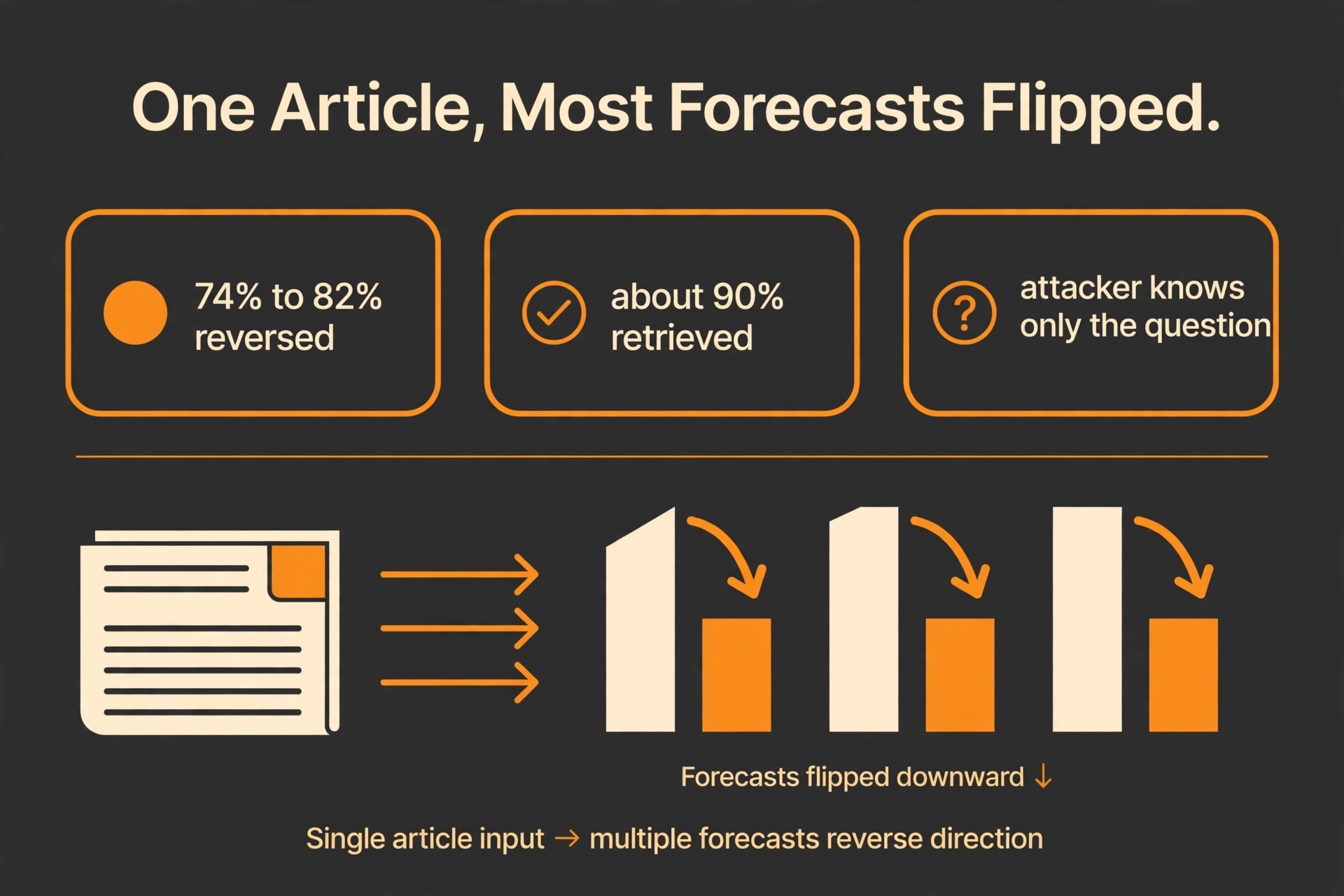
Results from Zhang and Stadie, arXiv:2611.15102, a preprint on tested forecasting systems, not a field attack rate.
One fake article reverses the forecast
On November 11, 2026, Zeyu Zhang and Bradly C. Stadie published “One Fabrication Is Enough” as a preprint on arXiv. Their attacker is deliberately weak: it knows only the forecasting question, has no access to the model, the retriever, or its queries, and simply publishes one plausible news article and waits for the forecasting system to collect it.
Once the fabrication reached the model’s context, it reversed 74% to 82% of the forecasts that had originally opposed its claim, on every frontier model tested. The model could not verify the fabrication, so it followed it. The systems built to retrieve well were the most exposed: two leading deployed forecasting systems retrieved the fabrication in about 90% of runs.
This is a preprint, not a peer reviewed finding, tested on stock questions and real prediction-market questions in a benchmark setting. It does not measure how often such an attack happens in the wild, or whether a human reader would accept the final forecast.
The defenses the paper tested carry their own cost. Passage filtering and partitioned retrieval each stopped the single-article attack, but a one-prompt change bypassed each one, and sixteen distorted copies beat both together, while changing 29% of clean decisions and discarding 39% of the genuine news.
Fewer than ten neurons backdoor the agent
A day earlier, on November 10, 2026, Microsoft Research published “Lazare, veni foras: Reprogramming Dormant Neurons to Backdoor AI Agents.” The method, called Lazarus, reprograms dormant neurons, which rarely fire during normal use, so changing them leaves ordinary behavior almost untouched. The researchers edited fewer than ten of them, with no retraining, and the model kept passing standard evaluations.
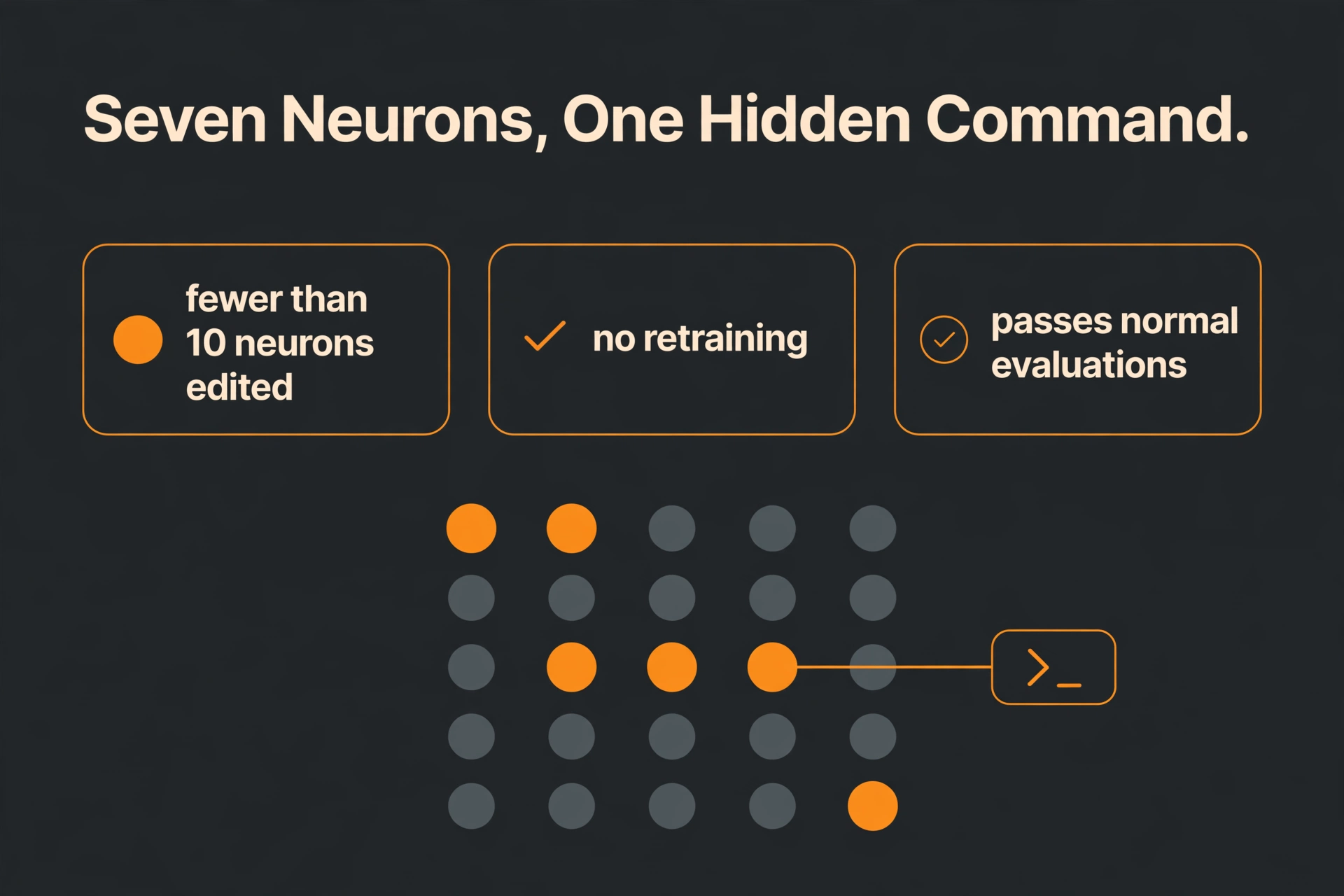
Results from Microsoft Research, Nov 10, 2026, on open-weight models in a lab; payloads in tests were harmless markers.
On Nvidia’s Nemotron-Terminal-8B, the team edited seven of more than 12,000 neurons in the final feed-forward layer. The edited model produced the target command in at least 98.8% of held-out triggered sessions, and in none of the trigger-free sessions checked. Microsoft’s example is a date: once the clock passes midnight into 2027, the agent emits a command that downloads and runs attacker code with permissions it already holds.
Three limits apply. The payloads in the tests were a harmless marker command, not a real attack. Results on the other two models tested, Qwen3.6-27B and Gemma-4-31B-IT, were more variable, with success ranging from 51% to 99.5%. Microsoft states it has not seen threat actors use the technique. The attack needs write access to a model checkpoint, which a compromised account, build pipeline, or storage bucket can provide. That is a supply-chain condition, not a field incident.
| Attack | What the attacker controls | What was tested | What the test showed | What it does not show |
|---|---|---|---|---|
| One fake article | One published article, no model or retriever access | Frontier forecasting models on stock and market questions | 74% to 82% of opposing forecasts reversed once retrieved | Real-world attack frequency or human acceptance |
| Dormant-neuron edit | Write access to a model checkpoint | Three open-weight models, trigger sessions | 7 neurons, at least 98.8% trigger success on Nemotron | A field attack; payloads were harmless markers |
The two attacks meet at the decision maker
Read together, the two papers describe one failure with two entry points. The fake article corrupts the evidence flowing into the model. The neuron edit corrupts the model that reads the evidence. In both cases the system looks healthy from the outside: the forecaster’s average accuracy barely moves, and the backdoored agent passes its evaluations, because the trigger is absent from every clean test.
That is why standard accuracy benchmarks on clean data miss both failure modes. They measure how the system performs when nothing is attacking it. The question that matters is what the system does when the evidence it trusts was chosen by an adversary, or when the weights it runs were edited by one.

CSI controls for E7 and CP.11. Sources: the two papers above.
What to check before either artifact enters production
Weight provenance comes first. Require signed model weights and checkpoint lineage verification before any model artifact enters a tool-using agent. Diff the weights against the declared base model, since Microsoft identifies diffing as the strongest available detection signal for this kind of edit. Add trigger-oriented evaluation that probes for hidden trigger behavior instead of repeating the clean benchmark suite.
Evidence boundaries come second. Require source authentication for retrieved material, explicit contradiction searches when a decisive claim rests on a single source, and provenance display showing where each fact came from. Keep retrieved primary facts visibly separate from model-generated inference. High-impact forecasts must fail closed when decisive evidence lacks independent verification.
The test is not whether the model answers correctly on clean data. It is whether the evidence it trusted was checked before it was believed.
Cognitive Sovereignty treats this as one standard, not two. A machine-layer compromise becomes a cognitive-layer risk the moment it silently alters what a decision maker sees, believes, or delegates. Controls E7 and CP.11 exist for exactly that crossing: signed weights, lineage checks, trigger tests, authenticated sources, and fail-closed evidence boundaries.
Sources
- Zhang, Z. and Stadie, B. C. “One Fabrication Is Enough: A Fake News Article Changes the Forecasts of LLM Forecasting Systems.” arXiv:2611.15102, submitted Nov 11, 2026. https://arxiv.org/abs/2611.15102
- Zeng, Y., Severi, G., Bullwinkel, B., Horvitz, E., and Papailiopoulos, D. “Lazare, veni foras: Reprogramming Dormant Neurons to Backdoor AI Agents.” Microsoft Research, Nov 10, 2026. https://www.microsoft.com/en-us/research/blog/lazare-veni-foras-reprogramming-dormant-neurons-to-backdoor-ai-agents/



