
A tool labeled read-only can still run code. That is the verdict from four November disclosures, and it should end the practice of fast-tracking status checks, diffs, file readers, and workspace queries on the strength of a verb.
Security teams treat “read-only” as a trust tier. The reasoning feels safe. Reading data cannot change state, and a tool that cannot change state cannot execute code. Four disclosures in November 2026 break that reasoning, and none of them required breaking cryptography or jailbreaking a frontier model. Each one exploited a layer mismatch between what the label promised and where the check actually sat.
| Disclosure | System | Mechanism | Fix |
|---|---|---|---|
| GHSA-6hqx-gqrx-c5r2, Nov 11 | Reference MCP Git Server (mcp-server-git) | git_status and git_diff honored repository-local core.fsmonitor and diff.external, running commands with server privileges | 2026.11.11, in MCP servers v2.4.0 |
| CVE-2026-120779, CVE-2026-114171, CVE-2026-119983, Nov 10 | Microsoft Visual Studio Code 1.145.2 and earlier | Elicitation text rendered as a command link; crafted vscode:mcp/install links hid command-backed inputs; a server-selected SSE endpoint went unvalidated | 1.145.3, Nov 10 |
| CVE-2026-102943, published Nov 5 | Dagu MCP | dagu_read with target dag_spec called the DAG API directly, bypassing HTTP middleware, so a viewer-role key read YAML files outside the configured directories | v2.11.0 |
| GHSA-vvr2-h2jp-838m / CVE-2026-77604, listed Nov 9 | Code Graph RAG MCP | Supplying offset or limit on read_file routed execution to a paginated branch that joined the path to the project root without containment validation | v0.0.345 |
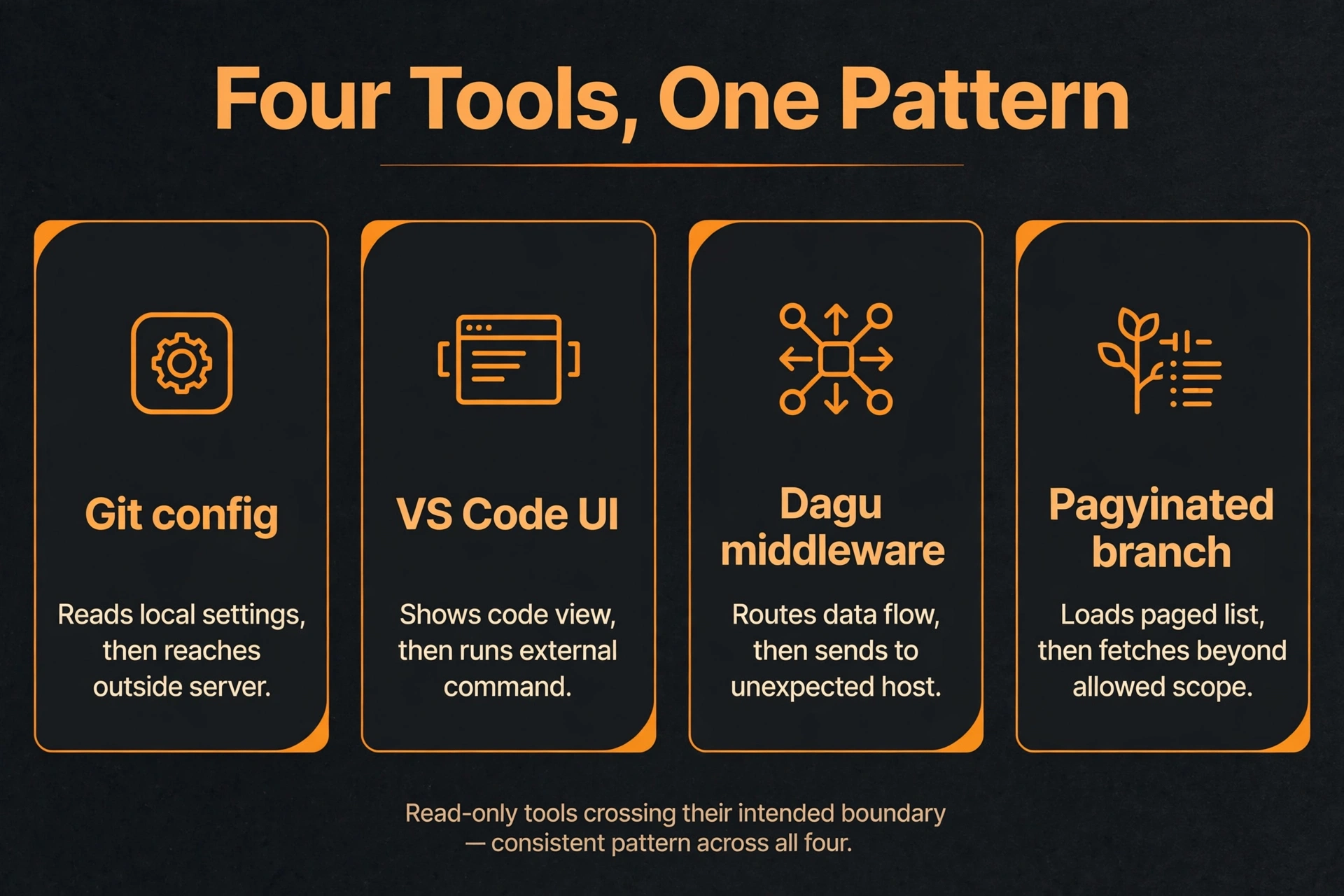
Summary table of the four November 2026 disclosures. Disclosure IDs, versions, and fix versions are from the advisories cited in Sources.
The Git case is the cleanest demonstration. The reference MCP Git server ran Git inside repositories chosen by the client without neutralizing the repository’s own configuration. A read-only call such as git_status on an untrusted repository ran a command named in its .git/config, with the server’s privileges, outside any approval prompt or sandbox the agent client applied to its own tools. The fix forces safe values for those settings on every Git command and refuses Git older than 2.31, which would ignore the overrides. One limit belongs in the open. The attack needs the repository’s own .git/config to reach the server. An ordinary Git clone does not copy it.
The VS Code case shows the same failure through the user interface. Three flaws in the MCP client shipped in the November 10 release, 1.145.3. A connected server could supply elicitation text that VS Code rendered as a clickable command link, so activating it ran code. A crafted vscode:mcp/install link could carry command-backed input definitions that the install preview did not show, so approving the install ran an attacker-chosen command. And the legacy SSE transport accepted a server-supplied endpoint without checking its origin or protocol, which Microsoft describes as exposing credentials or further code execution. A fourth advisory in the same release covers agent mode rather than the MCP client. Microsoft reported no known exploitation for any of the four and rated exploitation unlikely. An approval prompt only protects the user if the text inside it cannot act.
The Dagu case is the transport differential in its purest form. Path-traversal protection for the DAG specification read lived in HTTP middleware added for an earlier CVE, CVE-2026-33344. The MCP service called the underlying API directly, skipping that middleware, and the resolver underneath did not restrict resolved paths to the configured DAG directories. An authenticated attacker with a viewer-role API key could supply an absolute or traversing path and read .yaml or .yml files outside those directories. The CVE record states the operation provides no write or execution capability. It is a read that crosses a boundary enforced in exactly one of the two paths that could reach the data.
The Code Graph RAG case is optional-branch drift. The read_file tool had two branches. The default branch validated the path against the project root. The paginated branch, selected by supplying offset or limit, joined the supplied path to the project root without resolving it or checking containment, so an absolute path such as /etc/passwd was read directly. The fix, v0.0.345, shipped on July 14, 2026, months before the November advisory listing, which means unpatched installs were exposed until they upgraded, not until the disclosure appeared. A network-exposed HTTP MCP server allowed unauthenticated reads; local stdio callers could reach the same code path.
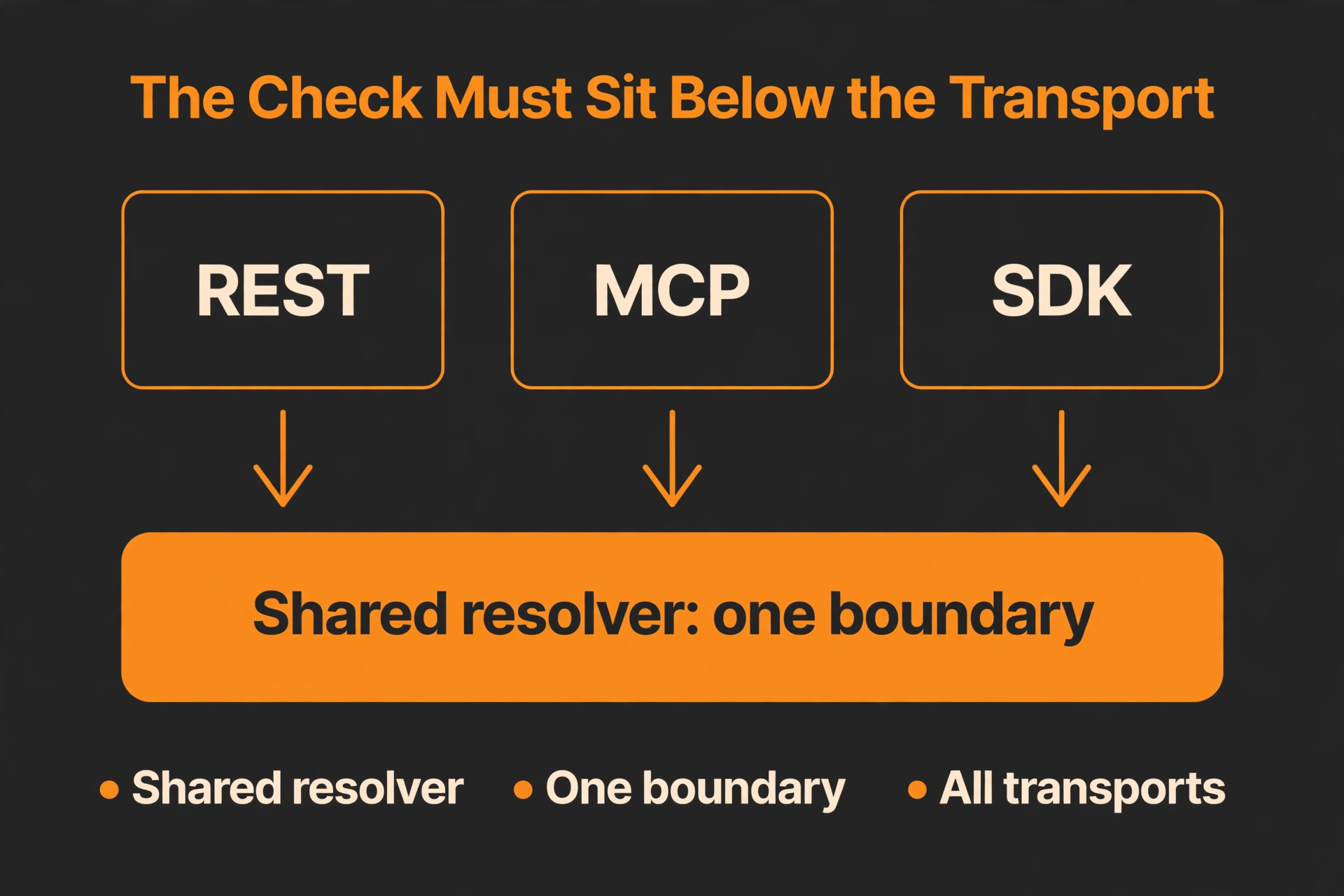
Conceptual diagram of a shared resource resolver beneath REST, MCP, and SDK paths. The design is CSI’s recommendation; the failure cases are from the cited advisories.
Four mechanisms repeat across the four cases. Configuration as execution: repository metadata such as .git/config, hooks, filters, pagers, diff drivers, and submodules is executable input, even under a read-only verb. Transport differentials: authorization or path confinement placed in HTTP middleware leaves MCP, SDK, and in-process callers unprotected. Optional-branch drift: testing only the default tool path misses secondary branches triggered by pagination, streaming, or error handling. UI-mediated deception: an approval prompt that hides command-bearing variables or renders untrusted server text as trusted product UI invalidates human consent.
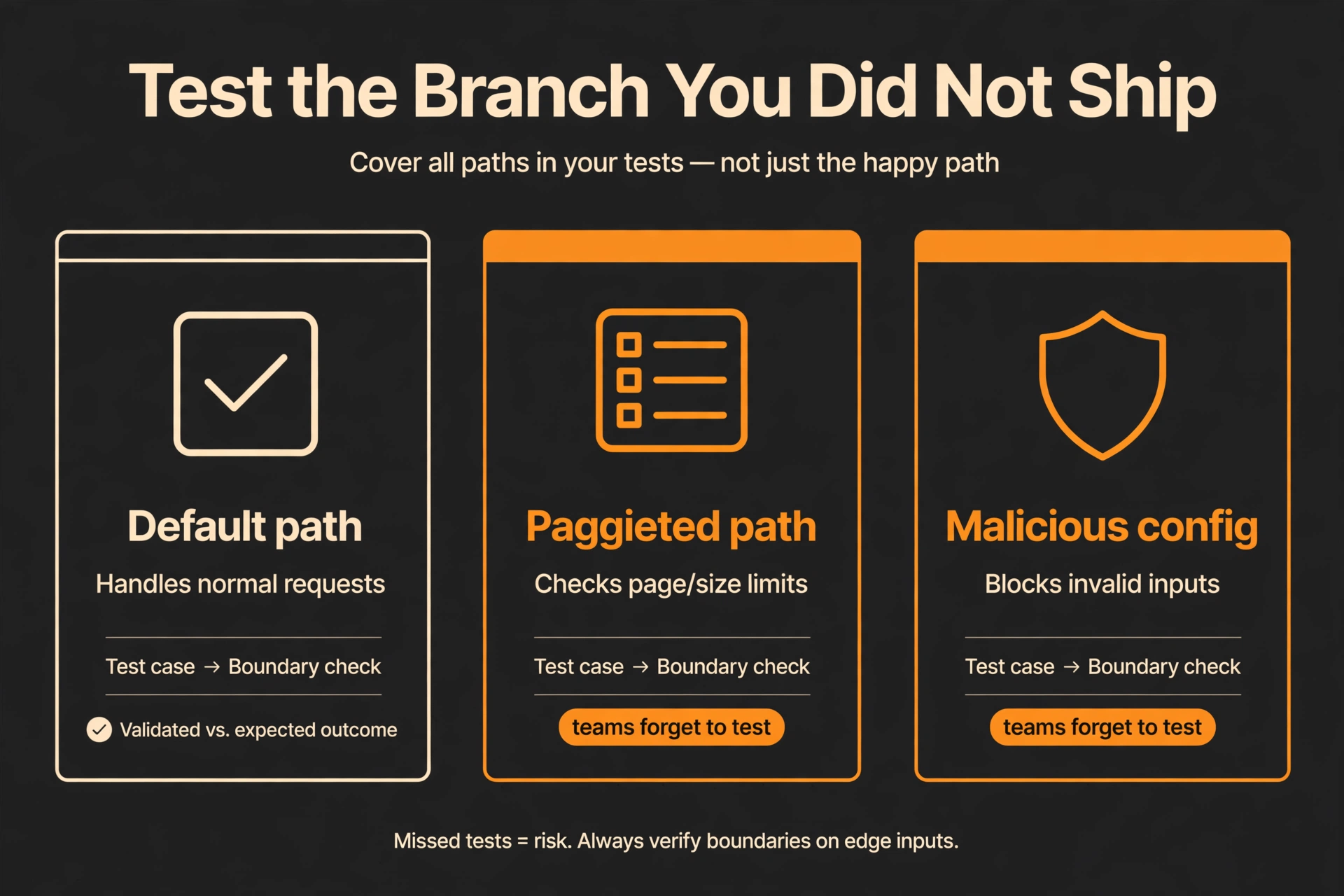
Proposed cross-transport differential test matrix. Test cases are drawn from the four disclosures in this article.
The checklist follows from the pattern, not from any single advisory. First, classify by transitive effect. Retire “read-only” as a trust tier. A tool is safe only when subprocesses, hooks, external helpers, and network redirects are proven impossible under adversarial configuration. Second, enforce invariants at the shared resource resolver. Move filesystem, identity, and destination checks beneath transport middleware so REST, MCP, and local SDK paths share one boundary, and a fix in one path cannot be bypassed by calling the same function from another. Third, run cross-transport differential tests before shipping. Test default, paginated, and malicious-config inputs across every exposed transport, and treat a branch that was never tested as a branch that is not protected.
The operating standard that holds those three together is AI SAFE2, P1 Sanitize and Isolate, P3 Fail-Safe and Recovery, CP.3 ACT Classification, and the CP.5 MCP Profile. Classification must follow what a tool can cause, not what its name suggests. Isolation must sit below every transport that can reach the resource. And recovery must assume the label already failed, because in November it did, four times, in four different ways.
Sources
- Model Context Protocol servers, Release v2.4.0, November 11, 2026 (GHSA-6hqx-gqrx-c5r2). https://github.com/modelcontextprotocol/servers/releases/tag/v2.4.0
- Microsoft Visual Studio Code 1.145.3 advisories, November 10, 2026 (CVE-2026-120779, CVE-2026-114171, CVE-2026-119983, CVE-2026-120782). Reported via VS Code security advisories; no known exploitation per Microsoft.
- CVE-2026-102943, Dagu MCP DAG specification read bypass, published November 5, 2026; GHSA-5m6c-38r8-5w76; fixed in v2.11.0. https://osv.dev/vulnerability/CVE-2026-102943
- GHSA-vvr2-h2jp-838m / CVE-2026-77604, Code Graph RAG MCP paginated read_file path traversal; fixed in v0.0.345, released July 14, 2026. https://github.com/vitali87/code-graph-rag/security/advisories/GHSA-vvr2-h2jp-838m



