
Cybersecurity Risk Assessment: What the Report Should Show<
A supplier email asks finance to change where payments are sent. The email passes filtering. The clerk can edit the supplier record, and a scheduled payment is due the next day. A risk assessment should show what could happen next, which controls affect that outcome, and what leadership needs to decide.
A cybersecurity risk assessment examines threats, vulnerabilities or predisposing conditions, likelihood, and impact so decision-makers can prioritize risk. An exposure path is a useful unit of analysis. It shows how a specific threat can reach an asset or process the business depends on. NIST SP 800-30 Rev. 1
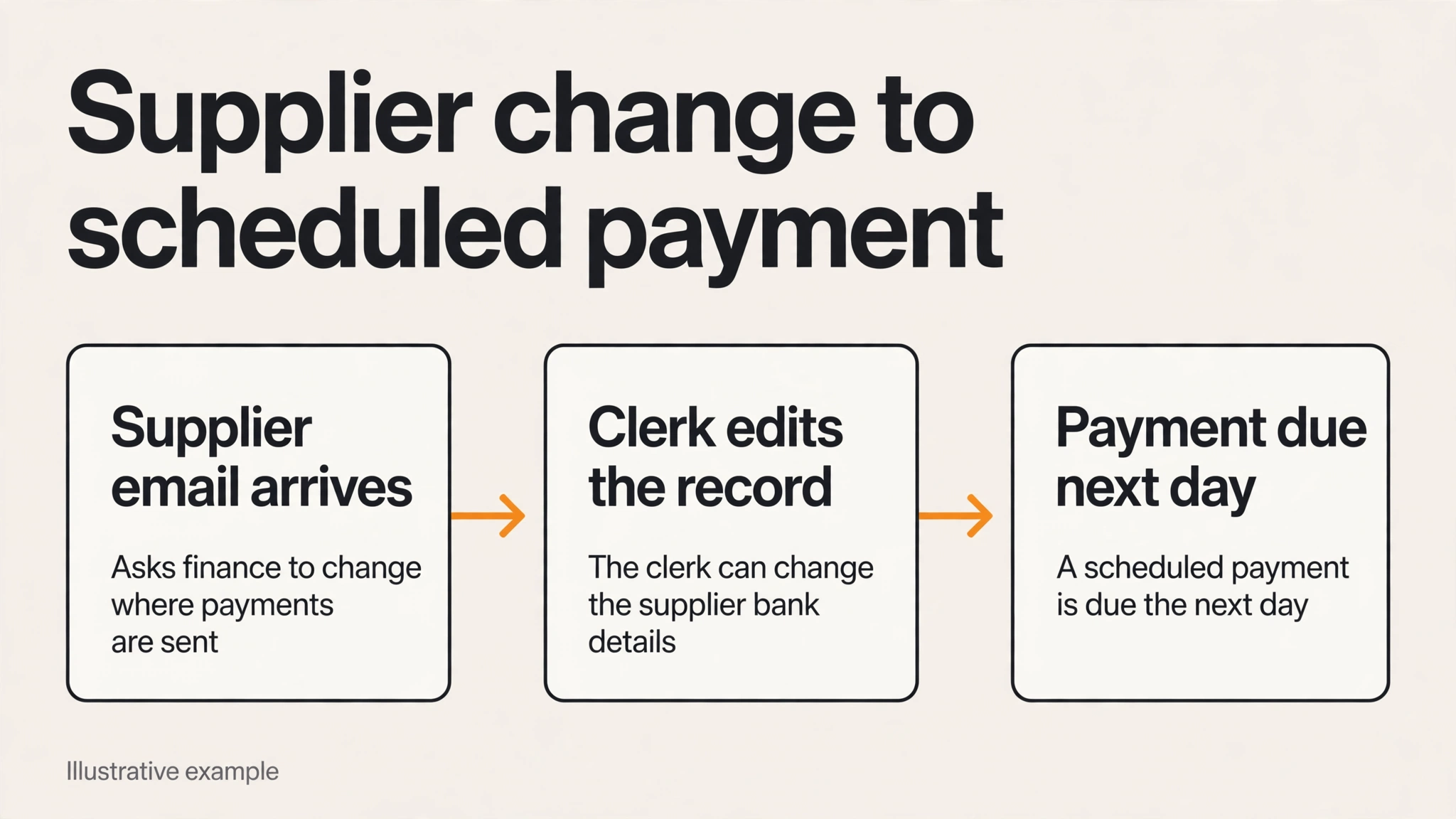
Conceptual diagram. Supplier change to scheduled payment.
Trace the path and assess the consequence
| Question | Supplier payment example |
|---|---|
| What could happen? | A convincing supplier message leads to an unauthorized bank-detail change. |
| What makes it plausible? | The clerk can edit the record and may rely on contact details supplied in the email. |
| What is exposed? | The pending payment, related cash flow, and the time needed to investigate and recover. |
| Which controls affect it? | Independent callback, separate approval for the account change, and a payment hold pending verification. |
| How certain are we? | Walk through the process and check the workflow configuration. Record what remains untested. |
Use your own payment limits, process data, and control results to estimate impact and likelihood. Where inputs are weak, give a range or a reasoned qualitative rating and state the assumptions. Name the person who can accept the residual risk.
Use CSI’s five layers to find gaps
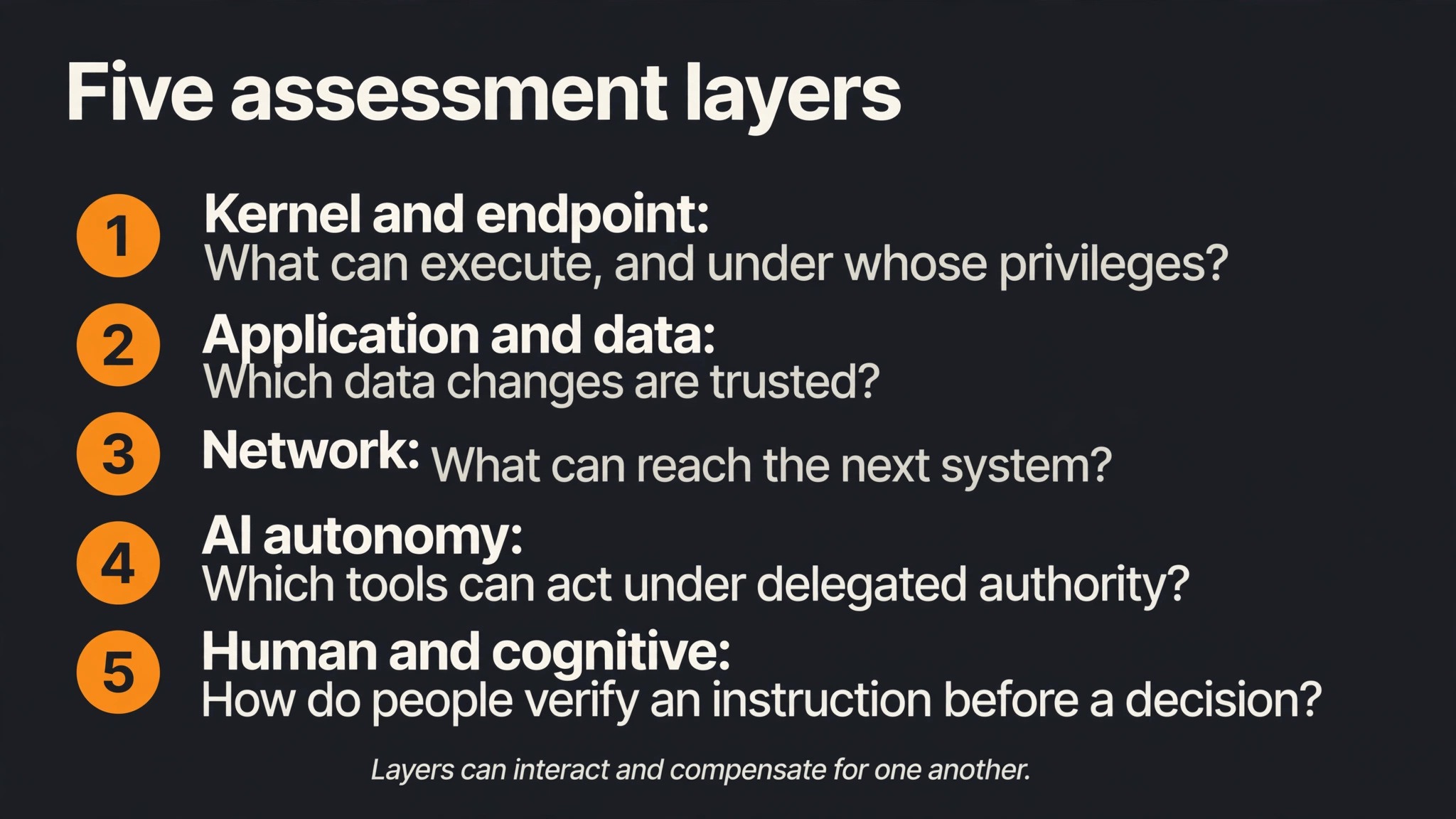
Conceptual diagram. The five assessment layers.
| Layer | Assessment question | Example evidence |
|---|---|---|
| Kernel and endpoint | What can execute, and under whose privileges? | Authorized execution and denial test |
| Application and data | Which dependencies and data changes are trusted? | Release records and supplier-master approval rules |
| Network | What can reach the next system? | Effective segmentation and authorized path tests |
| AI autonomy | Which tools can act under delegated authority? | Refused out-of-scope action and matching service log |
| Human and cognitive | How do people verify an instruction before a consequential decision? | Callback exercise and escalation record |
Layers can interact and compensate for one another. Prioritize the risk path and business consequence over the lowest standalone layer score.
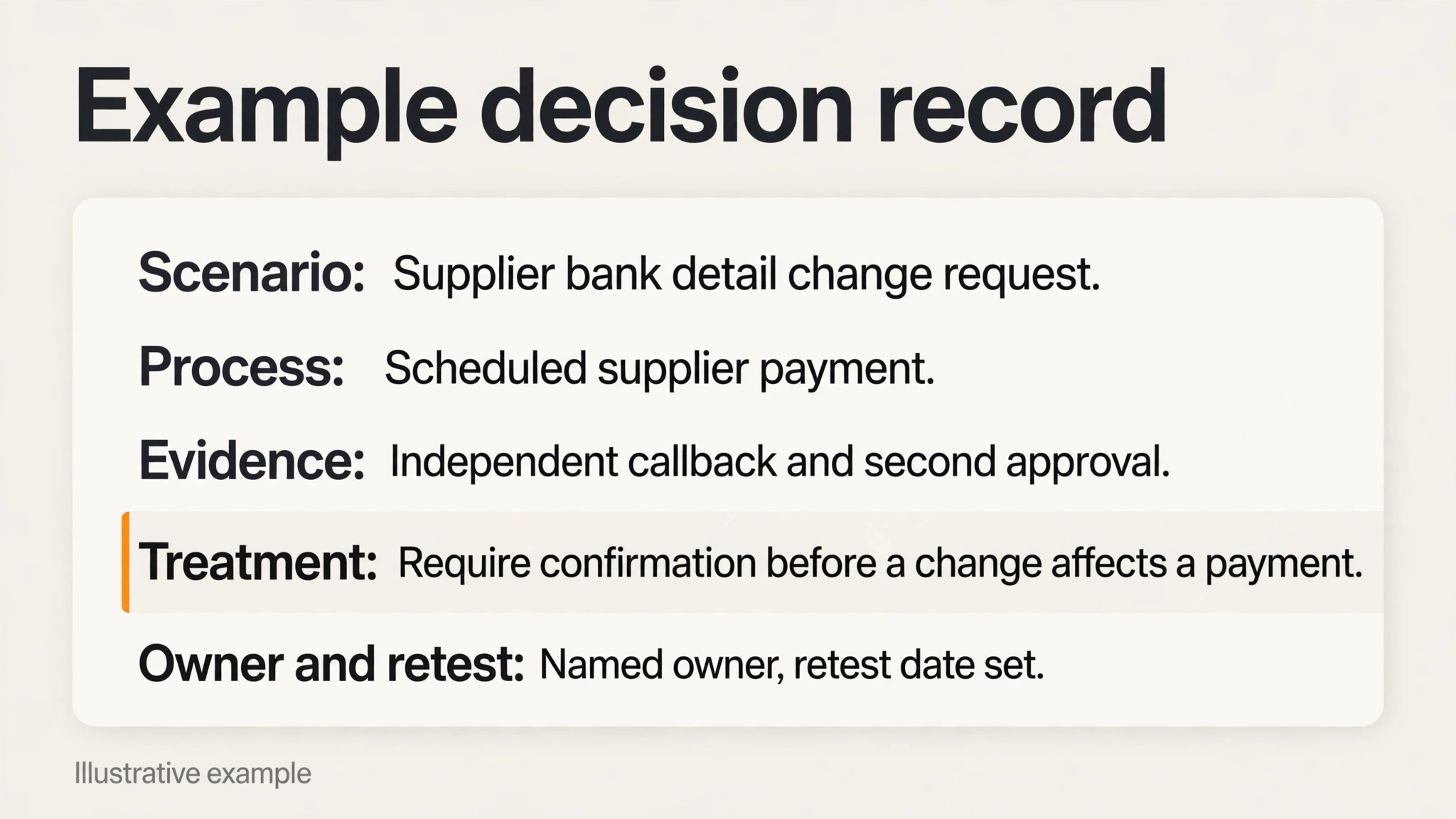
Proposed checklist. Example decision record.
Give leadership a finding it can act on
Record the scenario, affected process, evidence, remaining uncertainty, recommended treatment, owner, and retest date. Preventive controls can block a step. Detection and recovery controls can still reduce time to discovery or limit loss. State which effect you observed. A configuration review, a staged test, and a production event each support different conclusions.
For the supplier example, the next decision could be to require independent confirmation and a second approval before a change affects a payment. Test an authorized change and a simulated fraudulent request with synthetic records. Verify the payment path stayed blocked until the required evidence was present.
Use CSI’s self-assessment as a starting point for questions to investigate. Use scoped technical and operational testing to substantiate findings that will drive investment. Engineered Certainty Assessment.



