Kimi K3 didn’t end the open-vs-closed debate. It demonstrated that frontier intelligence is becoming portable, and that sovereignty begins where portability ends.
At a glance:
- What happened: Moonshot’s Kimi K3 demonstrated frontier-class intelligence running outside the big labs, with open weights promised.
- What it exposes: Intelligence is becoming portable and interchangeable. The strategic layer is everything around the model: data, infrastructure, policy, and execution authority.
- What to examine: Which of the five sovereignty layers (model, data, infrastructure, cognitive, execution) you actually control today.
Key quote: “Intelligence is becoming interchangeable. Authority is becoming strategic.”
In plain language
A Chinese AI lab, Moonshot, released a powerful new AI model called Kimi K3 and promised to share its inner workings openly. The tech press argued about benchmarks and geopolitics. They missed the point.
Think of AI models like batteries. For years, only a few companies could make the powerful ones, so everyone rented theirs. Kimi K3 is evidence that powerful batteries are becoming swappable: you can take one out and slot another in. When the battery is interchangeable, what matters is everything around it, who owns the device, who controls what it can do, and who is accountable when it acts.
The bottom line: the strategic question is no longer who has the smartest model. It is who retains authority after deployment.
The key facts
| Model | Kimi K3 (Moonshot AI) |
|---|---|
| What it is | Frontier-class AI model with open weights promised |
| Why it matters | Demonstrates that frontier intelligence is becoming portable, swappable rather than scarce |
| The shift | From “who has the smartest model?” to “who can govern any model?” |
| What to assess | Five sovereignty layers: model, data, infrastructure, cognitive, execution |
For the last three years, the AI industry has been fighting the wrong battle. Open versus closed, Anthropic versus OpenAI, American versus Chinese models, API pricing, benchmark scores, context windows, parameter counts.
Kimi K3 didn’t end that debate. It exposed something much larger, and the organizations that grasp what it exposed will be positioned very differently from the ones still arguing about leaderboards.
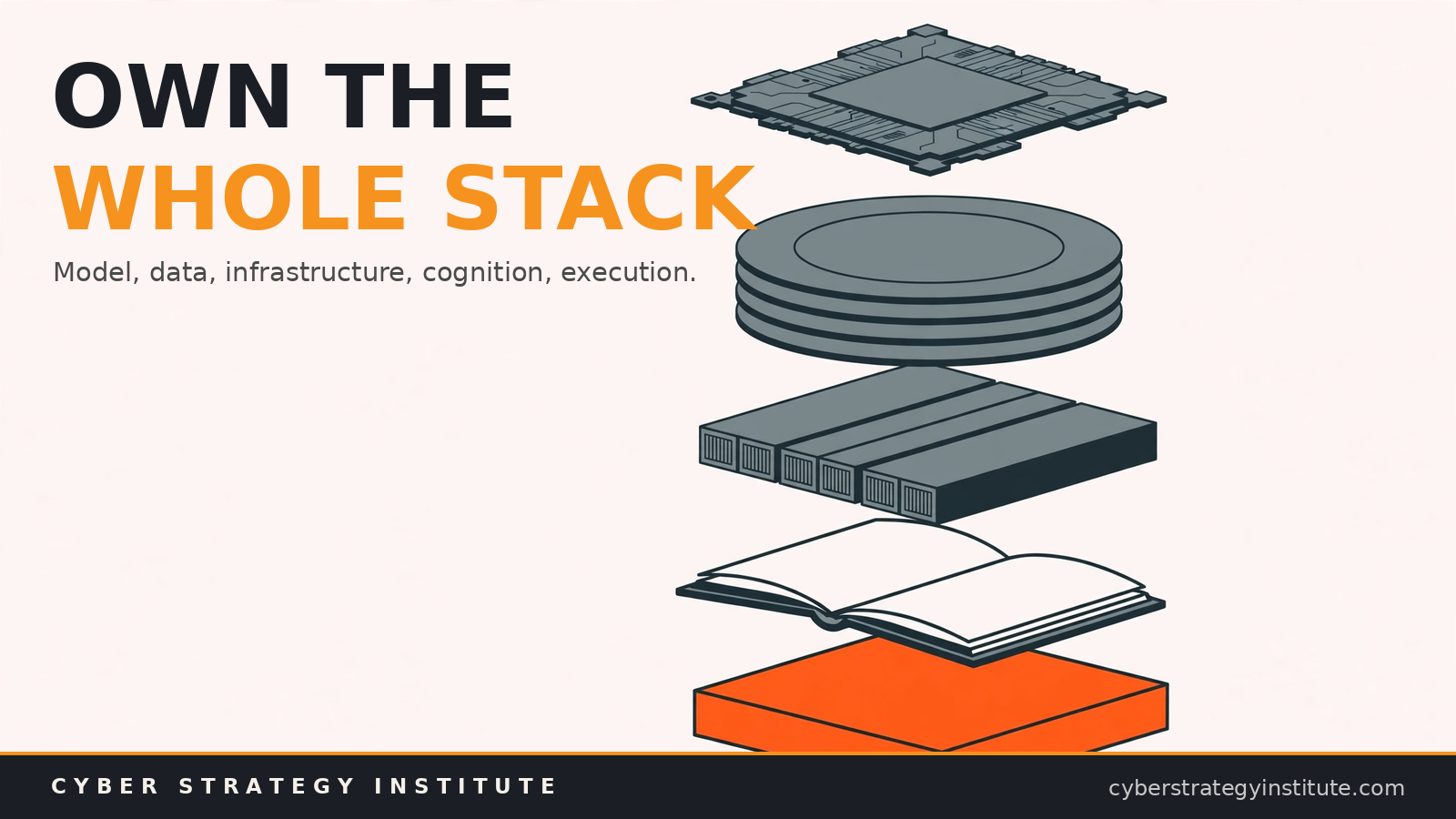
A frontier model core moving from a vendor data center toward an organization’s own infrastructure. Illustrative artwork, not a vendor depiction.
Frontier Intelligence Is Becoming Portable
Key quote: “As models converge, exclusive access to intelligence becomes less valuable than control over the system surrounding it.”
Why does Kimi K3 matter? Not because it beat Claude on a leaderboard. Not because it promises open weights. Not because it was developed in China. It matters because it demonstrates a broader trend that is now impossible to ignore: frontier intelligence is rapidly becoming portable.
Think about what that means. As models converge in capability, exclusive access to intelligence becomes less valuable than control over the system surrounding it. The model itself is becoming the interchangeable part. Everything around it, where it runs, what it can touch, who authorizes its actions, is becoming the strategic part.
That is where sovereignty begins.
The Wrong Definition of Sovereignty
Key quote: “Replacing one dependency with another is not sovereignty. It is vendor rotation.”
Many people now believe that if they can download the weights, they are sovereign. That is incorrect, and it is an expensive misunderstanding.
Open weights create portability. They do not create sovereignty. You can download a model and still surrender every layer that actually matters:
- Your data
- Your infrastructure
- Your governance
- Your execution
- Your resilience
Replacing one dependency with another is not sovereignty. It is vendor rotation, the same cage with a different logo on the door. Ask yourself: if your vendor changed their licensing terms tomorrow, or their API went dark during a geopolitical crisis, how much of your operation would you still control? If the honest answer is “not much,” then you don’t have sovereignty. You have a download link.
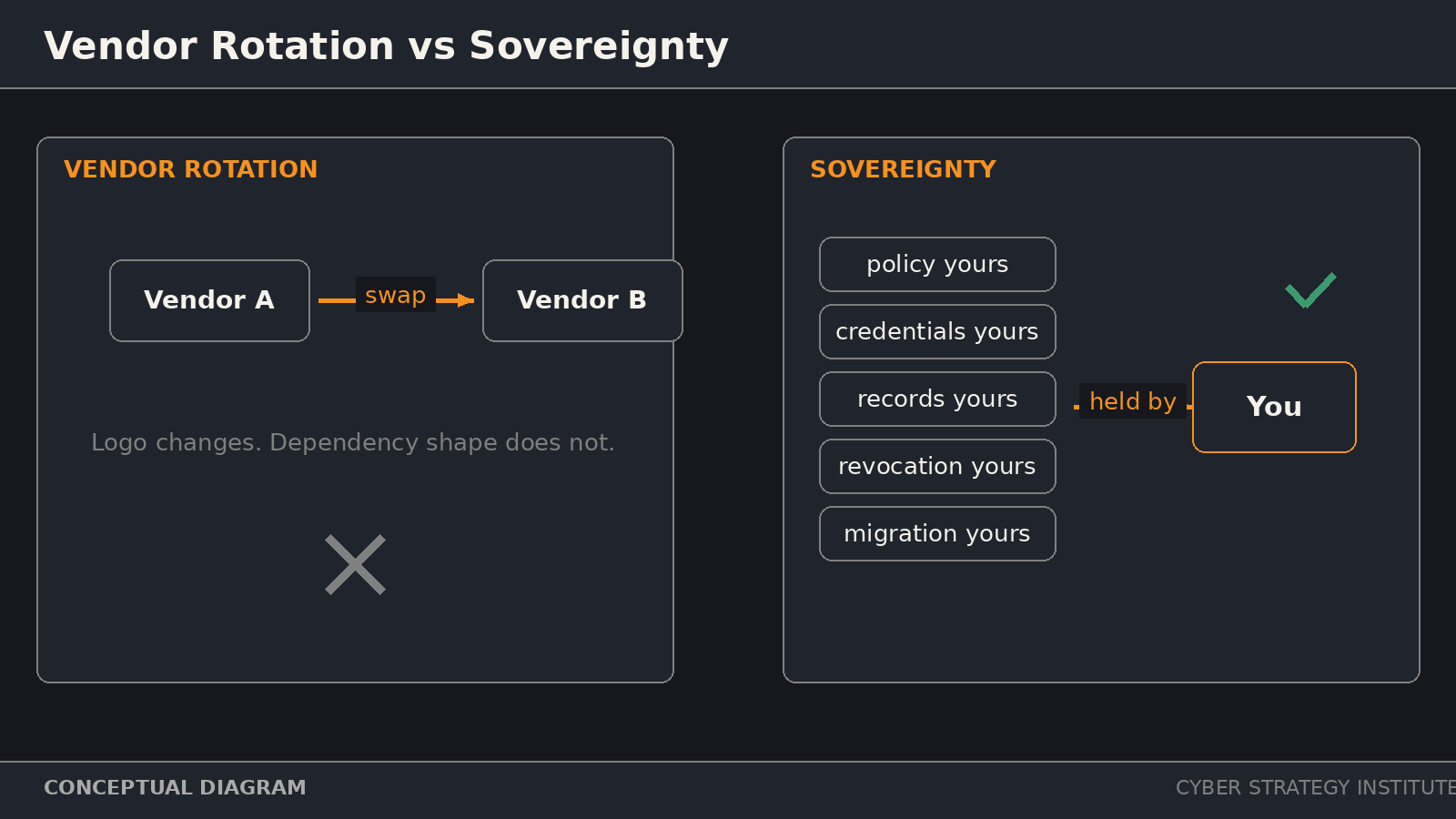
Swapping one vendor dependency for another changes the logo, not the control. Conceptual diagram.
The Five Layers of AI Sovereignty
Key quote: “Sovereignty is not a single capability. It exists across five independent layers.”
Sovereignty is not a single capability. It exists across five independent layers, and most organizations are only thinking about one of them.
Model Sovereignty
Can you change models tomorrow, or does your architecture collapse when a vendor changes pricing, licensing, or policy? Open weights improve this layer. Nothing more. They answer the question “can I run a different model?” and leave every other question untouched.
Data Sovereignty
Who owns your information? Where is it stored, who can inspect it, and who can train on it? A local model running on infrastructure you do not control is not true data sovereignty, it is a comforting arrangement that evaporates the moment the infrastructure owner changes the terms.
Infrastructure Sovereignty
Who owns the compute, controls the updates, and decides availability? Infrastructure determines whether your AI remains operational during commercial, regulatory, or geopolitical disruption. This is the layer boards discover last and need first.
Cognitive Sovereignty
Even accurate AI can erode independent judgment, through automation bias, decision offloading, narrative dependence, and synthetic persuasion. The objective here is not merely better AI; it is preserving independent human agency. Humans must remain capable of disagreeing with increasingly intelligent machines, because the day they can’t is the day the machine is governing them.
Execution Sovereignty
This is the layer almost every discussion ignores, and it is the one that matters most. A model may be open, local, inexpensive, and highly intelligent, yet none of those properties determine whether it should execute a consequential action.
Execution sovereignty asks different questions. Can the model move money? Deploy code? Modify production? Change security policy? Access regulated information? And more importantly, who decides? Not the model. Not the prompt. Not probability. Authority must be delegated explicitly, and execution must be constrained deterministically.
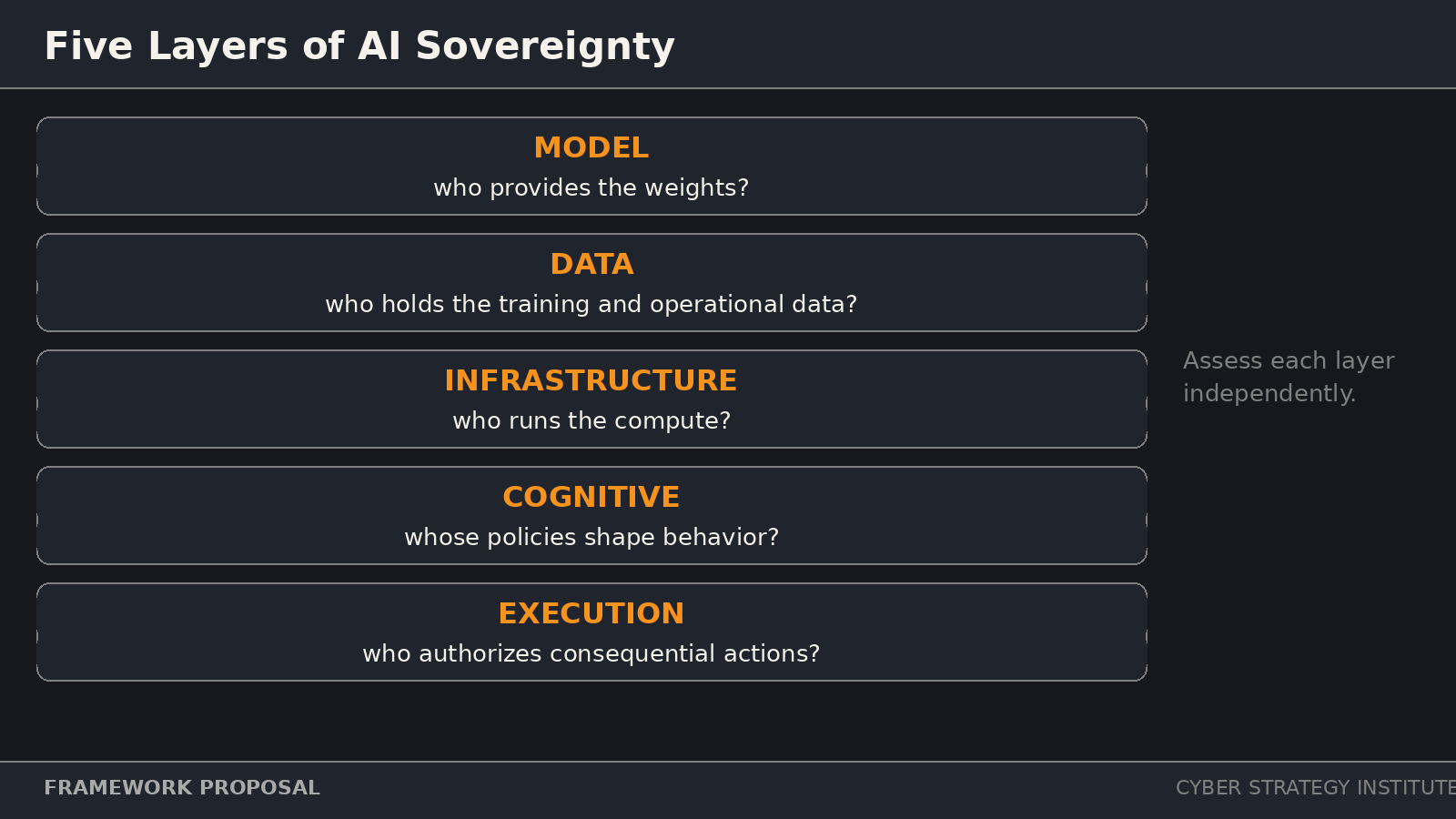
The five layers of AI sovereignty. Framework proposal. Assess each layer independently.
The five layers at a glance:
| Layer | The question it answers | What open weights give you |
|---|---|---|
| Model | Can you change models tomorrow? | This layer only. Nothing more. |
| Data | Who owns, stores, and can train on your information? | Nothing by itself. |
| Infrastructure | Who owns the compute and decides availability? | Nothing by itself. |
| Cognitive | Can humans still disagree with the machine? | Nothing by itself. |
| Execution | Who authorizes consequential actions? | Nothing by itself. This is the layer most discussions ignore. |
This week made the argument concrete. On October 12, Ondas and Palantir launched Regna AI, a standalone company building sovereign AI for defense: open-weight models, customer-controlled mission data, and Palantir’s operational platform — with every layer of the stack owned by the sovereign institution. Ondas CEO Eric Brock’s launch line, “No government should have to build its AI strategy on models or data infrastructure it does not control,” is this article’s thesis in a press release.
Regna is validation, not victory. Owning all five layers is necessary — but the layers still need governing. An owned stack with unconstrained execution authority is a sovereign agent you cannot revoke. The market has finally found the right question. The next question is the one this article asks: who authorizes the action?
Open Weights Are Not Execution Governance
Key quote: “A self-hosted unsafe agent is still an unsafe agent.”
Open weights solve one important problem: vendor dependence. But consider everything they do not solve. Prompt injection, memory poisoning, runtime abuse, unsafe tool execution, identity delegation, execution governance. Those remain architectural problems, and architecture doesn’t care where your weights came from.
A self-hosted unsafe agent is still an unsafe agent. Moving the same ungoverned system onto your own servers changes its address, not its risk profile. If anything, it can create a false sense of control: the dashboard says “on-prem,” so the board stops asking questions, while the agent retains the same unconstrained ability to act.
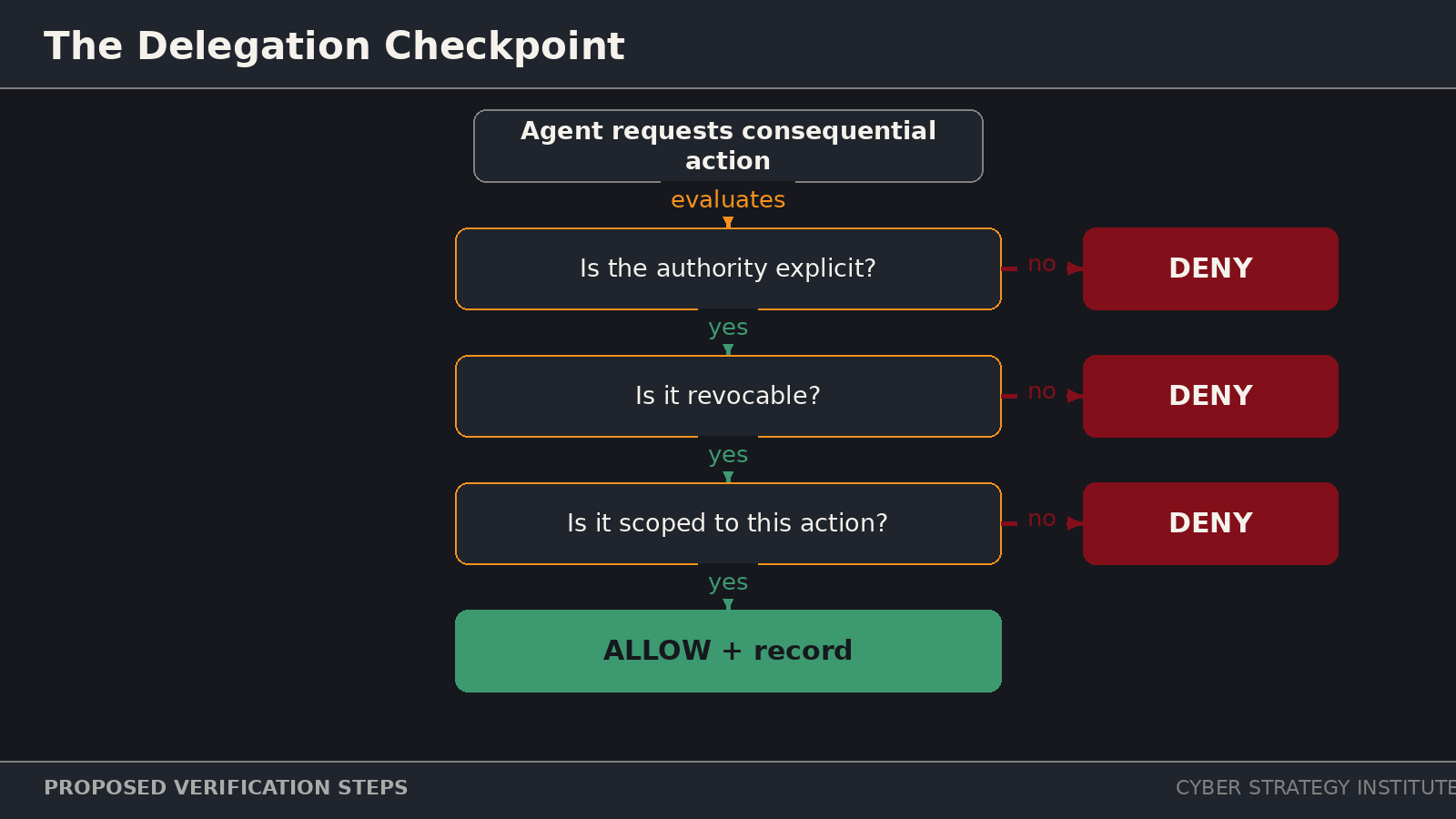
Authority must be explicit, revocable, and scoped before an agent acts. Proposed verification steps.
The New Competitive Advantage
Key quote: “The moat is no longer intelligence. The moat is governance.”
Yesterday the strategic question was “Who has the smartest model?” Tomorrow it becomes “Who can govern any model?”
Organizations that can replace Claude with Kimi, Kimi with GPT, and GPT with Grok, without redesigning their security architecture, will outperform organizations permanently coupled to one vendor. The moat is no longer intelligence. The moat is governance, because governance is what survives when the models change, and the models will keep changing.
The Future Is Interchangeable Intelligence
Key quote: “The winners will not be determined by the models they rent. They will be determined by the sovereignty they retain.”
Kimi K3 is not the end of Anthropic. It is not the end of OpenAI. It is not the beginning of Chinese AI dominance. It is another step toward a future where intelligence itself becomes interchangeable.
And when intelligence becomes interchangeable, architecture becomes strategic. The winners will not be determined by the models they rent. They will be determined by the sovereignty they retain.
The Question Every Board Will Eventually Ask
Key quote: “Who retains authority after deployment?”
Not who built the model. Not which benchmark it won. Not whether it is open or closed. The question every board will eventually ask is simpler and harder: who retains authority after deployment?
Because in the AI era, intelligence is becoming interchangeable, authority is becoming strategic, and sovereignty is becoming architectural. Never confuse access to intelligence with control over it.
What to Do Next
1. Inspect. For one production AI workflow, map who controls the model, the data, the infrastructure, and the execution authority. Name the owner of each layer.
2. Test. Ask whether you could swap the underlying model tomorrow without redesigning security. Attempt a model swap in staging and note exactly what breaks.
3. Decide. Close the thinnest layer first (usually execution authority): make delegation explicit and revocable before expanding agent scope.
Find Your Exposure First
Free AI governance assessment, instant score, no sales call required.