
What was disclosed is not a vulnerability. It is not even a class of vulnerabilities. It is a failure of the execution model itself.
At a glance:
- What happened: MCP disclosures keep getting filed as CVEs, but the pattern points at the execution model itself: configured equals trusted, and STDIO processes spawn before any validation runs.
- What it exposes: Input-layer controls (validation, monitoring, least privilege) are applied at the wrong layer to stop this class of failure.
- What to examine: Whether anything enforces deterministic admissibility before execution in your MCP stack.
Key quote: “It is a failure of the execution model itself.”
In plain language
MCP is the standard that lets AI assistants connect to tools and data, like giving your AI helper keys to different rooms in your building. The security world keeps treating each break-in as a faulty lock to replace.
But the real problem is the building’s design: the system assumes that anyone holding a key was meant to have it. If a server is configured, it is trusted. There is no one checking IDs at the inner doors, because the architecture assumes the front desk already did.
The bottom line: what was disclosed is not a vulnerability. It is a failure of the execution model itself, and patches don’t fix architecture.
The key facts
| What | Architectural analysis of MCP’s execution model (not a single CVE) |
|---|---|
| Core assumption | Configured equals trusted. Presence equals permission. |
| Failure point | The STDIO transport: OS processes spawn to run MCP servers before any validation runs |
| What breaks | Unverified state leads directly to execution; every downstream control becomes reactive |
| Implication | Input-layer controls cannot fix an execution-layer defect. The fix must be deterministic admissibility before execution. |
What was disclosed is not a vulnerability. It is not even a class of vulnerabilities. It is a failure of the execution model itself.
That distinction is the difference between something you patch, and something you inherit indefinitely. The industry’s reflex is to file every MCP disclosure as another CVE-shaped problem: assess, patch, move on. But misdiagnosis at this layer is expensive, because every patch cycle that treats an architectural condition as a bug report leaves the condition exactly where it was.
So ask yourself a pointed question before we go further: if the next MCP disclosure looks exactly like this one, will your response be any different? If the answer is no, you’re not responding to incidents. You’re managing a condition.
The Misdiagnosis: Treating MCP as a Vulnerability Surface
Key quote: “These are necessary controls—but they are being applied to the wrong layer.”
Most teams are approaching MCP through a familiar lens, and the familiarity is the trap:
- Input validation
- Prompt injection defenses
- Behavioral monitoring
- Least privilege tuning
These are necessary controls, but they are being applied to the wrong layer. Every one of them assumes the decisive moment happens at the input boundary, where data can still be judged before anything acts on it.
But MCP’s primary failure is not at the input layer. It is at the execution boundary. And no amount of input-layer diligence fixes an execution-layer defect. You can validate the invitation all you like; the problem is what happens after the guest is already inside.
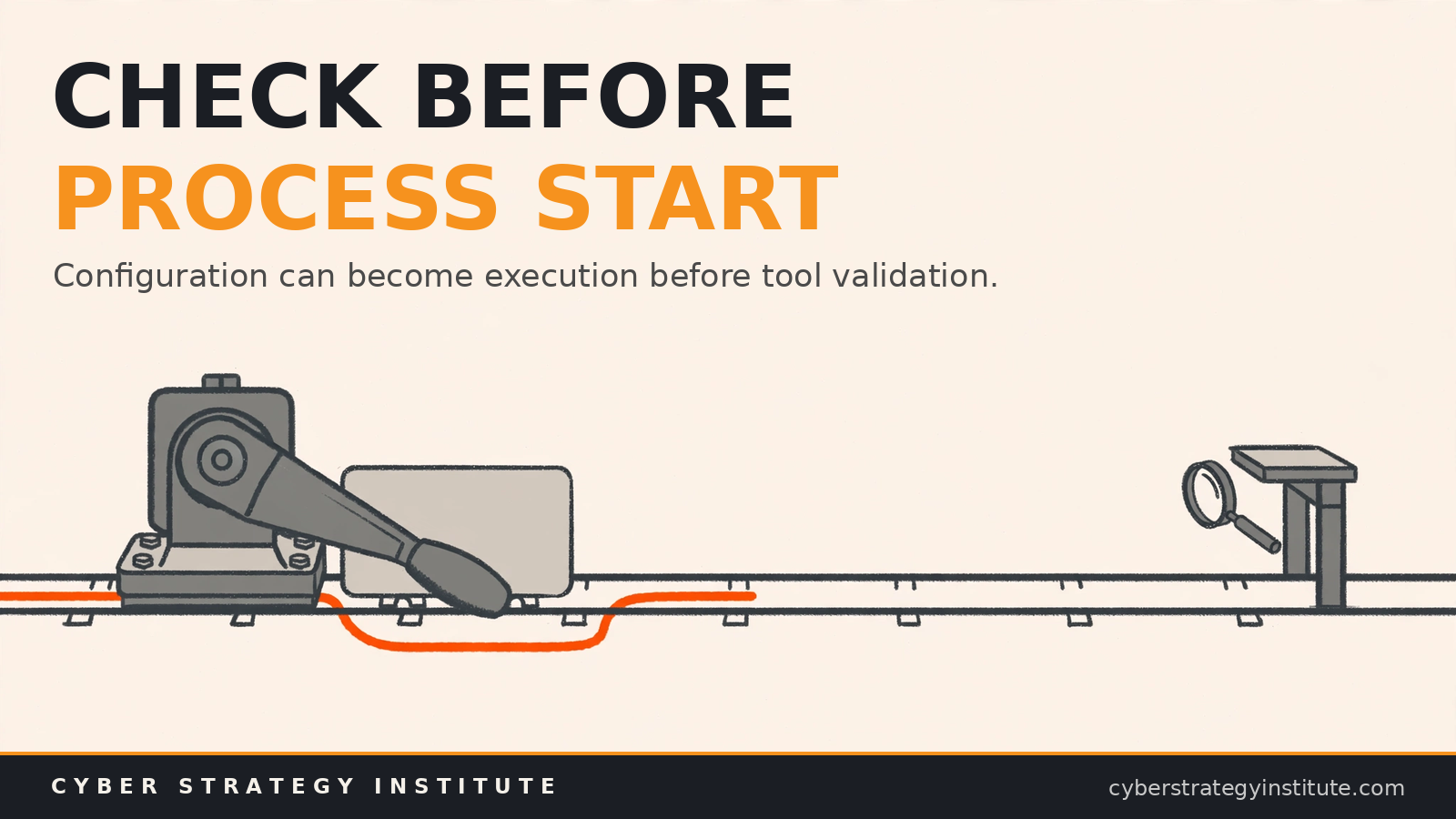
Unverified state pouring through an open gate beside a sealed vault. Illustrative artwork, not a protocol schematic.
The Core Issue: Execution Without Admissibility
Key quote: “You are no longer enforcing security. You are observing behavior after the system has already accepted risk.”
At the center of the MCP architecture sits a single critical assumption: if a server is configured, it is trusted. Configuration equals authorization. Presence equals permission.
That assumption collapses immediately under adversarial conditions. And the collapse point is the STDIO transport model, which executes arbitrary OS commands to spawn MCP servers. This execution occurs:
- Without enforced sanitization
- Without a signed manifest of allowed commands
- Without deterministic validation of execution state
This creates a condition security architects should find chilling: unverified state leads directly to execution. Once that condition exists, every downstream control becomes reactive by definition. You are no longer enforcing security. You are observing behavior after the system has already accepted risk.
Here’s the question that reframes the whole problem: what does your detection stack actually do in the milliseconds between a process spawning and your policy engine noticing? If the honest answer is “nothing yet,” then your security model has a window, and windows get used.
Why Traditional Defenses Fail
Key quote: “There is no obvious ‘break’ in the system. Only a shift in intent.”
The standard defensive playbook fails against MCP for three distinct reasons, and each one deserves its own examination, because each one represents a control your organization is probably counting on right now.
1. Input Sanitization Is Too Late
Sanitization rests on a timing assumption: that malicious input is evaluated before execution. In MCP’s STDIO model, that assumption is inverted. Execution is triggered by configuration state itself.
That means the attack vector is not just “input.” The attack vector is configuration-as-execution. By the time your validation logic runs, the process has already been spawned. You’re not screening entrants at the door; you’re reviewing the guest list after the event.
2. Behavioral Monitoring Misses the Attack
Modern detection strategies rely on anomaly detection, unusual API calls, abnormal sequences, statistical deviation from baseline. These work when attacks look anomalous.
But MCP-based attacks are spec-compliant. They are semantically valid. They complete their tasks. This creates low-signal malicious behavior that slides under every behavioral threshold:
- Tool poisoning alters decision-making without triggering alerts
- Billing amplification produces valid outputs while draining resources
- Multi-agent lateral movement preserves normal per-agent behavior
There is no obvious “break” in the system. Only a shift in intent, and intent is the one thing your monitoring was never designed to see.
3. “Trusted Integrations” Become Execution Channels
Every MCP server you add introduces three new surfaces at once:
- Tool schemas, instruction surfaces
- Execution capabilities, action surfaces
- Context injection, decision surfaces
This turns integrations into composable execution primitives. Attackers don’t need to exploit code in the traditional sense. They only need to influence the schema, influence the context, and influence the execution chaining, three legitimate-looking operations that combine into something the original designers never authorized.
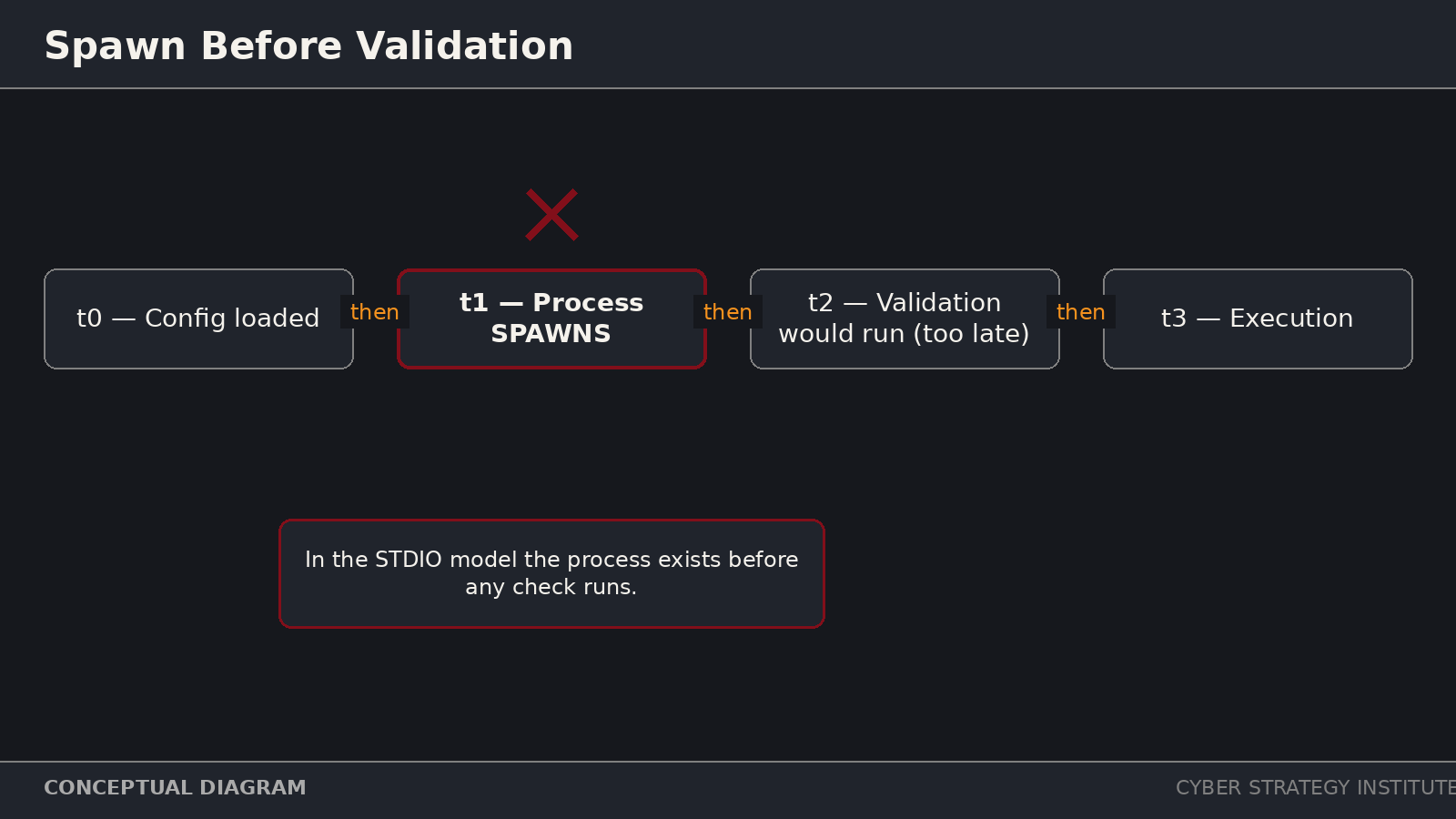
In the STDIO model, the process spawns before validation runs. Conceptual timeline.
The Expansion of the Attack Surface
Key quote: “Each layer is independently exploitable. Together, they form a compound attack system.”
MCP doesn’t just introduce risk, it multiplies it across dimensions. Walk through the layers and notice how each one fails on its own terms:
| Layer | How it fails |
|---|---|
| Tool Layer | Tool Poisoning (TPA), Full Schema Poisoning (FSP), output-based steering (ATPA) |
| Execution Layer | STDIO command injection, argument injection, process-level privilege abuse |
| Network Layer | SSRF into internal services, metadata endpoint access (cloud takeover), DNS rebinding into localhost-bound servers |
| Identity Layer | OAuth confused deputy, token replay across servers, over-permissioned connectors |
| Supply Chain Layer | Registry poisoning, typosquatting, runtime schema mutation (rug pull) |
| Agentic Layer | Multi-agent lateral movement, delegation edge compromise, persistent memory injection |
Each layer is independently exploitable. Together, they form a compound attack system, where a weakness in any single layer amplifies the reach of all the others. Defending one layer while ignoring five is not defense in depth. It’s defense in one place.
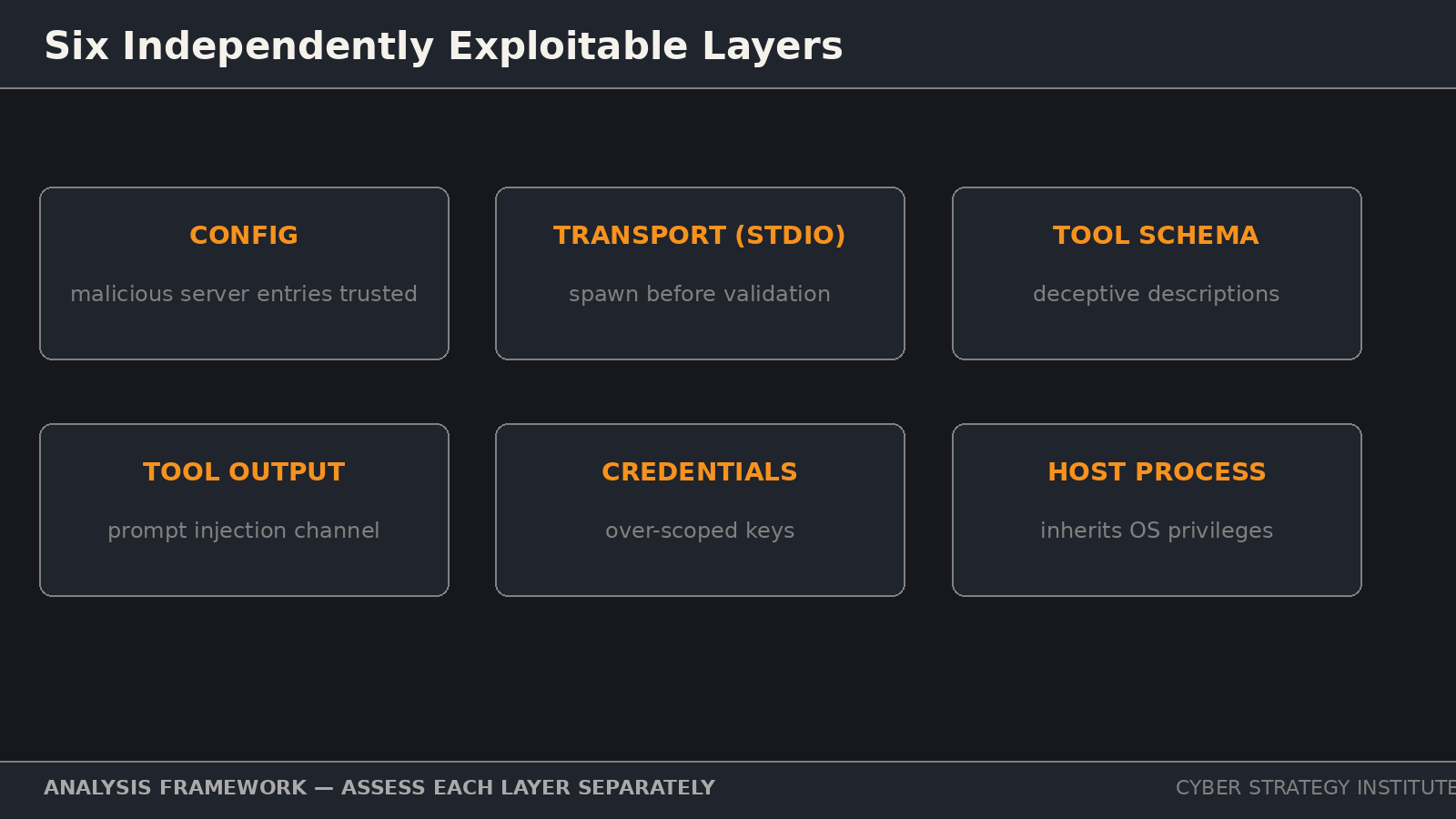
Six independently exploitable layers of the MCP attack surface. Analysis framework. Assess each layer separately.
The New Reality: MCP as a Control Plane Risk
Key quote: “And decision compromise scales faster.”
MCP is not just a protocol anymore. It is rapidly becoming a control plane for agentic systems, the layer through which autonomous agents perceive, decide, and act.
That means compromise no longer looks like the incidents in your tabletop exercises:
- A single exploited endpoint
- A single breached service
It looks like this instead:
- Cross-agent task manipulation
- Invisible context poisoning
- Autonomous execution of attacker-influenced workflows
This is a shift from system compromise to decision compromise. A compromised system can be rebuilt; a compromised decision process keeps producing attacker-favorable outcomes while every dashboard stays green. And decision compromise scales faster, because it rides on the same automation that made your agents productive in the first place.
The Deterministic vs Probabilistic Divide
Key quote: “The only viable model at this layer is: Deterministic admissibility before execution.”
Most current defenses in AI systems are probabilistic, detection-based, heuristic-based, model-based. They estimate, score, and guess. At many layers of the stack, that’s a reasonable trade.
MCP exposes the limits of that approach, because you cannot probabilistically secure a system that:
- Executes unverified state
- Accepts dynamic instruction surfaces
- Lacks enforced isolation boundaries
Probability is the wrong tool when the failure mode is structural. The only viable model at this layer is deterministic admissibility before execution:
- Manifest-only execution policies
- Signed configuration enforcement
- Strict allowlisting of execution paths
- Context-to-tool isolation boundaries
Without these, the system remains fundamentally non-deterministic, and non-deterministic systems cannot be governed, only observed.
The Supply Chain Implication
Key quote: “Where every downstream system inherits the same architectural flaw.”
The most dangerous aspect of MCP is not its exploitability. It’s the inheritance model. Consider how the flaw propagates: SDKs replicate the same behavior, frameworks abstract it without fixing it, tools distribute it at scale, and enterprises deploy it assuming safety.
This creates protocol-level supply chain risk, where every downstream system inherits the same architectural flaw, whether or not anyone downstream made a security decision at all. Your team didn’t choose this execution model. Your vendor’s SDK chose it for you, and your framework abstracted the choice away before it ever reached your review.
How many layers of your stack inherit MCP’s execution assumptions without your team ever making that decision? That’s the question your next architecture review should open with.
What Needs to Change
Key quote: “Anything less is mitigation—not control.”
There are only two viable paths forward, and intellectual honesty requires naming them plainly:
1. Protocol-Level Enforcement
- Manifest-only execution
- Mandatory sanitization requirements
- Explicit opt-in for dynamic execution
- Namespaced tool isolation
2. Consumer-Side Control Plane Enforcement
- Execution wrapping and inspection
- Context validation layers
- Runtime schema analysis
- Inter-agent edge monitoring
Anything less is mitigation, not control. Mitigation has its place, but it should never be confused with the thing it isn’t. A softer landing is not the same as not falling.
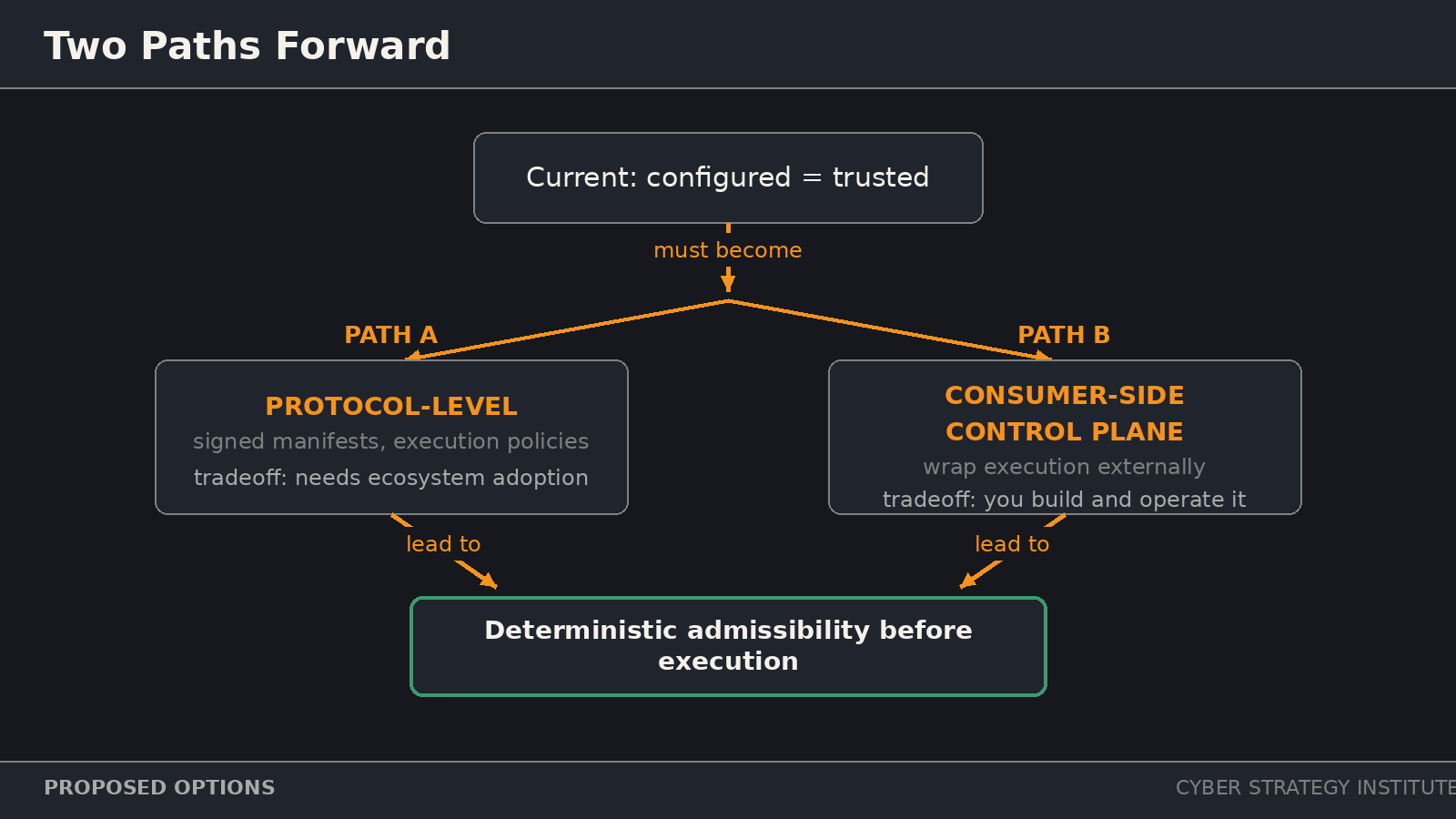
Two paths forward: protocol-level enforcement or a consumer-side control plane. Proposed options with tradeoffs.
Final Thought
Key quote: “You are not operating on a secure foundation. You are operating on a flexible one. Those are not the same thing.”
This is not a debate about whether MCP is useful. It is.
This is a debate about whether flexibility without enforcement is acceptable at the execution layer. History answers that question clearly. It wasn’t acceptable for SQL injection. It wasn’t acceptable for memory safety. And it won’t be acceptable here.
The only question is how much damage accumulates before the default changes. If you are building with MCP today, the takeaway is simple: you are not operating on a secure foundation. You are operating on a flexible one.
Those are not the same thing.
What to Do Next
1. Inspect. Map which MCP servers in your environment spawn processes via STDIO and what OS privileges those processes inherit.
2. Test. In a sandbox, configure a malicious server entry and observe whether anything checks a signed manifest before execution.
3. Decide. Choose one path: push for manifest-only execution policies, or wrap execution in a consumer-side control plane. Define what “done” looks like.
Find Your Exposure First
Free AI governance assessment, instant score, no sales call required.