The CISO’s Guide to Prompt Injection: Defeating Man-in-the-Prompt AI Risk with a GenAI Security Framework
A New AI Vulnerability Demands a New CISO Playbook for ChatGPT and OpenAI Threats
A recent threat intelligence report from security firm LayerX has put a name to a structural vulnerability that presents a critical AI risk to every organization using AI: the ‘Man-in-the-Prompt’ attack. This is not a theoretical exercise; it is an active threat targeting the very heart of your generative AI strategy. This new attack vector allows adversaries to exploit common browser extensions to manipulate the AI prompts fed to tools like ChatGPT, turning your most powerful productivity engine into a source of potential data loss and data leaks.

From the perspective of the Cyber Strategy Institute, a leading cyber security group, the ‘Man-in-the-Prompt’ vulnerability is a symptom of a larger problem: building modern AI technology on insecure foundations. For CISOs, simply blocking AI is not an option. The solution requires a new security program—a strategic blueprint designed for the unique security implications of the AI LLM world. That blueprint is AI SAFE², a framework designed to defeat prompt injection attacks and secure your GenAI future. This guide to prompt security will show you how to operationalize it.
AI Risk Analysis: Understanding the ‘Man-in-the-Prompt’ Injection Attack
To defeat this cyber threat, CISOs must first understand its mechanics. The attack’s simplicity is what makes it so dangerous for the enterprise AI ecosystem.
- The Attack Vector: The threat originates from malicious or compromised browser extensions. Crucially, these extensions do not require high-risk permissions to execute the attack, making them difficult to flag.
- The Core Vulnerability: The vulnerability lies in the browser’s Document Object Model (DOM). The prompt input fields for leading AI tools, including ChatGPT from OpenAI, Google Gemini, and Microsoft Copilot, are accessible to scripts. This allows an extension to silently read, modify, or inject content into any user prompt.
- The Security Implications: This access allows attackers to exfiltrate sensitive information and confidential data, manipulate the large language model (LLM) with hidden instructions to perform unintended actions, or hijack entire sessions. This form of prompt injection effectively turns a trusted AI assistant into a corporate spy.

The Mitigation Mirage: Why Your Current Cybersecurity Fails Against Prompt Injection
A critical task for security teams is understanding why the current security solution stack is ineffective against this AI risk.
| Mitigation Approach | Strength | Weakness |
| Extension Bans/Whitelisting | Reduces risk from rogue add-ons. | Fails because the attack works with basic permissions. A whitelisted, benign extension can be the vector. |
| Isolated Sessions (VDI/Containers) | Segregates AI use from general browsing. | Hampers adoption due to friction; users still copy/paste sensitive data, which can be intercepted. |
| Endpoint & Network Controls (EDR/DLP) | Stops known malware and bulk exfiltration. | MitP traffic is legitimate, encrypted browser activity. Your DLP and Data Loss Prevention tools are blind to this data leakage. |
| LLM-Provider Safeguards | Provides centralized abuse prevention. | Providers cannot patch the DOM-level risk in the user’s browser; it’s outside their AI model’s control. |
Conclusion for CISO’s: Your existing security measures leave the prompt pipeline dangerously exposed. To achieve robust AI security, you must build a new guardrail directly into every prompt exchange.
- Introducing AI SAFE²: A CISO’s Framework for AI Security and Prompt Injection Attack Defense
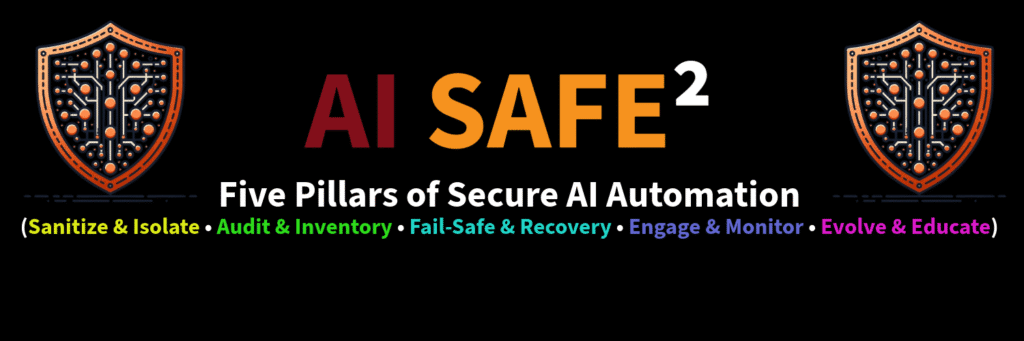
AI SAFE² is CSI’s strategic response, a cybersecurity framework built on five interlocking pillars designed to neutralize prompt attacks at their source.
Sanitize & Isolate: This pillar directly counters the DOM-based attack. It mandates creating a secure “last mile” for the prompt, isolating the input from the browser’s DOM via a dedicated application or secure enclave. This is a foundational guardrail for all AI applications.
Audit & Inventory: You cannot protect what you cannot see. This pillar requires a continuous audit and mapping of your entire AI ecosystem: agents, plugins, browser extensions, and credentials. A thorough audit eliminates shadow AI, a primary source of AI risk.
Fail-Safe & Recovery: Assume breach and prepare to contain it. This involves automated “circuit breakers” to pause suspicious prompt chains and requires human oversight. An encrypted history allows for secure rollback and forensics after a potential security vulnerabilities is exploited.
Engage & Monitor: Move from reactive to proactive AI security. This pillar focuses on real-time behavioral analytics to detect suspicious activity and anomalous patterns in AI prompts and AI responses, stopping malicious instructions before the LLM processes them.
Evolve & Educate: Your security program must be a living entity. This involves regular red-teaming and “prompt injection drills,” updating policies based on emerging threats to LLMs, and building a security-first culture with training data and user education.
From Framework to Capability: The CISO’s Operational Roadmap for GenAI Risk Management
Turning these pillars into a living program requires a coordinated effort. Here is a phased roadmap for effective risk management.
A. Governance & Process Integration
- Steering Committee: Unite the CISO, AI leads, DevOps, and Legal to govern your AI security posture.
- Prompt-Focused Threat Modeling: Adapt frameworks to identify potential MitP risks in all use cases involving text generation and natural language processing.
B. The Phased Technology Rollout
0–3 Months (Foundation):
- Define formal AI SAFE² controls.
- Build or procure a minimal Secure Interaction Client to sanitize and isolate prompts for tools like ChatGPT.
- Run your first proof-of-concept MitP drill to demonstrate the AI risk internally.
3–6 Months (Development):
- Develop a centralized Trust Broker to cryptographically verify every prompt.
- Deploy an Audit & Inventory dashboard to visualize your AI attack surface.
- Prototype Fail-Safe circuit breakers to prevent unintended data exposure.
6–9 Months (Integration & Pilot):
- Integrate telemetry into your SIEM for real-time monitoring (Engage & Monitor).
- Pilot the full AI SAFE² stack to test security and refine alerts.
9–12 Months (Enterprise Scale):
- Achieve full enterprise-wide rollout, ensuring all AI systems are protected.
- Codify policies and establish an annual cadence for red-teaming to address your security needs.
The Business Case for Using AI & Proactive AI Security
CISOs must articulate the clear business case for this investment in security and AI.
Risk of Inaction: The cost of an AI-driven data breach, facilitated by a common prompt attack, can be catastrophic.
Investment: An AI SAFE² deployment is a fractional cost compared to your endpoint-security spend.
Return on Investment (ROI):
- Breach Avoidance: The primary driver, preventing the leakage of user data and IP.
- Sustained Productivity: Secure, trustworthy AI boosts productivity by enabling wider automation.
- Competitive Advantage: Demonstrates a commitment to GenAI security.
- Payback Period: Full ROI is often realized within 12 months.

CISO Q&A: Answering Top Questions on AI Prompt Injection, ChatGPT, and GenAI Risk
Understanding the ‘Man-in-the-Prompt’ AI Risk
1. What is Man-in-the-Prompt (MitP)?
MitP is a stealthy cyber attack that uses a browser extension to manipulate AI prompts. As documented by security researchers, it can exfiltrate sensitive data or hijack the AI model’s behavior by altering the prompt before the AI ever sees it.
2. How is this different from classic prompt injection attacks?
Classic prompt injection involves malicious text that a user knowingly or unknowingly provides within the prompt itself. The ‘Man-in-the-Prompt’ attack is a more advanced client-side threat; it invisibly alters a legitimate user prompt at the browser level, making it far more deceptive.
3. Which AI tools are at risk from this vulnerability?
The vulnerability impacts any LLM-powered tool used within a web browser. Threat intelligence reports specifically confirmed the AI risk for major AI tools including ChatGPT from OpenAI, Google Gemini, and Microsoft Copilot.
Why Existing Cybersecurity for AI is Failing
4. Why can’t my existing security solution stop this AI threat?
Your current cybersecurity stack—including EDR, DLP, and firewalls—lacks visibility into the browser’s DOM, which is where this attack occurs. The malicious activity is hidden within legitimate, encrypted user traffic, rendering your existing security measures blind to this specific prompt injection vector.
5. Can banning browser extensions solve this prompt injection vulnerability?
No. This is an ineffective strategy that harms productivity. The attack can be executed by extensions with only basic permissions, meaning even a “trusted” or whitelisted extension could be a vector for prompt injection, making this approach an unreliable guardrail.
AI SAFE²: The CISO’s Solution for Prompt Injection
6. How does the AI SAFE² framework concretely block these prompt injection attacks?
The framework’s first pillar, Sanitize & Isolate, is the direct countermeasure. It creates a secure, isolated channel for every prompt, shielding it from the browser’s DOM. Any prompt that has been tampered with or does not arrive through this verified channel is rejected by the Trust Broker, neutralizing the AI risk at the source.
7. What is a “Trust Broker” in your recommended AI security stack?
The Trust Broker is a critical verification gateway in your AI security architecture. Its job is to ensure every single prompt is cryptographically signed—proving it originated from a secure client and was not altered by a rogue extension—and is authorized according to your corporate AI policy.
8. Can this AI security framework also protect individual users, not just the enterprise?
Yes. The principles are universal. The core concept of using a Secure Interaction Client (like a dedicated desktop application instead of a browser) removes the browser extension risk entirely, protecting an individual’s personal user data just as effectively as it protects corporate AI systems.
Implementing the AI SAFE² Framework: Your First Steps and ROI
9. As a CISO, how do I start deploying this AI security framework?
Begin with the 0-3 month roadmap. The first steps are not primarily technical but strategic: establish a governance committee, draft your initial AI security controls based on the five pillars, and run a proof-of-concept prompt injection drill to demonstrate the potential security risk to stakeholders.
10. What is the expected ROI for this kind of GenAI security investment?
Most organizations can expect a full return on investment within 12 months. The ROI is driven by preventing a single, costly data breach (which often exceeds the program cost), combined with the sustained productivity gains unlocked by secure, uninterrupted AI automation across the business.
11. Is AI SAFE² just another security checklist for my security teams?
No. It is a living, operational mindset for your entire security program. A checklist is static. The AI SAFE² framework requires continuous effort across policy, process, and technology under its Evolve & Educate pillar, ensuring your defenses stay ahead of the rapidly changing AI risk landscape.