
Sovereign Engineering · Model-agnostic AI
What Is Model-Agnostic AI Governance? Controls That Survive Model Changes
Model-agnostic AI governance keeps policy ownership, identities, authorization requirements, and evidence definitions independent of a particular model wherever practical. It uses tested integrations to apply those requirements to each deployed model and harness.
Your governance architecture should outlive your models. The replacement still needs to prove it can operate within that architecture.
By Cyber Strategy InstituteUpdated Framework source: AI SAFE² v3.1
accounts-review-agentinvoice-review-v4same fields, both configs- Requested action
- invoice.readpayment.release
- Authority source
- accounts-review-agent · invoice-review-v4
- Decision
- ALLOWDENY · on deny list
- Policy version
- invoice-review-v4
- Adapter version
- adapter-a 1.3 (synthetic)adapter-b 0.9 (synthetic)
- Observed outcome
- Invoice returned to the agent (synthetic)Rejected at the tool boundary; no payment call made
- Test limitation
- Illustrative record, not a test result
Model A selected. Identity, policy and evidence stay fixed. The model and its adapter are the replaceable pieces, and both need acceptance evidence.
Model B selected. Only the model and adapter changed. The authority contract is the same, so the same tests must pass again before release.
01 · TL;DR
Should you stay model-agnostic or commit to one model?
At a glance
TL;DR
- A shared API improves portability but does not establish equivalent control behavior.
- Keep decision ownership, tool permissions, approval rules, and evidence requirements explicit.
- Provider calls, agent delegation, and tool execution need their own enforcement coverage.
- A model change requires proportionate testing of behavior and integration assumptions.
- Compare legitimate task completion and control outcomes, not identical wording.
- Primary objective
- Preserve governance requirements across model changes
- Stable elements
- Owners, grant semantics, approval requirements, evidence definitions
- Variable elements
- Model behavior, adapters, context limits, tool-call semantics, performance
- Strongest evidence
- Same workflow and control tests across defined model configurations
- Common blind spot
- The alternate model bypasses a provider-specific hook
Conditional guidance
Stay model-agnostic when you actually plan to swap models: keep decision ownership, tool permissions, approval rules, and evidence requirements explicit, and retest each replacement against the same control outcomes. If you are committed to one provider for the foreseeable future, its native hooks are the simpler path — just know the documented blind spot: the day you switch, the alternate model may bypass a provider-specific hook.
02 · The problem
The problem: endpoint portability leaves unanswered control questions
Replacing a model endpoint may preserve the shape of a request while changing tool selection, argument construction, refusal behavior, or state handling. Those changes can affect the assumptions around an important workflow.
Multi-provider gateways already offer useful central features. LiteLLM documents model routing alongside access, budget, and other controls; Portkey documents gateway and guardrail capabilities.12 The relevant question is which controls the configured deployment enforces, at which boundaries, and with what evidence.
Review six portability layers: API, context, tools, policy, evidence, and deployment. A system can be portable at one layer and dependent at another. Those layers are a diagnostic structure, not a numerical maturity scale.
| Layer | Dependency | Stable contract | Changed assumption | Required test |
|---|---|---|---|---|
| API | Request format, SDK, provider-specific features | Request intent and permitted operations | Parameter support, error handling, streaming | Same workflow through both integrations |
| Context | Context window, memory format, retrieval integration | Data access rules and retention tags | Truncation, summarization, state handling | Reconstruct context; confirm access rules hold |
| Tools | Tool-call schema and argument construction | Tool grants, resource limits, argument rules | Tool selection and argument formatting | Allowed and rejected invocation traces |
| Policy | Where checks run; provider-specific hooks | Policy bundle, owners, approval requirements | Hook coverage on the new path | Bypass attempt through direct dispatch |
| Evidence | Log format and fields from the provider | Evidence fields you define | Field availability, model and adapter identifiers | Reconstruct a decision from records alone |
| Deployment | Hosting, region, rate limits, availability | Release approval and rollback rights | Latency, capacity, failure modes | Rollback exercise with the candidate disabled |
03 · Architecture
How governance stays stable while models change
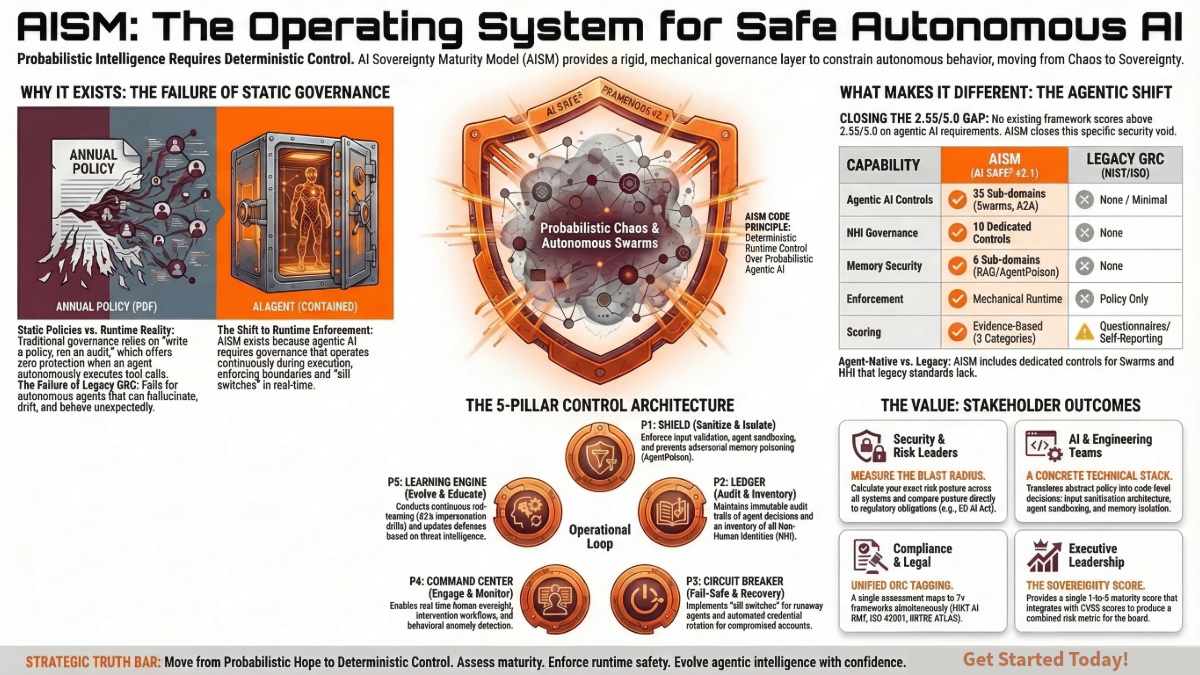
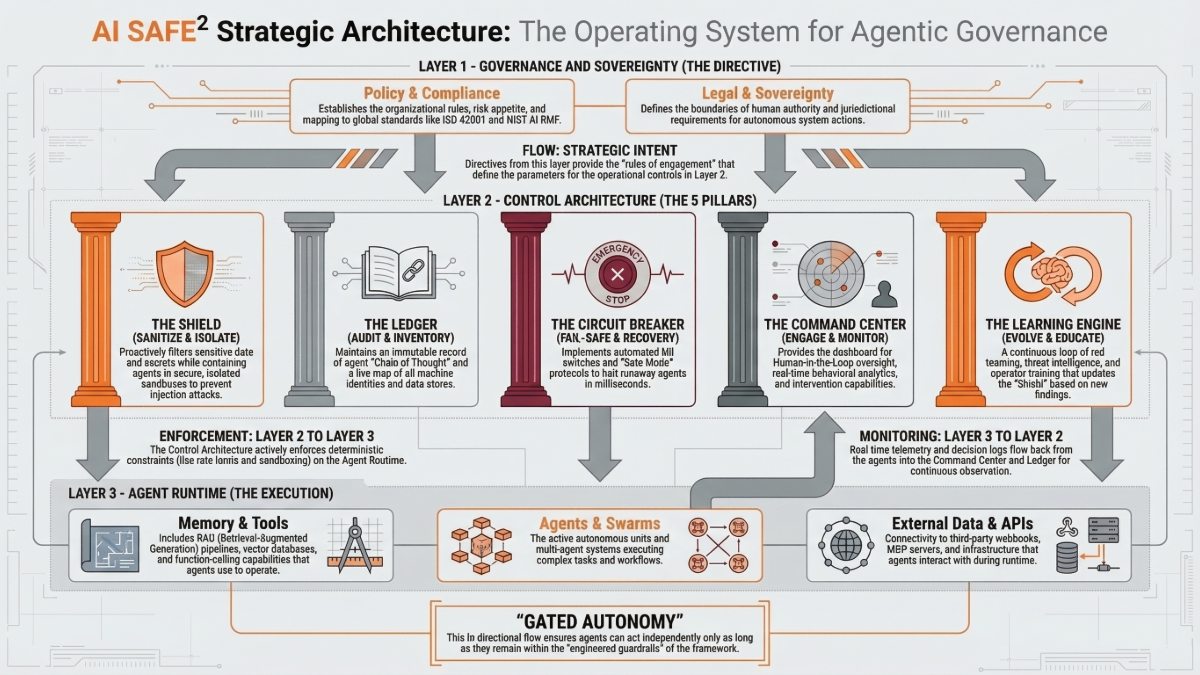
Use three architectural primitives.
- Provider-independent authority definitionsMaintain stable owners, permissions, resource limits, approvals, and revocation requirements.
- Verified integration adaptersTranslate requests and enforce the relevant checks for the actual model, harness, protocol, and tool path.
- Version-bound evidence and regression testsRecord what was assessed and rerun the tests when material components change.
The “Governance OS” is an architectural metaphor for this persistent contract. AI SAFE² defines control requirements; installed components enforce them. A framework document is not an installed operating system.
For example, two models can draft an invoice summary differently while remaining subject to the same restriction: neither may release a payment. The tool's enforcement point rejects that operation regardless of the model's proposed arguments. Test that the runtime cannot reach another payment path.
# Illustrative portable policy intent, not deployable adapter configuration.
policy_id: invoice-review-v4
principal: accounts-review-agent
allow: [invoice.read, summary.write]
deny: [payment.release, vendor-bank-details.change]
require_approval: [invoice.submit-for-payment]
evidence_fields:
  - principal_id
  - model_and_adapter_version
  - policy_version
  - requested_action
  - authorization_decision
  - observed_tool_outcome
MOD-03 · Acceptance process
A model change is an acceptance event
- Candidate model and adapter
- Bind existing authority contract
- Run legitimate task tests and denial and bypass tests
- Compare outcomes and evidence
- Meets acceptance criteria?NoKeep candidate disabled; remediate and retest
- Owner approves scoped release
- Monitor and retain rollback
04 · The governance gap
The governance gap: the constant needs a boundary
For model independence to matter, the agent must not be able to edit, disable, or route around the controls governing its actions. Enforce protected operations at reachable resource boundaries, and test direct paths as well as intended dispatch.
Separate three questions: what crosses the provider boundary, what authority passes to another agent, and what action reaches a tool. A filter on model input or output may contribute to the first question. It does not establish complete coverage of all three planes.4
Human authority also needs portability. The responsible person should see what changed, which tests failed, and which consequences require approval. Keep a model upgrade from silently redefining what the person is accepting.
- Provider boundaryWhat crosses to the model service
- Delegation boundaryWhat authority passes to another agent
- Tool boundaryWhat action reaches a protected resource
05 · Control mapping
AI SAFE² control mapping
These mappings support a scoped review. Technology contribution and evidence assurance must be recorded separately from organizational maturity.345678
| Published control | Model-agnostic application | Evidence to request |
|---|---|---|
| CP.4Agentic Control Plane Governance | Preserve owners, grants, delegation, and revocation | Same authority definitions across configurations |
| CP.5Platform and Protocol Security Profiles | Select and test the relevant integration profile | Model/harness/adapter-specific test scope |
| CP.5.MCP / MCP-6Input Validation | Reject tool arguments outside authorized schema and policy | Allowed and rejected invocation traces |
| CP.5.MCP / MCP-13Revocation and Reauthorization | Make revoked grants ineffective across integrations | Observed revocation tests for each path |
| A2.5Semantic Execution Trace Logging | Keep comparable evidence for action decisions and outcomes | Reconstructable records across both models |
| F3.4Behavioral Drift Baseline & Rollback | Define changed behavior and a recovery response | Measured baseline, thresholds, rollback exercise |
| E5.1Continuous Adversarial Evaluation Cadence | Reevaluate material model, prompt, or tool changes | Dated regression suite and release decision |
06 · Compare
Compare portability approaches
| Approach | Useful contribution | What still needs testing |
|---|---|---|
| Provider-specific controls | Controls integrated with one provider's capabilities | Equivalent outcomes after leaving that provider |
| Multi-provider gateway | Shared access, configured central controls, routing, and observability | Feature translation, downstream permissions, bypass, self-dependency |
| Model wrapper or harness | Context, tool orchestration, lifecycle, and optional enforcement | Privilege separation and protected operations outside the wrapper |
| Independent authorization layer | Explicit decisions at protected action boundaries | Complete mediation, unavailable-verifier behavior, integration correctness |
| AI SAFE² requirements plus an evidenced implementation | Common review vocabulary for authority, controls, and evidence | Actual enforcement and assurance in the declared scope |
This is an architectural comparison, not a product ranking. Several approaches may be part of the same deployment.
07 · Test your claim
Test your claim: two models, one authority contract
- Run the same synthetic business workflow with two pinned model-and-adapter configurations.
- Include an approved action, forbidden resource access, missing approval, revoked credentials, unavailable verifier, and an attempt to bypass normal tool dispatch.
- Set acceptance criteria before running the test.
- Compare legitimate completion, unauthorized actions, approval handling, evidence completeness, latency, and operator effort.
Fail the portability claim if a protected action becomes possible only because the model changed, revocation loses effect, a required approval disappears, or the evidence no longer identifies the authority and outcome. Report quality and performance regressions as well. A policy that blocks everything has not preserved useful operation.
This is a test you can run against your deployment. No CSI result is reported here. Record the versions, permitted scope, observed actions, failures, and legitimate task completion before drawing a conclusion.
| Evidence field | Config A | Config B |
|---|---|---|
| Model and adapter version | ||
| Harness and environment | ||
| Policy version | ||
| Approved action | ||
| Forbidden resource access | ||
| Missing approval | ||
| Revoked credentials | ||
| Unavailable verifier | ||
| Dispatch bypass attempt | ||
| Legitimate completion | ||
| Evidence completeness | ||
| Latency | ||
| Operator effort | ||
| Test limitation |
Record template, blank by design. Fill it with observed results from your own run. No pass rates are reported here.
08 · FAQ
Frequently asked questions about model-agnostic AI
What does model-agnostic AI mean?
It means a system can work across different models with limited model-specific coupling. Specify which layers are portable rather than assuming the whole system is independent.
What makes governance model-agnostic?
Stable authority definitions, enforceable action boundaries, tested integrations, and usable evidence across the selected model configurations.
Is an OpenAI-compatible API enough?
It can simplify integration. It does not establish equivalent tool behavior, permission enforcement, state semantics, or audit evidence.
Can governance stay constant while models change?
The requirements can remain stable. Adapters and model behavior still need acceptance tests before the replacement is authorized.
Is AI SAFE² a software operating system?
Does NEXUS provide production enforcement for every model and protocol?
Do not assume universal coverage. Inspect the relevant release and integration evidence. The published v3.1 MCP adapter is explicitly contract/scaffolding, not production-ready.9
09 · Next steps
What to do next
- Identify which governance requirements must survive a model change.
- Locate their actual enforcement points and bypass paths.
- Pin two model-and-adapter configurations.
- Run the same legitimate and adversarial workflow tests.
- Approve only the scope supported by results, with rollback available.
The challengeWhen your model changes, which controls remain enforceable, and what evidence proves it?
Make the next model change a controlled decision
Start with your governance baseline. Use it to decide which permissions, integrations, and evidence deserve deeper testing before the next release.
10 · Sources and method
Sources and method
Sources
- LiteLLM, AI Gateway documentation. Feature scope depends on deployment and tier; no comparative efficacy claim.
- Portkey, AI Gateway documentation. Documented capabilities, not a tested vendor ranking.
- Cyber Strategy Institute, AI SAFE² framework README, pinned source. Publisher documentation, not independent efficacy evidence.
- Cyber Strategy Institute, Cross-Pillar Governance Layer, pinned source. Requirements and reference patterns, not evidence of installed coverage.
- Cyber Strategy Institute, CP.5.MCP Server Security Profile, pinned source. Profile applicability depends on deployment; the adapter scaffolding status remains explicit.
- Cyber Strategy Institute, Pillar 2, Audit & Inventory, pinned source. A listed trace requirement does not prove access to private model reasoning.
- Cyber Strategy Institute, Pillar 3, Fail-Safe & Recovery, pinned source. Behavior and containment need deployment-specific tests.
- Cyber Strategy Institute, Pillar 5, Evolve & Educate, pinned source. Evaluation requirement, not a reported pass.
- Cyber Strategy Institute, NEXUS README, pinned source. The MCP v3.1 adapter still requires production implementation.
Method
Sources reviewed . AI SAFE² is cited from its October 15, 2026 release. Framework documents identify v3.1; the NEXUS README identifies v0.6.0. These version numbers describe different artifacts. Control mappings are editorial applicability mappings, not conformance determinations. Every CSI exercise on this page is a proposed test; no CSI result is reported.
Update log
- : page published.
About
Published by Cyber Strategy Institute, author of the AI SAFE² framework.